

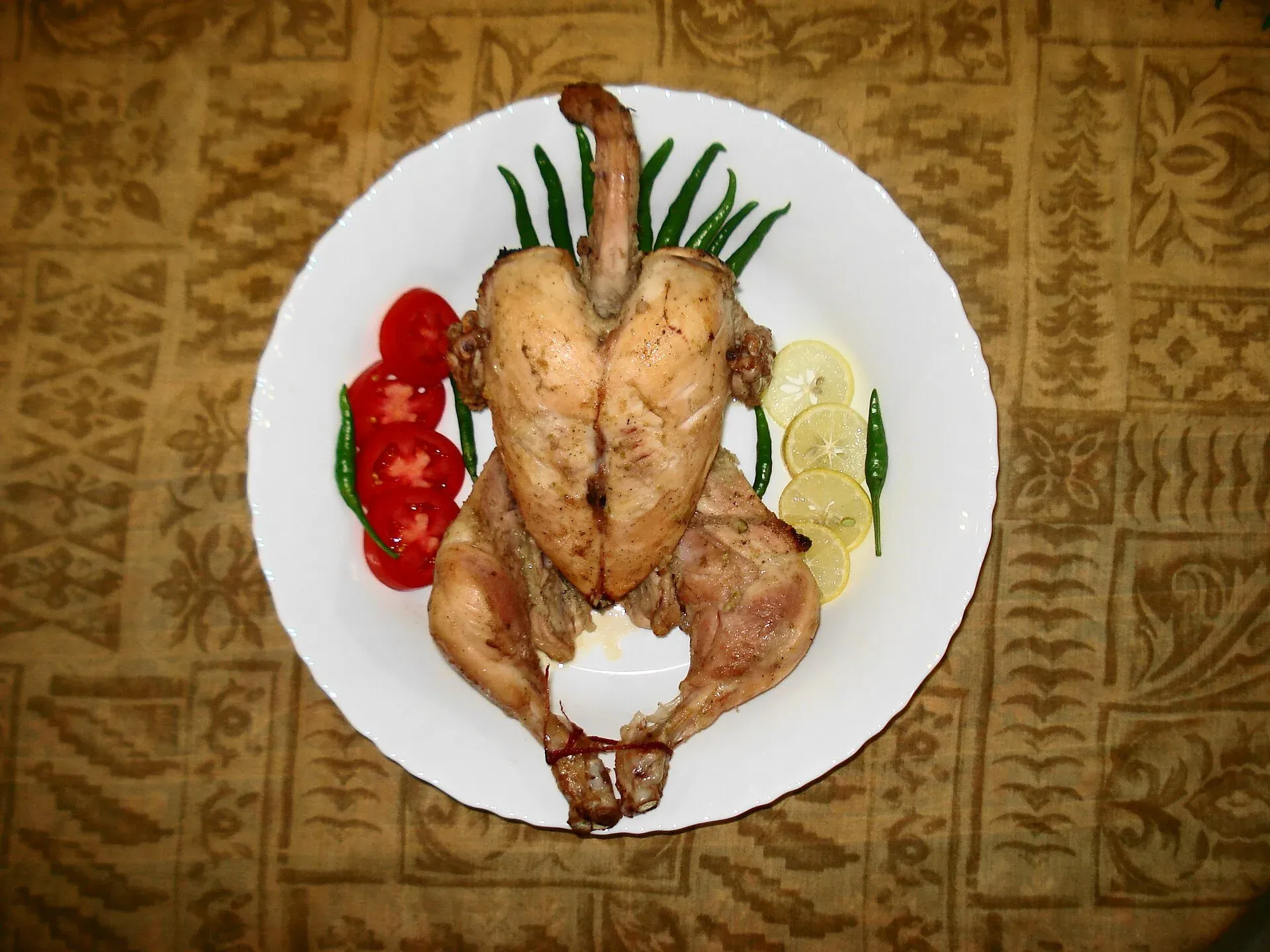
Photo: Miansari66, with thanks · Public domain (CC0) · via Wikimedia Commons · temporary stand-in photo

Sajji
Whole lamb or chicken roasted slowly beside a fire, seasoned with little more than salt, and served with rice or bread. A dish of the Baloch, strongly linked with Quetta and now sold across Pakistan.
What it is
Sajji is a roast of lamb or chicken, cooked whole and seasoned very simply. The meat is not marinated in heavy spices. Instead it is cooked slowly beside a fire until it is tender and the skin turns crisp. It is one of the best-known dishes of Balochistan.
How it is made
The traditional version uses a whole lamb or young goat, skewered on a stick and stood upright beside a wood or coal fire so it roasts by radiant heat. Salt is the main seasoning, and some cooks add a little extra flavouring. Dawn (2015) describes the original Balochistan recipe as the animal hollowed out and stuffed with potatoes and rice, and Wikipedia also says rice is cooked inside it. Other accounts, such as Arab News (2021), describe meat seasoned with salt alone and slow-roasted over coal for about four hours with no stuffing, so practice varies. In towns, whole chickens are often cooked the same way.
Where it comes from
Sajji is associated with the Baloch. Wikipedia traces it to the Lehri tribe of the Baloch, in southern Punjab, citing four sources, while Arab News (2021) links the method to the Dera Bugti and Kohlu areas and says the Quetta sajji tradition emerged in the 1960s. There is no known firm historical source, so we treat the origin as tradition. It has spread from Balochistan to restaurants across the country.
Where you will eat it
- Quetta, where sajji restaurants are a local feature.
- Karachi, Lahore and Islamabad, where Balochi-style restaurants serve it, often using chicken.
- Larger towns of Balochistan, at roadside restaurants and at weddings and Eid feasts.
Please avoid choosing from lists of "best" sajji places.
When people eat it
Sajji is a lunch or dinner dish. It is popular for weddings and for Eid, particularly Eid al-Adha, and for gatherings with guests. It is more common in the cooler months.
Dietary notes
- Halal: normally made with halal meat.
- Not vegetarian.
- Spice level: mild. The meat is lightly salted, so chilli sauce is optional.
- Gluten: none in the meat; it may be served with bread (kaak or naan).
- Fat: lamb sajji is fatty.
How to order and eat it
Order by the whole or half piece, or by weight. Rice and bread are the usual accompaniments, with lemon and sometimes yogurt or chutney. In Balochistan, the meat is often torn and eaten with the right hand. Share it among the group and wait for the host to start.
Prices vary by place and season and are not given here.
Sources and last checked
Last checked Confidence medium4 sources1 still to check
- Last checked
- Method
- Desk research from published sources
- Confidence
- medium
- Checked by
- trek.pk research team
Researched from published sources; not yet checked on the ground by our team. Spot something out of date? Report a mistake.
Sources
- Sajji (English Wikipedia) · Wikipedia · checked
- Reinventing the Baloch Sajji · Dawn · checked
- In Balochistan, taste of Eid Al-Adha comes with authentic, slow-cooked sajji · Arab News · checked
- In Balochistan, taste of Eid Al-Adha comes with authentic, slow-cooked sajji · Arab News · checked
Still to be checked on the ground (1)
- Which regional style (stuffed or unstuffed) a given restaurant serves: ask at the restaurant