

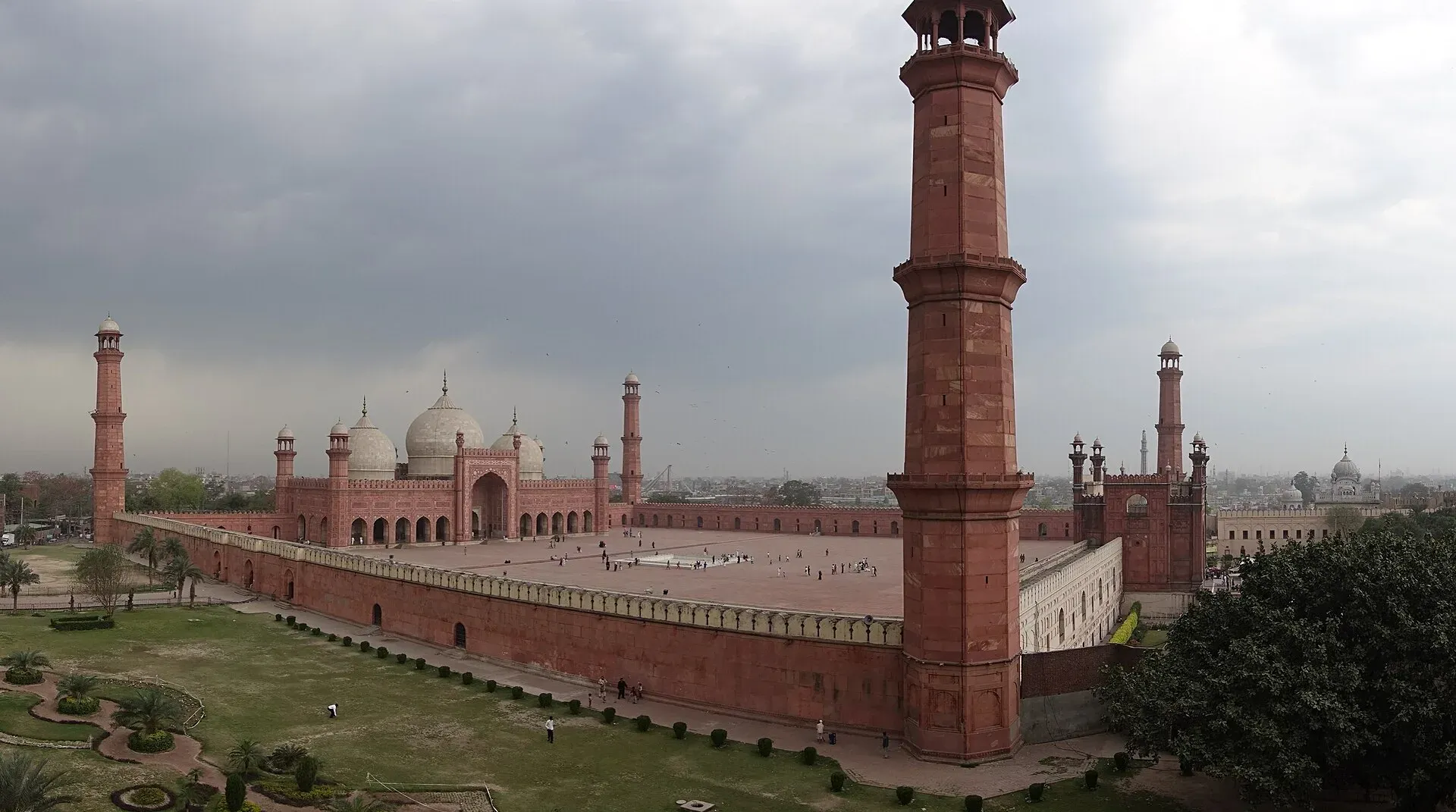
Photo: Marsmux, with thanks · CC BY-SA 4.0 · via Wikimedia Commons · temporary stand-in photo
Badshahi Mosque
Lahore's great Mughal mosque, built for Emperor Aurangzeb in 1671-73 from red sandstone and marble. It faces Lahore Fort and has been on UNESCO's tentative list since 1993.
Overview
The Badshahi Mosque, or Royal Mosque, is the largest and best-known mosque of the Mughal period in Lahore. It stands at the edge of the Walled City, directly opposite the Alamgiri Gate of Lahore Fort, with the Hazuri Bagh lawn between them. Its red sandstone walls, white marble domes and four tall minarets make it one of the easiest landmarks to pick out in the city.
History
The mosque was commissioned by the Mughal emperor Aurangzeb in 1671 and opened in about 1673-74. The work was overseen by Muzaffar Hussein, known as Fidai Khan Koka, the emperor's foster brother and the governor of Lahore. Under Sikh rule in the 19th century the building fell into poor repair. Ranjit Singh's army used the courtyard as a stable and the 80 cells (hujras) as soldiers' quarters and stores, and Henri de La Rouche temporarily kept gunpowder in a tunnel linking the mosque to the fort. The Hazuri Bagh Baradari was built in 1818, and Ranjit Singh's samadhi was begun beside the mosque in 1839. After 1857 the British removed the 80 small cells around the courtyard and replaced them with open arcades. A major repair programme began in 1939 and was completed in 1960 at a cost of 4.8 million rupees. It began under Sikandar Hayat Khan, and his tomb, like that of the poet Muhammad Iqbal, lies near the entrance. Marble inlay in the prayer hall was repaired in 2000, and the courtyard's red sandstone paving was replaced in 2008.
The mosque has been on Pakistan's UNESCO tentative list since 1993. That means it has been proposed for World Heritage status, but it has not been inscribed. (Lahore Fort and the Shalimar Gardens, a short distance away, are a separate World Heritage Site, inscribed in 1981.)
What to see and do
Aurangzeb used a plan similar to the one Shah Jahan chose for the Jama Masjid in Delhi, but on a far larger scale. Both use red sandstone with white marble inlay. The overall complex measures about 170 m by 170 m. The gate is a two-storey red sandstone entrance with carved panelling and a muqarna (honeycomb vault) feature, and it faces east towards the Alamgiri Gate of Lahore Fort. The mosque stands on the west side of Hazuri Bagh, beside the Roshnai Gate, one of Lahore's original thirteen gates. It was the largest mosque built in the Mughal era and, according to Wikipedia, stayed the largest in the world for more than 300 years.
- The gateway and courtyard. A flight of 22 steps leads up to the main gate. The courtyard covers about 25,600 square metres and can hold around 100,000 people at Eid prayers. The prayer hall holds roughly 10,000.
- The prayer hall. Three marble domes, the largest in the centre, sit above a hall faced with red sandstone and inlaid with carved marble and floral designs.
- The minarets. There are eight in all: four large octagonal ones, each given as 60 m tall by Wikipedia (citing UNESCO), at the outer corners, and four smaller ones.
- The museum. A small museum inside the complex displays relics associated with the Prophet Muhammad and his companions, and a gallery of Quran manuscripts stitched in gold and silver thread. In April 2026 the relics were moved from the gallery built in 1885 to a new climate-controlled gallery at the mosque, so what is on show and where may differ from older guides.
- Nearby. Lahore Fort, the Hazuri Bagh, the tomb of the poet Muhammad Iqbal beside the gateway, and Roshnai Gate are all within a few minutes' walk.
When to visit
Go early in the morning or an hour before sunset for softer light and cooler stone; the courtyard paving gets very hot in summer. The cooler months, October to March, are the most comfortable. Friday midday and the days around Eid are busy because this is a working mosque.
Where to stay and eat
Hotels of every level are spread across Lahore; the Walled City and the Fort Road area are the most convenient for early starts. Food Street, in the old city near the mosque, is the well-known place to try Lahori food in the evening.
Good to know
- This is an active place of worship. Dress modestly: long sleeves and trousers or a long skirt, and a scarf for women. Shoes are removed at the steps and left at the shoe counter.
- Visitors are not usually welcome in the prayer hall during prayer times.
- Photography is generally fine in the courtyard. Ask before photographing people at prayer, and avoid flash inside.
- An entry fee, if any, and the visiting hours were not confirmed by an official source when this page was written. Current fees will be added soon; ask at the gate or check with the Auqaf and Religious Affairs Department, Punjab.
Highlights
- Built for Aurangzeb, opened about 1673-74
- Courtyard of about 25,600 square metres
- Four large and four small minarets
- Faces Lahore Fort across the Hazuri Bagh
- On UNESCO's tentative list since 1993
Getting there
The mosque is at the northern edge of Lahore's Walled City, beside Roshnai Gate and opposite Lahore Fort. Taxis and ride-hailing cars can drop you near the Fort Road side. From Lahore Junction railway station it is a short drive; allow extra time for traffic in the old city. On foot, the walk from Lahore Fort takes only a few minutes across the Hazuri Bagh.
Tips
- Dress modestly and be ready to leave your shoes at the counter.
- Go at sunrise or late afternoon; the courtyard stone is very hot at midday in summer.
- Combine it with Lahore Fort and the Walled City on foot.
- Ask before photographing worshippers.
- Check the museum's current opening times at the gate.
Photos we still need: Food Street or a Lahori dish near the mosque. Send us yours
Sources and last checked
Last checked Confidence medium6 sources3 still to check
- Last checked
- Method
- Desk research from published sources
- Confidence
- medium
- Checked by
- trek.pk research team
Researched from published sources; not yet checked on the ground by our team. Spot something out of date? Report a mistake.
Sources
- Badshahi Mosque · Wikipedia · checked
- Badshahi Mosque, Lahore (Tentative List 1277) · UNESCO World Heritage Centre · checked
- List of World Heritage Sites in Pakistan · Wikipedia · checked
- Pakistan Tourism Guide 2021 · Tourism Development Corporation of Pakistan (TDAP) · checked
- Holy relics moved to climate-controlled gallery at Badshahi Mosque · Dawn · checked
- Badshahi Mosque (architecture, Sikh period, restoration) · Wikipedia · checked
Still to be checked on the ground (3)
- Opening hours and any entry fee (no official page found)
- Visiting arrangements for the new relics gallery (opening times not published)
- Wikipedia calls the mosque the third largest in Pakistan; not the largest (the page text above does not claim otherwise)

