

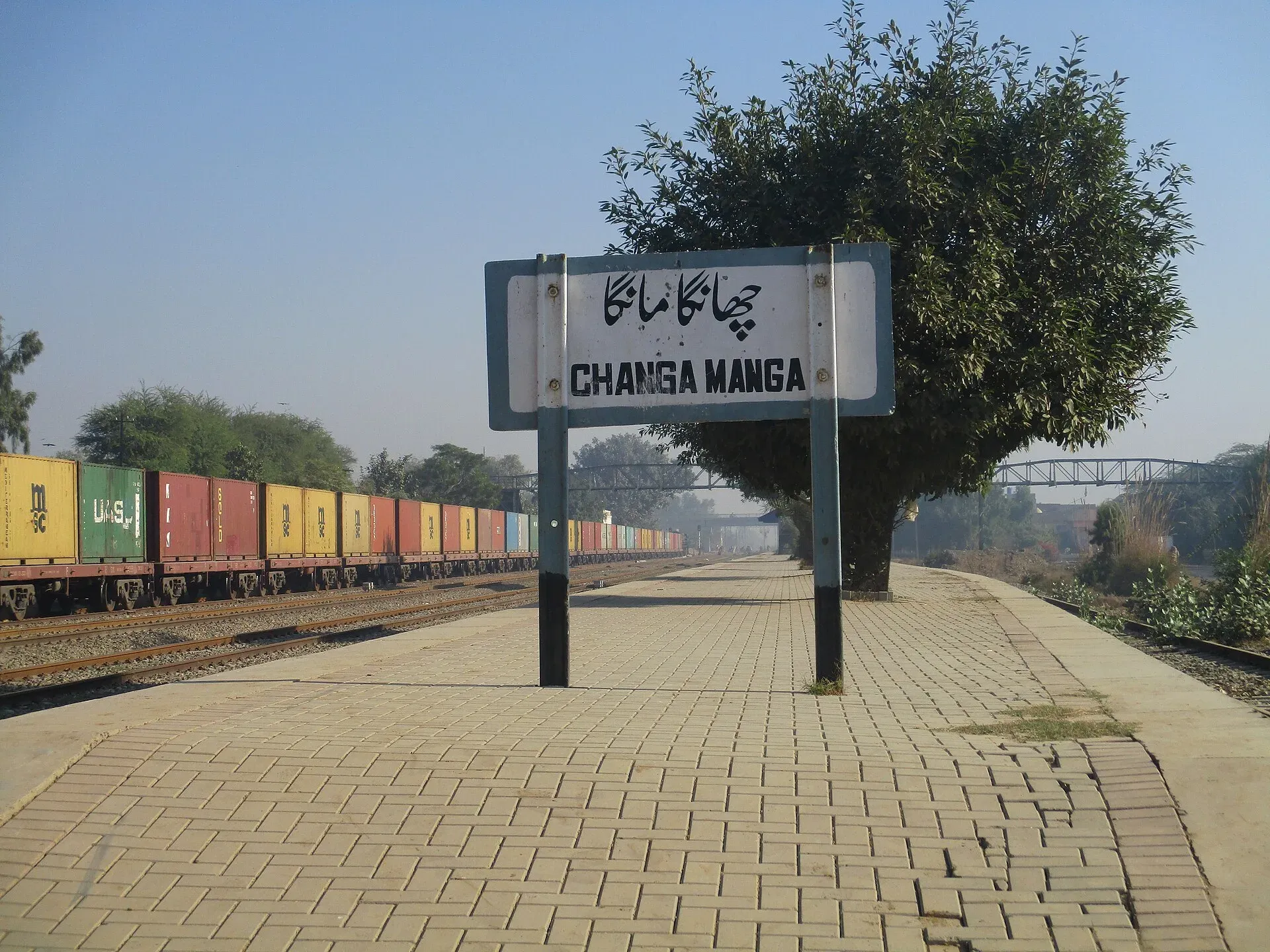
Photo: Changa Manga railway station, with thanks · CC BY-SA 4.0 · via Wikimedia Commons · temporary stand-in photo

Changa Manga
One of the world's oldest hand-planted forests, set up in 1866 near Lahore with shisham and kikar. It has a small railway, wildlife and a vulture conservation centre.
Overview
Changa Manga is a man-made forest in Chunian Tehsil, Kasur District, Punjab, planted by British foresters from 1866 on semi-desert scrub. Wikipedia gives its area as 5,065 ha (about 50 km2), though the text also says 48.6 km2. It is described as one of the oldest hand-planted forests in the world, and was once among the largest; deforestation has since reduced it to less than half its original size. Wikipedia puts it about 74 km from Lahore; OSRM gives about 76 km by road (modelled 1.1 h).
History
The planting was done to supply timber and fuel for the North-Western Railway. Dr John Lindsay Stewart, the first Conservator of Forests in Punjab, recommended the land in 1864, and the German forester Berthold Ribbentrop oversaw much of the early plantation. The first planting, over about 3,400 ha, did poorly until a trench-and-ridge irrigation system devised by Charles Frederick Amery was adopted in 1868. By 1870 the irrigated plantation covered about 3,700 ha, and the first successful harvest came in 1888.
The name comes from two brothers, Changa and Manga, described as bandits who were caught by the police. A silk experiment was tried here in 1912 with about three million silkworm eggs.
What to see and do
The commonest trees are shisham (Dalbergia sissoo) and kikar (Acacia nilotica), with white mulberry, simal (Bombax ceiba), eucalyptus and poplar. The forest has a recreation area, picnic spots and a narrow-gauge forest railway of 610 mm gauge, built to haul timber. It still runs, mainly for timber, with occasional tourist rides. Wikipedia also describes a 5 km miniature-train ride in the recreation park, a water turbine, a waterfall, a children's play area and Lunar Lake, where boating is possible.
The forest is flat and lined with straight rows of trees, so walking and cycling are easy. Birdwatchers can look for woodland species in the plantation and waterbirds at the small lakes.
Wildlife and the vulture centre
Wikipedia lists 14 mammal species including hog deer, jackal, nilgai and wild boar, about 50 bird species including Indian peafowl, plus reptiles, amphibians and insects. The hog deer is listed by the IUCN as Endangered. A 16 ha wildlife reserve was built in 2008.
The Gyps Vulture Conservation Centre works on the white-rumped vulture (Gyps bengalensis), which is Critically Endangered; vulture numbers in Pakistan, India and Nepal fell by more than 90 per cent. The centre runs under WWF-Pakistan and the Punjab Wildlife and Parks Department. The programme began in 2004 and the centre was fully operational in 2007.
When to visit
November to March is the most comfortable. Summers are hot.
Where to stay and eat
Most visitors come as a day trip from Lahore. There are small food stalls near the recreation area.
Good to know
- The forest depends on irrigation. A sanctioned discharge of 113 cusecs was secured after water shortage caused plant failures.
- Threats: illegal logging, overgrazing, water scarcity and encroachment. Wikipedia reports that over 60% had been deforested by 2011, which led to an Ombudsman investigation and a 2012 order to remove senior forest officials. Recovery work since includes army patrols, boundary fencing and about 607 ha of new planting.
- Because it is planted, the forest is managed for timber as well as recreation, so you may see felling or planting work in some blocks.
- Entry and train fees are unconfirmed; current fees will be added soon.
- For foreign visitors: the UK FCDO page does not list Changa Manga; read the live page before you travel.
Highlights
- Planted forest dating from 1866
- Narrow-gauge forest railway
- Hog deer, nilgai and many birds
- Vulture conservation centre
Getting there
From Lahore, Changa Manga is about 76 km by road (OSRM, modelled 1.1 h). Allow longer on weekends.
Tips
- Visit on a weekday
- Bring water and snacks
- Respect wildlife and keep to paths
Wildlife
Photos we still need: the forest railway and plantation rows (section: What to see and do); the vulture conservation centre aviary (section: Wildlife and the vulture centre). Send us yours
Sources and last checked
Last checked Confidence medium5 sources4 still to check
- Last checked
- Method
- Desk research from published sources
- Confidence
- medium
- Checked by
- trek.pk research team
Researched from published sources; not yet checked on the ground by our team. Spot something out of date? Report a mistake.
Sources
- Changa Manga (Wikipedia) · Wikipedia · checked
- Hog deer (Wikipedia) · Wikipedia · checked
- White-rumped vulture (Wikipedia) · Wikipedia · checked
- Pakistan travel advice (updated 27 October 2026) · UK Foreign, Commonwealth & Development Office · checked
- OSRM driving routes (modelled distance and time) · OSRM project · checked
Still to be checked on the ground (4)
- Area: Wikipedia's summary box gives 5,065 ha (about 50.65 km2) but its text gives 48.6 km2; no official figure found
- Current deforestation figure (Wikipedia still only gives 'over 60% by 2011', from The Nation)
- Railway running status (Wikipedia, citing a 2007 source, says the line remains operational; no recent report found)
- Distance from Lahore: Wikipedia gives 74 km in one place and 45 km in another
Nearby and related

Lahore
Punjab's capital and Pakistan's cultural city: Mughal forts, mosques and gardens, a lively Walled City, and some of the best food in the country.

Kasur
Old fortified town south of Lahore, 54 km away, home to the shrine of the Sufi poet Bulleh Shah. Close to the India border; check advice.
Chichawatni Plantation
A canal-side forest plantation of roughly 4,700 ha near Chichawatni in Sahiwal district, described as Pakistan's second-largest plantation after Changa Manga. Shisham and eucalyptus dominate, and honey is a local product.