

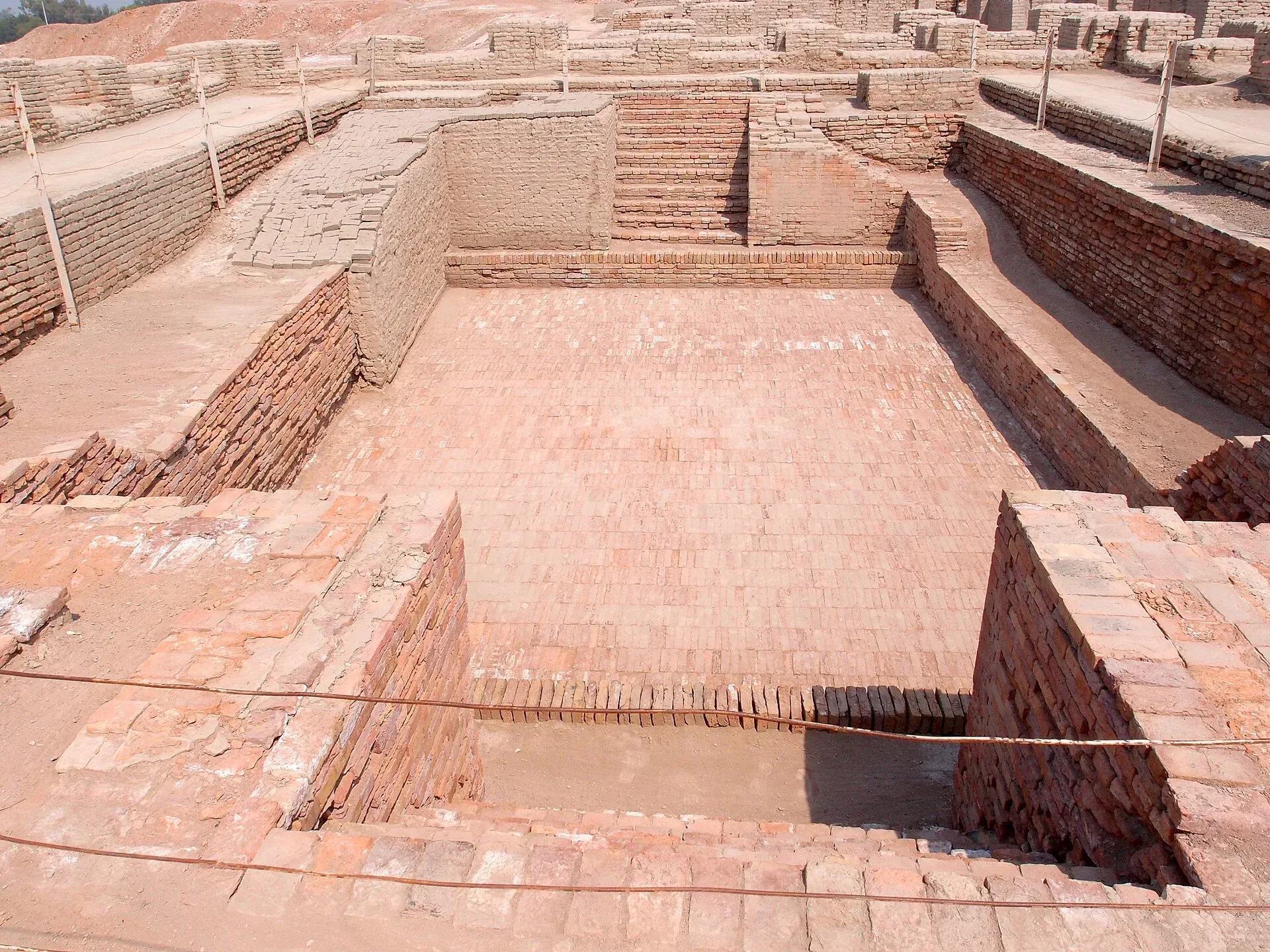
Photo: Saqib Qayyum, with thanks · CC BY-SA 3.0 · via Wikimedia Commons · temporary stand-in photo

Moenjodaro Site Museum
The site museum beside the ruins of Moenjodaro, opened in 1967, with Indus Valley tools, pottery and comparative material from Rohri, Kot Diji and Amri. Its star find, the Priest-King, is in Karachi.
Overview
The Moenjodaro Site Museum stands beside the ruins of the Indus Valley city of Moenjodaro (often spelled Mohenjo-daro) in Larkana district, Sindh. The site is managed by the Culture, Tourism, Antiquities and Archives Department of the Government of Sindh. The ruins are about 27 to 28 km from Larkana town, according to The Friday Times and Wikipedia.
Plan your visit
- Nearest town
- Dokri
- Opening hours
- Check before you go: no official hours confirmed. Some travel guides mention a weekly closing day, which is not confirmed.
- Getting there
The museum is on the Moenjodaro site, near Dokri in Larkana district. Larkana is the nearest large town; check current road and rail options locally. More
Best months
Nov – Feb
- Moenjodaro Site Museum
- Related place nearby: Moenjodaro
History of the museum
The first museum was built in 1924-25 to hold the finds; some sources give 1925 and others 1923 as its founding year. Devi Dayal Mathur was its first custodian. Indus floods damaged its sun-dried brick walls in 1929, and in 1936 it had two main galleries, two storage halls and four small rooms for laboratories and storage. Admission was already charged in the 1930s.
The building collapsed at 8:15 am on 29 August 1953 because of waterlogging and seepage, smashing seals, copper and bronze vessels and other objects. The collection moved to a temporary shed while a new design was prepared. The French architect Michel Ecochard drew up plans in 1957 to 1959, the foundation stone was laid on 16 March 1960, and President Ayub Khan inaugurated the new museum on 20 January 1967.
The building
Ecochard's building has two storeys and covers about 1,000 square metres. Old-style bricks form the vertical parts and concrete slabs the horizontal ones. The ground floor is an open hall for large jars and reconstructions, laid out to let the prevailing winds through. The first floor has galleries with showcases for small objects such as seals, toys, figurines and animal sculptures. Two interior courts act as light shafts, and the plain brick walls face the prevailing winds. The ground floor was given a marble finish in 1996.
What to see and do
At the 1967 opening, 1,425 of about 15,000 registered antiquities were on display. The rest stayed in reserve storage. The displays included comparison material from the nearby Indus-period sites of Rohri, Kot Diji and Amri, dioramas of stone-tool industries from the Soan Valley and Rohri, and three murals painted in 1963, including a reconstruction of the city. Gold, silver and copper jewellery and stone beads were kept in a British-era metal cupboard with hidden lockers.
The most famous finds are elsewhere. After Partition, Pakistan received the Priest-King statue, a soapstone figure now in the National Museum of Pakistan in Karachi, while India kept the bronze Dancing Girl and the Pashupati seal. A theft on 10 May 2002 took 40 original Indus seals and copper tablets from this museum. A pot holding Kushan-period copper coins (2nd to 5th century AD) was found in the Stupa Area on 15 November 2023.
The Friday Times (September 2025) says the coins should be shown in a Buddhist gallery and calls for a new gallery of excavation photographs (1922 to 2025), a research library and more care and security; it gives no list of what is on display now. The site beside the museum has handicraft and souvenir shops, an information centre and a guide service, according to the same article.
The site beside the museum
Moenjodaro dates from about 2500 BCE to 1700 BCE and was one of the largest Indus Valley settlements, with a mud-brick citadel mound about 12 m high and a lower city laid out on a grid. The Great Bath is a brick pool about 12 by 7 m and 2.4 m deep, lined with bitumen. There were more than 700 wells and a covered drainage system along the main streets. UNESCO listed the site in 1980, the first World Heritage Site in South Asia. See Moenjodaro for the ruins.
When to visit
November to February is the best time. Summers are very hot, and the monsoon can cause heavy rain; record rain of up to 779.5 mm fell here in August 2022, and conservation work with UNESCO and the Sindh antiquities directorate began in early 2023.
Where to stay and eat
Facilities near the site are limited. Larkana has hotels and restaurants. Carry water and snacks.
Good to know
- Hours and tickets: not confirmed from an official source. Tickets for the site and museum are reported but amounts conflict between guides. A fee may apply; current fees will be added soon. Ask the Sindh antiquities directorate (+92 21 99212126).
- Photography: rules not confirmed.
- Ask the district administration or local police about current conditions before you go. Travel advice: For foreign visitors: the UK FCDO (updated 27 October 2026, checked 16 November 2026) advises against all but essential travel to Sindh north of and including Nawabshah, and Larkana district falls in that area. Check the FCDO page before deciding to travel and consider whether you need local advice.
Highlights
- Two-storey museum inaugurated on 20 January 1967 beside the Indus Valley ruins
- Material from Moenjodaro, Rohri, Kot Diji and Amri
- A 1963 mural showing the city's restoration and trade, according to the Friday Times
- The Priest-King statue is in Karachi, not here
Getting there
The museum is on the Moenjodaro site, near Dokri in Larkana district. Larkana is the nearest large town; check current road and rail options locally. Because of the FCDO advice below, plan carefully and check conditions first.
Tips
- Visit the ruins and the museum on the same ticketed day; allow half a day.
- Come between November and February; summer is very hot.
- Do not expect the famous statues: the Priest-King is in the National Museum, Karachi.
- Check the official situation before travelling; the area north of Nawabshah is under FCDO advice.
Photos we still need: the museum building and its galleries. Send us yours
Sources and last checked
Last checked Confidence medium5 sources6 still to check
- Last checked
- Method
- Desk research from published sources
- Confidence
- medium
- Checked by
- trek.pk research team
Researched from published sources; not yet checked on the ground by our team. Spot something out of date? Report a mistake.
Sources
- How the Mohenjodaro Archaeological Museum rose, fell and rose again over a century (25 September 2025) · The Friday Times · checked
- Mohenjo-daro · Wikipedia · checked
- Pakistan Tourism Guide 2021 (museums lists) · Trade Development Authority of Pakistan (TDAP) · checked
- Pakistan travel advice (updated 27 October 2026) · UK Foreign, Commonwealth & Development Office · checked
- Foreign travel advice: Pakistan - warnings and insurance · UK FCDO · checked
Still to be checked on the ground (6)
- Opening days and hours
- Ticket charge for the site and the museum
- Current galleries and which objects are on display (Friday Times, Sept 2025, gives no list)
- Photography rules
- Current security situation in Larkana district (FCDO advises against all but essential travel to Sindh north of and including Nawabshah)
- Visitor figures and facilities at the site (The Friday Times describes them; not confirmed on site)
Nearby and related

Moenjodaro
The ruins of a planned Indus Valley city built around 2500 BCE, with brick streets, drains and the Great Bath. A UNESCO World Heritage Site since 1980, about 30 km from Larkana in Sindh.

National Museum of Pakistan
Pakistan's national museum in Karachi's Burns Garden, with eleven galleries from Indus Valley material and Gandhara sculpture to Islamic art, manuscripts and relics of national leaders.