

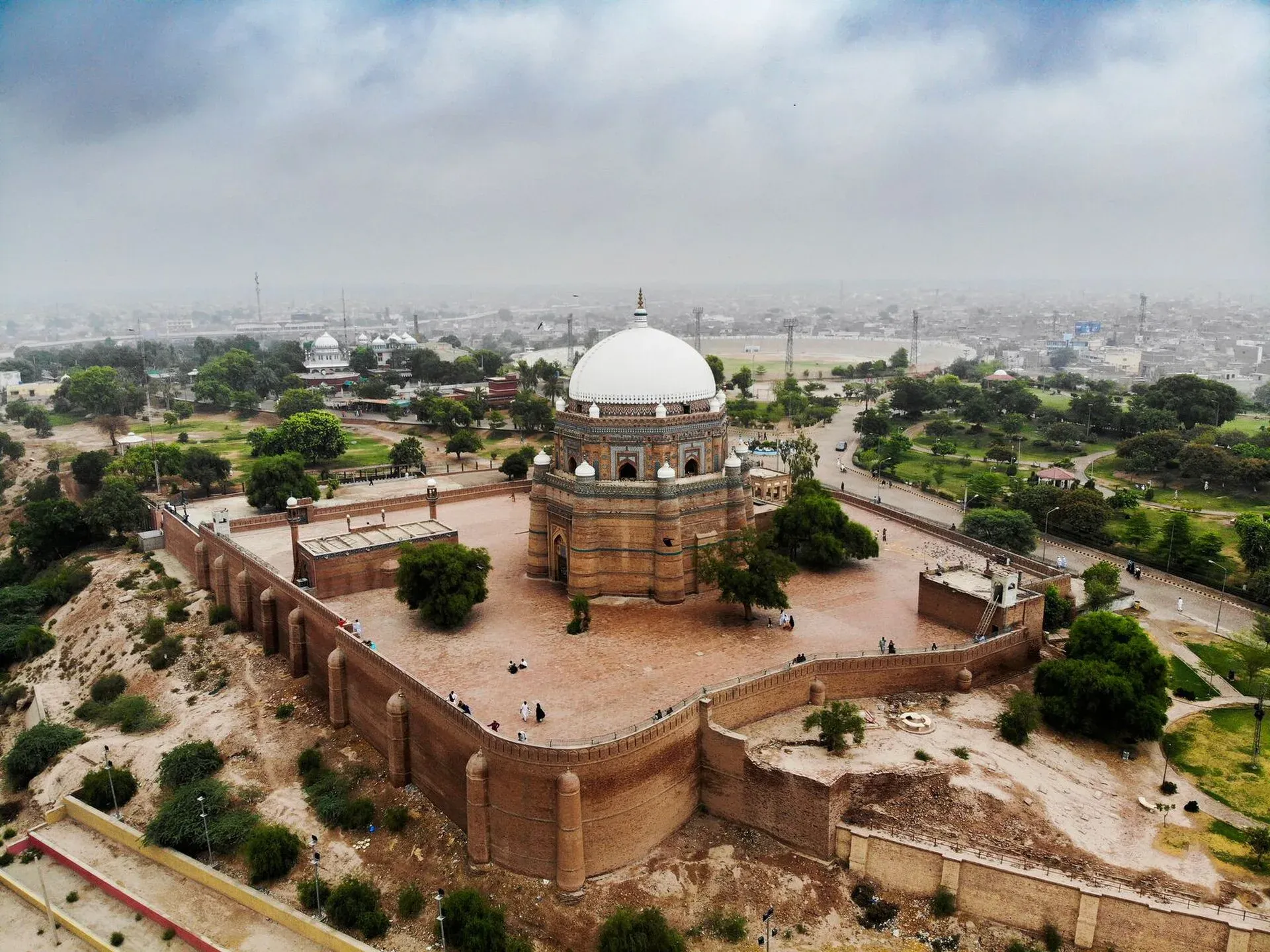
Photo: Yaarahmadd, with thanks · CC BY-SA 4.0 · via Wikimedia Commons · temporary stand-in photo

Multan
The City of Saints in southern Punjab: blue-tiled Sufi shrines, a crowded old city, blue pottery, sohan halwa and mangoes.
Overview
Multan is a city of southern Punjab on the old course of the Chenab, known as the City of Saints for its many Sufi shrines. It is one of the oldest cities in South Asia, with a history reaching back more than two thousand years. It is famous for blue-tiled shrines, hand-painted pottery, mangoes and a hot, dry climate. The old city rewards a slow day on foot, and Multan makes a good stop between Lahore and the south on the M-5 motorway.
History in brief
Multan was an important trading city on the route between South and Central Asia. Wikipedia places early settlement nearby at around 3000 BCE, records an attack by Alexander the Great's forces in 326 BCE, and says Muhammad bin Qasim took the city in 712 CE. It became a centre of Sufism, and shrines were built from the 12th century onward.
The Langah Sultanate made Multan its capital in 1445, and the Mughals later held it as a major province. The city walls date from 1627 and were rebuilt in 1756. The Sikh Empire took Multan in 1818, and the British captured it in 1849 after a long siege that destroyed most of the old fort. The fort mound, with the Qasim Bagh gardens, remains the heart of the old city.
Neighbourhoods
- Old city and Chowk Bazaar: walled-city lanes, bazaars and the main shrines. Good for crafts and history.
- Qasim Bagh and Fort: the fort mound, with gardens and the Tomb of Shah Rukn-e-Alam.
- Cantonment and Gulgasht Colony: quieter, with parks, restaurants and hotels. Good for a base.
- Bosan Road: a modern commercial road with malls and food.
- Hussain Agahi Bazaar: a major market for crafts, textiles and pottery.
Top sights
- Shrine of Shah Rukn-e-Alam: a 14th-century shrine with a huge tiled dome, one of the finest in Pakistan. Wikipedia describes it as the earliest Tughluq-era monument in Multan. It stands on a small hillock behind the fort ruins and is visible on entering the city.
- Shrine of Bahauddin Zakariya: a major 13th-century Sufi shrine on the old city hillock, close to the Rukn-e-Alam shrine.
- Shrines of Shah Shams Sabzwari, Shah Gardez and Shah Ali Akbar: further shrines with blue tilework. The Shah Gardez tomb is a rectangular building from the 1150s covered in blue glazed tiles; Shah Ali Akbar's dates from the 1580s.
- Multan Fort and Qasim Bagh: the old fort mound. Its walls once ran nearly 1.6 km, but most of it was destroyed in the 1848-49 siege, and the grounds are now a park with a viewpoint over the city on the western side.
- Ghanta Ghar (Clock Tower): a colonial landmark built in the Indo-Saracenic style, with a renovated square.
- Shahi Eidgah and Sawi Mosque: the Eidgah dates from 1735, with Mughal-era frescoes and a bulbous dome; the Sawi Mosque is regarded as the oldest in the city and is now roofless.
- Hussain Agahi Bazaar: a crowded market for crafts.
- Blue pottery workshops: Multan is known for blue-glazed pottery, and visits are possible in some workshops.
- Khooni Burj: a historic tower in the old city.
- Ibn-e-Qasim Bagh: a large park for the evening.
- Mango orchards: in season (June to August), orchards around the city are open for tasting.
Bazaars and crafts
- Hussain Agahi Bazaar: a large, crowded market for textiles, spices, carpets, pottery and sweets. Wikivoyage mentions specialty oils, a spice section, and nearby Sarafa (jewellery) and Choorian (bangles) bazaars. Bargaining is expected.
- Blue tiles and pottery: Multan is known for blue enamelled tiles and hand-painted pottery, especially vases.
- Camel-skin lamp shades and handicrafts: sold at Hussain Agahi Bazaar.
- Multani mitti: the local clay, sold for face masks.
- Khussa and jewellery: Wikivoyage lists Multani shoes, worn at weddings and festivals, and the "Multani har" jewellery style among local crafts.
Food and drink
Multan is known for sohan halwa, a dense sweet made with ghee and nuts, and for Multani mangoes. Wikivoyage says the Qadeerabad area is known for making it fresh. Other dishes include Multani karahi, kebabs and lassi, and dahi bhalla and gol gappay snacks. Falsa cola, a red-currant drink, is a summer speciality, and goli soda is a soft drink sealed with a marble stopper. Mango season brings Chonsa, Langra and Sindhri varieties. Walk the lanes around Chowk Bazaar for old sweetshops and breakfast. Choose busy stalls and drink bottled water.
A day in Multan
- Morning: start early at the Rukn-e-Alam and Bahauddin Zakariya shrines, before the heat, and walk the fort mound.
- Midday: have sohan halwa and a late breakfast in the old lanes, and see the Eidgah, Sawi Mosque or Shah Gardez tomb.
- Afternoon: browse Hussain Agahi Bazaar for pottery and textiles, then end at the Ghanta Ghar.
- Evening: a park or Chenab riverbank picnic once the heat eases.
Getting there
- By air: Multan International Airport (MUX) has domestic flights and some international services.
- By rail: Multan Cantonment is a major station on the Karachi to Peshawar main line.
- By road: the M-5 motorway runs south to Sukkur and the M-4 north-east to Faisalabad. Intercity coaches operate from several terminals.
Getting around
Rickshaws and ride-hailing (Careem, inDrive) are the usual choices, and the Multan Metro Bus runs on a main corridor. The old city is best on foot, as the lanes are narrow.
Where to stay
- Cantonment, Gulgasht and Bosan Road: the main hotel areas, with the best choice and services.
- Near the Fort: a few simple hotels close to the shrines.
When to visit
October to March is the most comfortable. Summers are very hot, with temperatures often above 45 C (the Wikipedia record is 50 C, in May 2010; the mean June daily maximum is about 41.6 C), and spring is short. Winter mornings can be foggy.
Safety and etiquette
Multan is generally calm, but crowds at shrines can be large, especially on Thursdays and during Urs festivals. Dress modestly, cover your head if asked, and remove your shoes at the shrines. Ask before photographing worshippers. Check current official advice before you go.
Day trips
- Uch Sharif (about 130 km by road: OSRM measured 132 km, about 1 hour 30 minutes of driving, on 17 November 2026), a group of historic shrines and tombs near Bahawalpur.
- Bahawalpur and Derawar Fort (about 100 km and further).
- Tulamba and Harappa for archaeological sites.
- Lal Suhanra National Park near Bahawalpur.
Good to know
Multan has a Metrobus (18.5 km, 21 stations, opened January 2017) between Bahauddin Zakariya University and Kumharanwala Chowk, though Wikipedia reports that it fell short of its ridership target and that the fleet was cut back (no current service report found). A fee applies at some museums and parks; current fees will be added soon. Shrine visiting hours differ and some areas are restricted to men or women. Check at the entrance.
Highlights
- Shrines of Shah Rukn-e-Alam and Bahauddin Zakariya
- Old city bazaars and blue pottery
- Sohan halwa and Multani mangoes
- Uch Sharif as a day trip
Hotels, food, fuel and services in Multan
Places to stay
- Hotel Crown Inn MultanCall Hotel Crown Inn MultanMap of Hotel Crown Inn Multan in Google Maps
- Avari Boutique MultanCall Avari Boutique MultanMap of Avari Boutique Multan in Google Maps
- Arena by Pearl-ContinentalCall Arena by Pearl-ContinentalMap of Arena by Pearl-Continental in Google Maps
- Belmorris Hotels & ResortsCall Belmorris Hotels & ResortsMap of Belmorris Hotels & Resorts in Google Maps
- S Chalet MultanCall S Chalet MultanMap of S Chalet Multan in Google Maps
- Bling International Hotel MultanCall Bling International Hotel MultanMap of Bling International Hotel Multan in Google Maps
Places to eat
- The SicilianCall The SicilianMap of The Sicilian in Google Maps
- 14th Street Pizza Co. - MultanCall 14th Street Pizza Co. - MultanMap of 14th Street Pizza Co. - Multan in Google Maps
- KFCCall KFCMap of KFC in Google Maps
- Al Kaif MultanCall Al Kaif MultanMap of Al Kaif Multan in Google Maps
- McDonald'sCall McDonald'sMap of McDonald's in Google Maps
- Devour - GulgashtCall Devour - GulgashtMap of Devour - Gulgasht in Google Maps
Essential services fuel stations, mechanics, pharmacies and hospitals and clinics
Fuel
- Wahid PSO Petrol Pump jangla walaCall Wahid PSO Petrol Pump jangla walaMap of Wahid PSO Petrol Pump jangla wala in Google Maps
- Nigana F/S Total ParcoCall Nigana F/S Total ParcoMap of Nigana F/S Total Parco in Google Maps
- HASCOL Petrol & CNG StationCall HASCOL Petrol & CNG StationMap of HASCOL Petrol & CNG Station in Google Maps
- Shell Petrol PumpCall Shell Petrol PumpMap of Shell Petrol Pump in Google Maps
- Polwel Hascol Petrol Pump MultanMap of Polwel Hascol Petrol Pump Multan in Google Maps
- Fit petroleumCall Fit petroleumMap of Fit petroleum in Google Maps
Mechanics and tyre shops
- Suzuki Fort Motors (KR)Call Suzuki Fort Motors (KR)Map of Suzuki Fort Motors (KR) in Google Maps
- Fine Cool Car AC and RepairsCall Fine Cool Car AC and RepairsMap of Fine Cool Car AC and Repairs in Google Maps
- Lucky Tyre Service Tyre shop MultanCall Lucky Tyre Service Tyre shop MultanMap of Lucky Tyre Service Tyre shop Multan in Google Maps
Pharmacies
- Buch International HospitalCall Buch International HospitalMap of Buch International Hospital in Google Maps
Hospitals and clinics
- Well Being Diagnostic CentreCall Well Being Diagnostic CentreMap of Well Being Diagnostic Centre in Google Maps
- SN HealthcareMap of SN Healthcare in Google Maps
- Mukhtar A Sheikh Memorial Welfare HospitalCall Mukhtar A Sheikh Memorial Welfare HospitalMap of Mukhtar A Sheikh Memorial Welfare Hospital in Google Maps
- Strides Healthcare & Artificial LimbsCall Strides Healthcare & Artificial LimbsMap of Strides Healthcare & Artificial Limbs in Google Maps
- Pak Italian Modern Burn centerCall Pak Italian Modern Burn centerMap of Pak Italian Modern Burn center in Google Maps
- Bakhtawar Amin Memorial Trust Hospital MultanCall Bakhtawar Amin Memorial Trust Hospital MultanMap of Bakhtawar Amin Memorial Trust Hospital Multan in Google Maps
Listings come from Google Maps data and are unverified: phone numbers, opening months and prices may have changed. Report a problem · Own one of these? Claim it
Tips
- Visit in winter; summers are extremely hot.
- Dress modestly and remove shoes at shrines.
- Go early to the bazaars.
- Try sohan halwa from an old shop.
Photos we still need: Hussain Agahi Bazaar or a blue-pottery workshop; sohan halwa or other Multani food. Send us yours
Sources and last checked
Last checked Confidence medium7 sources4 still to check
- Last checked
- Method
- Desk research from published sources
- Confidence
- medium
- Checked by
- trek.pk research team
Researched from published sources; not yet checked on the ground by our team. Spot something out of date? Report a mistake.
Sources
- Multan · Wikipedia · checked
- Pakistan Railways · Ministry of Railways · checked
- Old trek.pk Multan page (facts only) · trek.pk · checked
- List of cities in Pakistan by population (2023 census) · Wikipedia · checked
- Multan Metrobus · Wikipedia · checked
- List of airports in Pakistan · Wikipedia · checked
- Multan · Wikivoyage · checked
Still to be checked on the ground (4)
- Shrine opening hours and rules (no official source found)
- Khooni Burj and Ghanta Ghar current access (Wikipedia notes only that the clock tower is from the colonial period)
- Multan Metrobus current service (Wikipedia: 47 buses at start, fleet later cut, ridership below target; no current report found)
- Shrine visiting hours and women-only areas
Nearby and related

Lahore
Punjab's capital and Pakistan's cultural city: Mughal forts, mosques and gardens, a lively Walled City, and some of the best food in the country.

Karachi
Pakistan's largest city and main port: colonial buildings, museums, beaches, busy bazaars and some of the country's best food.
Vehari
District capital in south Punjab on the old Multan-Delhi road, known for cotton, mangoes and canal farming.
Shujabad
Walled town south of Multan on the Chenab, founded in 1750 and famous for its mangoes.