

Photo: Shaguftakarim, with thanks · CC BY-SA 4.0 · via Wikimedia Commons · temporary stand-in photo
Tomb of Jahangir and Akbari Sarai
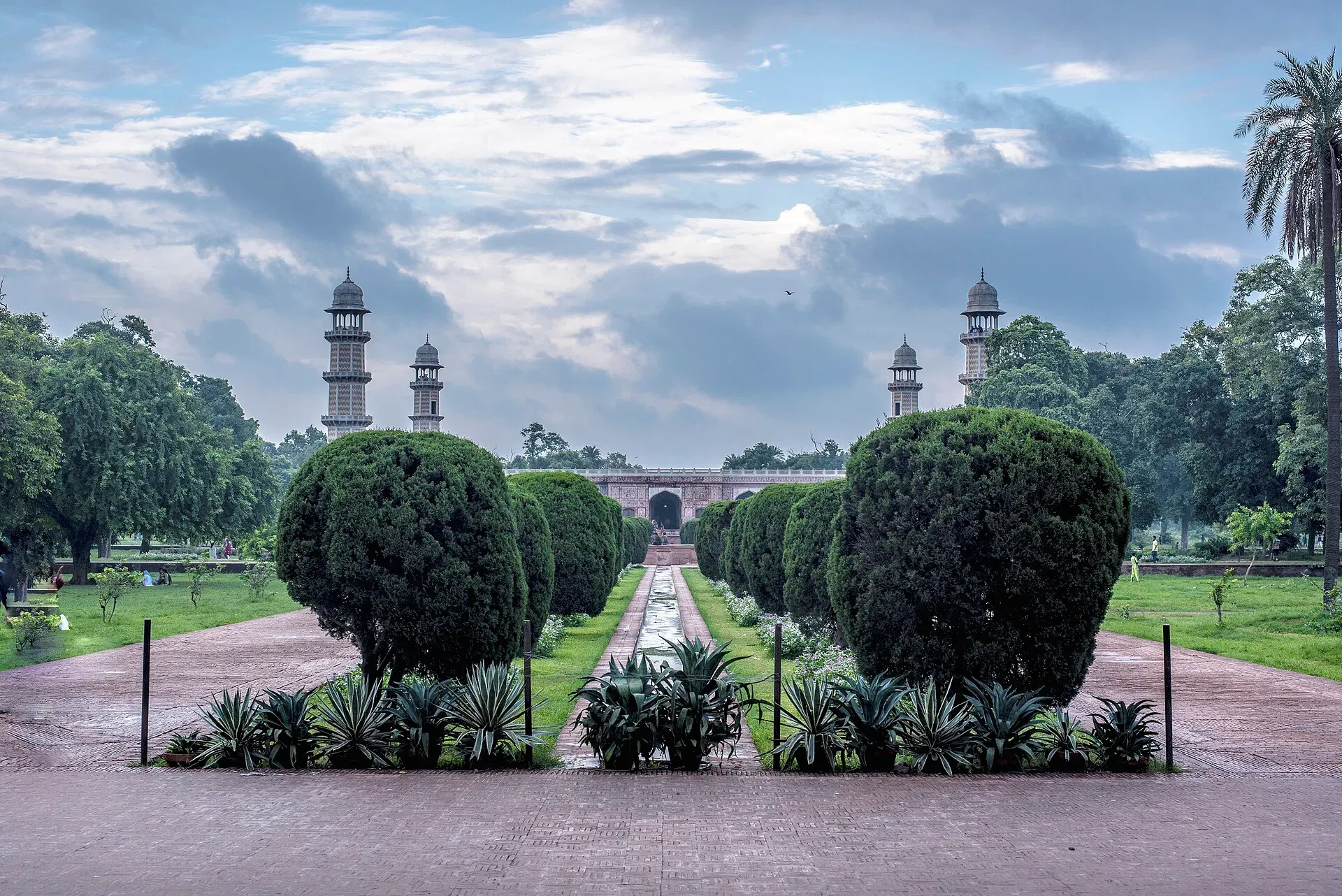
The Mughal emperor Jahangir's mausoleum at Shahdara in Lahore, finished in 1637, with the Akbari Sarai gateway and the tomb of Asif Khan. The group is on UNESCO's tentative list (1993).
Overview
The Tomb of Jahangir stands at Shahdara Bagh, on the west bank of the Ravi river, north-west of Lahore's Walled City. It is the burial place of the fourth Mughal emperor, Nur-ud-Din Jahangir, who ruled from 1605 to 1627. The tomb sits in a large walled garden. Visitors enter from the west through the Akbari Sarai, a courtyard gateway, and next to the garden are the tomb of Asif Khan, Jahangir's brother-in-law, and the tomb of the empress Nur Jahan. The three monuments are listed together on Pakistan's tentative list for UNESCO World Heritage (1993). They are not inscribed.
Plan your visit
- Nearest town
- Lahore
- Getting there
Shahdara Bagh is on the northern side of Lahore, on the west bank of the Ravi river, north-west of the Walled City. A taxi, ride-hailing car or rickshaw from central Lahore or the Walled City is the simplest option. More
Best months
Oct – Mar
- Tomb of Jahangir and Akbari Sarai
- Related place nearby: Lahore
History
Jahangir died on 28 October 1627 near Rajauri, in the Kashmir foothills, and his body reached Lahore on 12 November. His son Shah Jahan ordered a mausoleum "befitting an Emperor". Work began in 1627, took about ten years, and cost about Rs 10 lakh. The Akbari Sarai belongs to the same group, and the tomb of Asif Khan was finished in 1645.
Later centuries were hard on the site. Under Sikh rule, in the early 19th century, the complex was stripped of building materials, some of which went to decorate the Golden Temple in Amritsar. The British built a railway line between the tombs of Asif Khan and Nur Jahan and made repairs in 1889-90. The Ravi has flooded the site many times, most seriously in 1988, when about 10 feet of water covered much of it for five days.
The mausoleum
The tomb is a square, single-storey building on a plinth about 22 feet high, with arcades on all four sides. Its red sandstone is inlaid with white marble. Four octagonal minarets rise from the corners to about 100 feet. Each has three stages and a white marble cupola. Minarets were absent from early Mughal tombs, and they reflect a renewed interest in Timurid forms from Central Asia, alongside Persian influence.
There is no central dome. Jahangir is said to have forbidden one, and the roof is plain. A story that a dome or second storey was stolen has no evidence behind it.
The cenotaph and interior
An octagonal central chamber is lined with carved marble. Vaulted rooms around it are decorated with Mughal fresco, and carved screens (jali) let in patterned light. The white marble cenotaph is inlaid in pietra dura (stone inlay) with plant motifs and carries the 99 Names of Allah. The emperor's remains lie in a crypt below. Whether the interior is open to visitors on a given day has not been confirmed.
The garden
The garden follows the Persian chahar bagh (four-part) plan. It is a quadrangle of about 500 m on each side, divided into four squares and then sixteen smaller ones by paved walkways and two central water channels. Gates face the four directions, and the mausoleum stands in the middle. Clipped hedges, flower beds and long straight paths make it a place to walk rather than hurry.
The Akbari Sarai
A sarai is a rest-house for travellers. This one is a large rectangular quadrangle of about 12 acres, measuring roughly 797 by 610 feet, with corner towers. About 180 cells line a raised terrace around the courtyard. They housed travellers and stored their luggage and gear. Two large gateways, north and south, were built to be seen from afar. The main portal leading to the tomb has a double-storey iwan (vaulted porch), muqarnas (stacked, honeycomb vaulting) and pietra dura decoration. A three-domed red sandstone mosque stands among the cell rows.
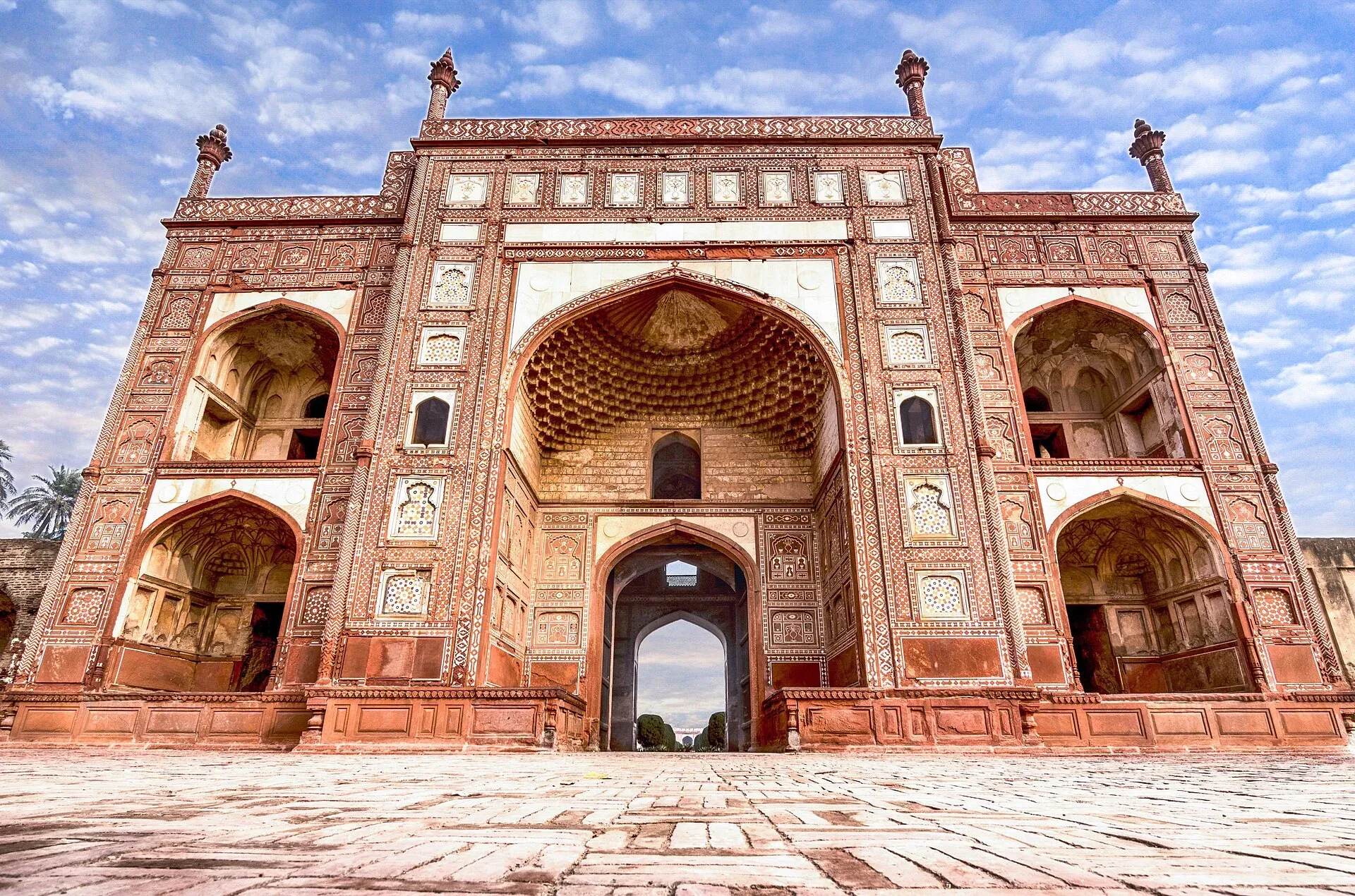
Photo: Shaguftakarim, with thanks · CC BY-SA 4.0 · via Wikimedia Commons · temporary stand-in photo
The sarai worked as a rest station and mail post, offering free fodder, hot and cold water, beds, a physician and a baker. Despite the name, one source says work began in the 1550s under Islam Shah Suri, with the cells and gateways added in the mid-1600s, so sources give different dates. Under Sikh rule it became a cantonment, and the British damaged it badly when it served as a railway depot. It is described as the best-preserved sarai in Pakistan.
The tomb of Asif Khan
Asif Khan, Jahangir's brother-in-law, has a large tomb in the neighbouring enclosure, finished in 1645. It is octagonal, with a brick dome that has lost its facing. The tomb, its walls and its main gate are in poor condition, and conservation work was resumed in 2005 with the Global Heritage Fund. The tomb of Nur Jahan lies slightly south-west of it. No current report on visitor access to either tomb has been found.
Protection
The Federal Antiquities Act 1975 protects the site and bans construction within 200 feet. Private houses nevertheless stand only a few metres from the boundary walls. The tomb appeared on the 1,000-rupee note until 2005, and Pakistan issued a stamp showing it in 1954.
When to visit
Go in the cooler months, October to March, and in the morning or late afternoon, when the light on the sandstone is good. Marble and sandstone are hot at midday in summer.
A short visit
Allow one to two hours. A simple order is the Akbari Sarai first, since it is the way in, then the garden and the mausoleum, then the tomb of Asif Khan if access is open. The Walled City, Lahore Fort and the Badshahi Mosque are on the other side of the city, so most visitors treat Shahdara as a separate half-day trip.
Getting there and good to know
- By road. Shahdara Bagh is about 7 km and 10 minutes from Delhi Gate in the Walled City (OSRM estimate, 17 November 2026, optimistic). Allow extra time for traffic. A taxi, ride-hailing car or rickshaw is the simplest way.
- Rail and bus. A railway line runs beside the site, and Shahdara Bagh railway station serves the area. Wikivoyage also notes that the Metro Bus line ends at Shahdara Terminal.
- Manners. Dress modestly and ask before photographing other visitors. Families come here on outings.
- Hours and fees. Opening hours and any ticket price were not confirmed by an official source. Current fees will be added soon; check with the Punjab Archaeology Department.
Highlights
- Mausoleum finished in 1637 for Emperor Jahangir
- Four octagonal minarets, no central dome
- Pietra dura cenotaph with the Names of Allah
- Chahar Bagh garden about 500 m square
- Akbari Sarai gateway and Asif Khan's tomb nearby
Tips
- Go in the morning when the light on the sandstone is good.
- Allow one to two hours for the tomb, sarai and tomb of Asif Khan.
- Take a ride-hailing car or rickshaw; the site is outside the Walled City.
- Dress modestly and ask before photographing other visitors.
Photos we still need: the tomb of Nur Jahan. Send us yours
Sources and last checked
Last checked Confidence medium8 sources4 still to check
- Last checked
- Method
- Desk research from published sources
- Confidence
- medium
- Checked by
- trek.pk research team
Researched from published sources; not yet checked on the ground by our team. Spot something out of date? Report a mistake.
Sources
- Tomb of Jahangir · Wikipedia · checked
- List of World Heritage Sites in Pakistan (Tentative List) · Wikipedia · checked
- Pakistan Tourism Guide 2021 · Tourism Development Corporation of Pakistan (TDAP) · checked
- Tomb of Asif Khan · Wikipedia · checked
- Shahdara Bagh · Wikipedia · checked
- Akbari Sarai (Wikipedia) · Wikipedia · checked
- Lahore (Wikivoyage) · Wikivoyage · checked
- OSRM driving routes (road distance and time estimate) · OSRM · checked
Still to be checked on the ground (4)
- Opening hours and ticket price (not on Wikipedia; no official page found)
- Current access to Asif Khan's tomb and Nur Jahan's tomb (Asif Khan's described as dilapidated; no current visitor report)
- Whether the tomb interior is open to visitors
- Start date of the Akbari Sarai (sources differ: 1550s or 1637)


