

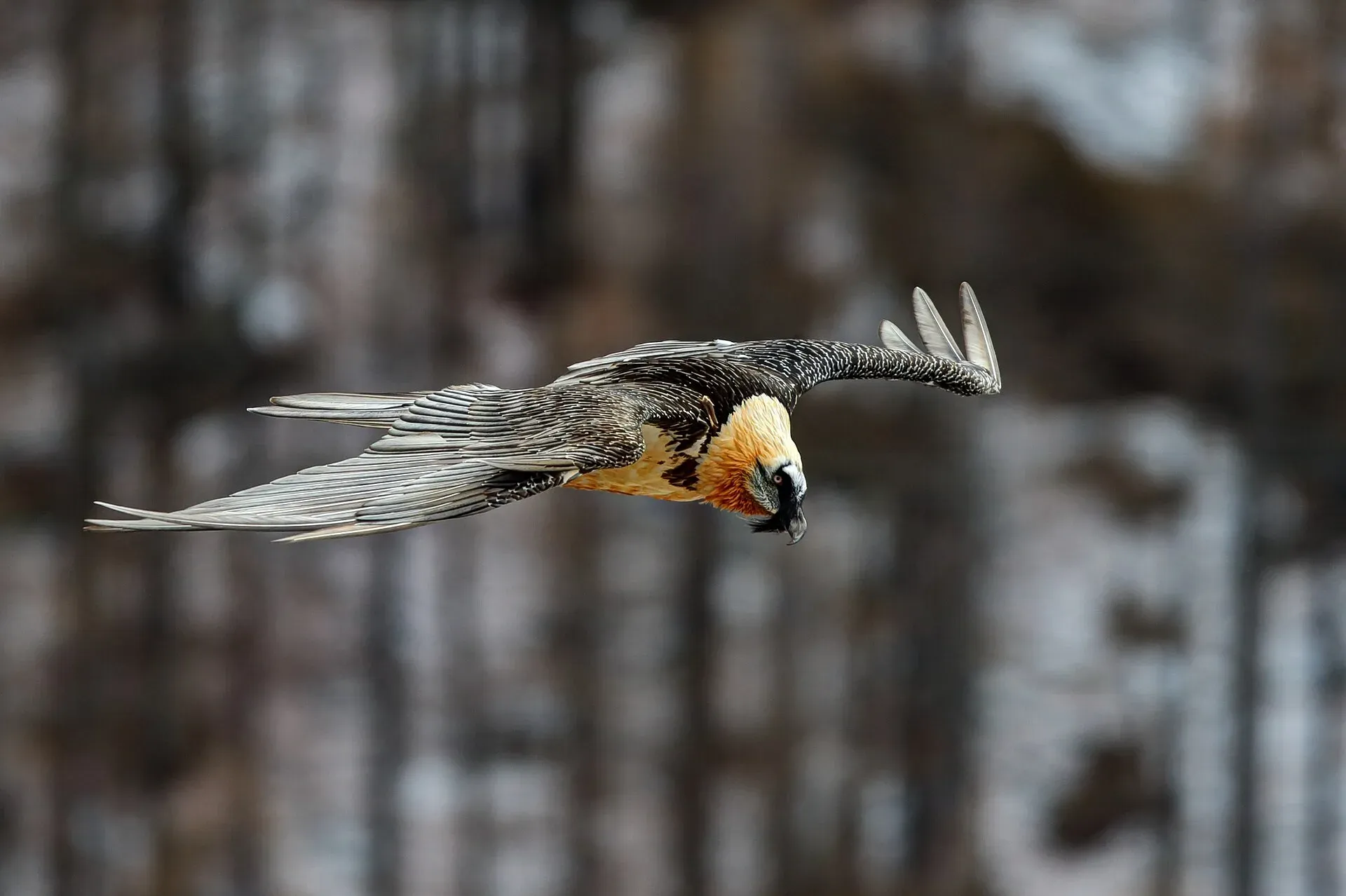
Photo: Luca Casale, with thanks · CC BY-SA 4.0 · via Wikimedia Commons · temporary stand-in photo

Bearded Vulture
Also called the lammergeier, this huge cliff-dwelling raptor eats bones. It is a rare sight over high valleys in the Karakoram, Hindu Kush and western Himalaya.
Overview
The bearded vulture or lammergeier (Gypaetus barbatus) is a very large bird of prey of high mountains. It is the only known vertebrate whose diet is 70 to 90 per cent bone. In Pakistan its name appears on the maps: Yirgot Maidan in the Karambar valley means "bearded vulture's plain" in the trekking notes.
Identification
- Size: 94 to 125 cm long, with a wingspan of 2.31 to 2.83 m.
- Shape: long, narrow wings and a long, wedge-shaped tail, longer than the wing is wide. This separates it from the golden eagle.
- Adult: grey-blue to grey-black above, with orange or rusty head, breast and legs, a creamy forehead, a black band across the eye and black bristles under the chin that form the "beard".
- Voice: mostly silent, with shrill whistles in breeding displays and a falcon-like cheek-acheek at the nest.
Where and when to see it in Pakistan
It is resident on high crags. Our park pages list lammergeier at Khunjerab, Deosai, Central Karakoram, Qurumber, Broghil and Machiara. A Chitral survey from December 2020 to December 2021 counted eight bearded vultures, and described the species as rare compared with the Himalayan griffon. Look along cliff lines and ridges in the middle of the day, when it soars on warm air.
Behaviour
It feeds on bone marrow. It swallows smaller bones whole and carries larger ones 50 to 150 m up, then drops them on rocks to break them open. Young birds take up to seven years to master this. Adults dust-bathe in iron-rich mud, which gives them their rusty colour. Females lay one or two eggs in mid-winter.
Threats and conservation
The IUCN lists the bearded vulture as Near Threatened (IUCN, 2021); it was Least Concern in 2004 and has been Near Threatened since 2014. Wikipedia describes the population as thought to be declining. The Chitral survey found that veterinary shops still stocked painkillers (NSAIDs) that can harm vultures, including diclofenac sodium, although meloxicam was also on sale, and that food was scarce. Wikipedia's diclofenac article, citing a 2021 Guardian report, says veterinary diclofenac has been banned in Pakistan.
Birding etiquette
Keep your distance and use binoculars. Never play recorded calls near nests, and do not use flash. Stay on paths, keep dogs away, and follow the instructions of park staff and local guides. Never approach cliffs where large birds are nesting.
Sources and last checked
Last checked Confidence medium6 sources2 still to check
- Last checked
- Method
- Desk research from published sources
- Confidence
- medium
- Checked by
- trek.pk research team
Researched from published sources; not yet checked on the ground by our team. Spot something out of date? Report a mistake.
Sources
- Bearded vulture · Wikipedia · checked
- Gypaetus barbatus (assessment 2021) · IUCN Red List · checked
- Conservation of Threatened Vulture Species Through Research and Awareness Raising Programs in Chitral Pakistan (final report, 12 Feb 2022) · Rufford Foundation · checked
- Trekking in the Karakoram and Hindukush (place names; facts only) · Lonely Planet · checked
- Diclofenac · Wikipedia · checked
- Gypaetus barbatus (IUCN Red List category) · GBIF, IUCN Red List checklist · checked
Still to be checked on the ground (2)
- Breeding sites and numbers outside Chitral
- Current Pakistan veterinary diclofenac ban: only a second-hand reference (Wikipedia citing The Guardian, 2021); not checked against a Pakistani official notice