

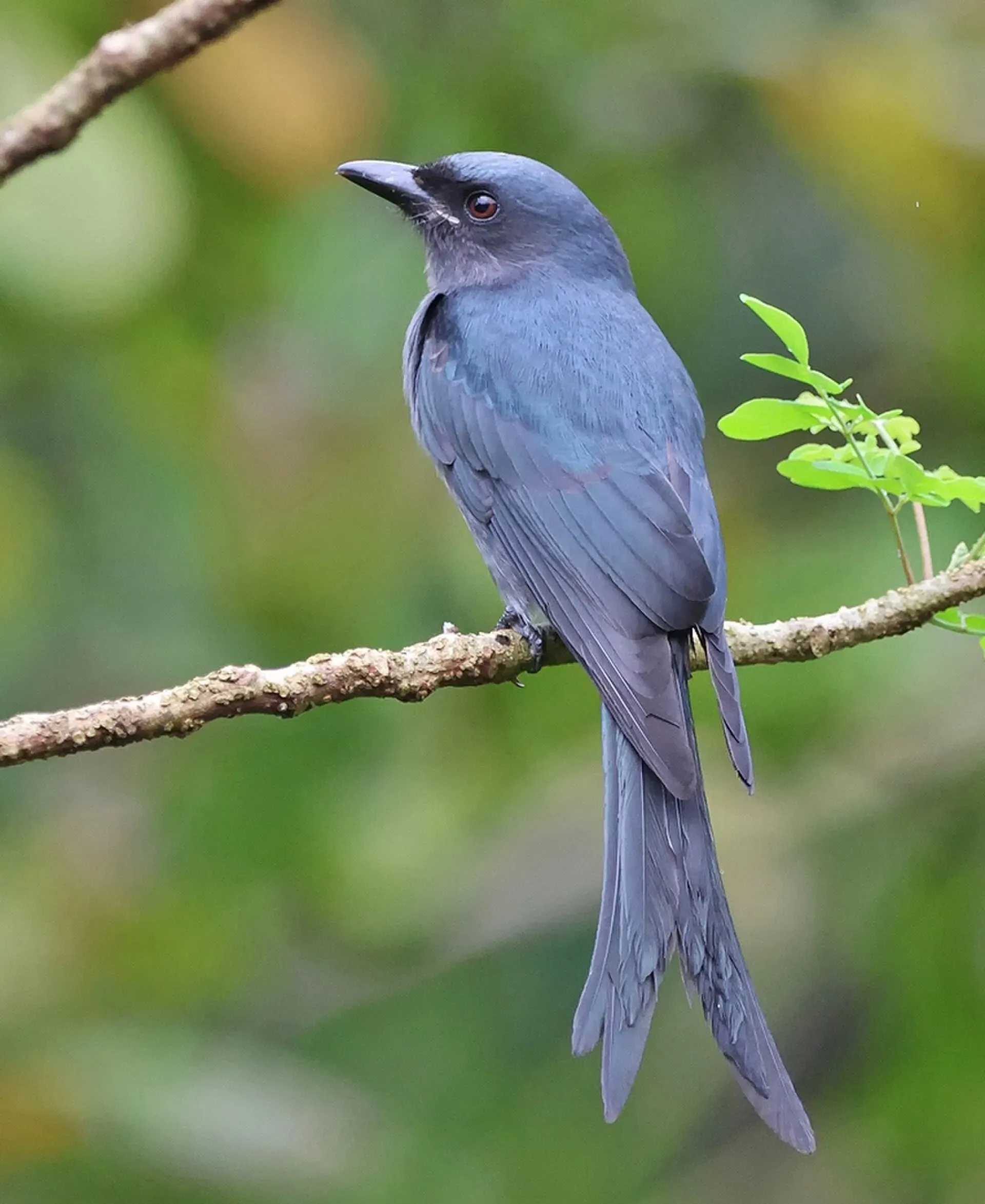
Photo: Swardeepak, with thanks · CC BY-SA 4.0 · via Wikimedia Commons · temporary stand-in photo

Black Drongo
A glossy black bird with a forked tail that perches on wires and fence posts in open farmland. It is fearless towards crows and birds of prey and common across Pakistan.
Identification
The black drongo is an all-black bird about 28 cm long with a deeply forked tail. In good light it has a bluish gloss. It often shows a tiny white spot at the base of the bill. It perches openly on wires, posts and bare branches, then darts out to catch insects in the air. It is the only black, fork-tailed bird that you will usually see on farmland wires.
Status
IUCN Red List: Least Concern (BirdLife International, 2016), because of its large range and common numbers.
Where and when in Pakistan
It is a common resident from the Indus valley east across South Asia. In northern Pakistan and north-eastern Afghanistan it is described as a summer visitor, and its seasonal movements are poorly understood. A study on the Pothwar Plateau looked at its feeding and habitat use. Look along telephone lines, in crop fields, paddies, orchards and light woodland, and near river banks, in the plains all year and in the north mainly in summer. A photo record exists from Balloki in Kasur, Punjab.
Behaviour
It is aggressive and fearless. Although it is small, it dive-bombs crows and birds of prey that enter its nesting territory. This habit gave it the old name "king crow". Smaller birds, especially bulbuls, often nest nearby for protection. It eats mainly insects caught in flight or taken from the ground. It also sings in the morning in the breeding season. Birds breed until August in much of the subcontinent. The Asian koel sometimes lays eggs in its nest.
Threats and conservation
It is not threatened. Pesticide use in farmland may affect insect prey, but there is no known Pakistan-specific study.
Birding etiquette
- Use binoculars or a telescope and keep your distance. Never use recorded calls to draw a bird in, and do not use flash.
- Stay away from nests and roosts, and keep dogs out of wetlands and nesting areas.
- Do not use drones near birds.
- Never buy a captive or trapped wild bird, or take part in trapping.
- Hire a licensed local guide where you can, and ask the local wildlife department about access and timing.
Sources and last checked
Last checked Confidence medium4 sources2 still to check
- Last checked
- Method
- Desk research from published sources
- Confidence
- medium
- Checked by
- trek.pk research team
Researched from published sources; not yet checked on the ground by our team. Spot something out of date? Report a mistake.
Sources
- Black drongo · Wikipedia · checked
- Feeding Ecology, Behaviour and Habitat Utilization of Black Drongo in Pothwar Plateau, Pakistan · Journal of Bioresource Management · checked
- Black Drongo Dicrurus macrocercus · BirdLife International DataZone · checked
- Dicrurus macrocercus (IUCN Red List category) · GBIF, IUCN Red List checklist · checked
Still to be checked on the ground (2)
- Which subspecies occurs in Pakistan is not settled in the sources we could read
- Exact arrival and departure dates in northern Pakistan are not documented in the sources we could read