

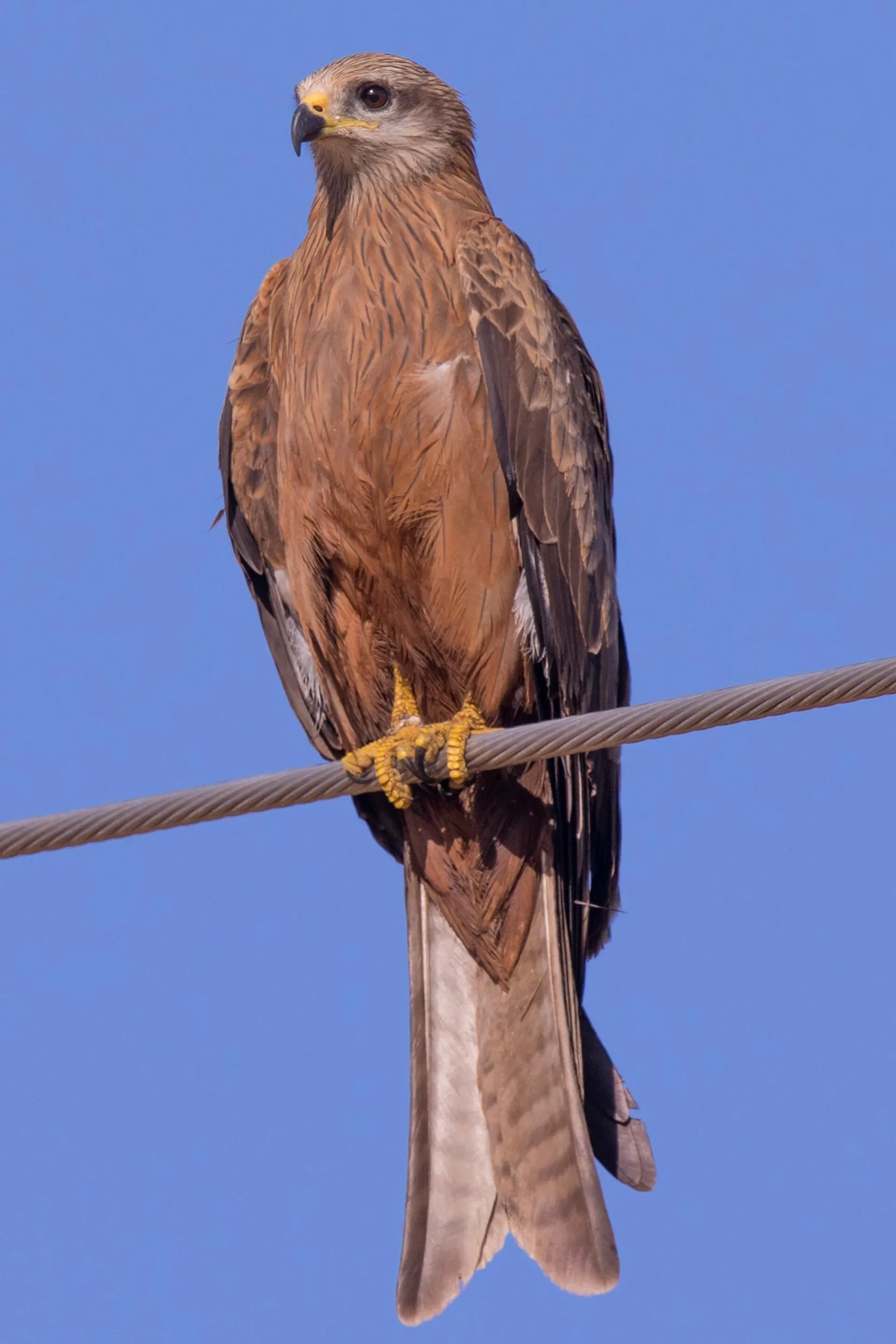
Photo: Andreas Trepte, with thanks · CC BY-SA 4.0 · via Wikimedia Commons · temporary stand-in photo

Black Kite
The black kite is Pakistan's most familiar bird of prey. It circles over towns, rubbish tips and rivers all year, with a shallow forked tail and a shrill, whinnying call.
Identification
The black kite is a medium-sized raptor with a wingspan of about 1.5 m and an average weight of about 735 g. It is mostly dark brown, with a black bill, a yellow cere and yellow legs. In flight, look for angled wings and a shallow forked tail. The call is a shrill whistle followed by a rapid whinnying trill. Two kinds matter in Pakistan: the small resident govinda, found from eastern Pakistan through India, and lineatus, the black-eared kite, which has a larger pale patch at the wrist, which breeds from Siberia round the Himalaya and winters in South Asia.
Status
IUCN Red List: Least Concern (BirdLife International, 2021). Global numbers are very large.
Where and when to see it in Pakistan
Look up almost anywhere, all year. Black kites are well adapted to towns and soar over cities, over markets, rubbish tips and rivers. Winter brings extra birds. They gather in large roosts at dusk, which can be an impressive sight from a rooftop or park.
Behaviour
It is an opportunistic hunter and scavenger. It takes small live prey, fish, carrion and household waste. In Indian cities, kites sometimes swoop down to take food from people's hands, and their talons can injure bystanders; the same can happen in Pakistani cities. Eat in covered spaces and do not hold food up in the open. Birds spend much of the day gliding on thermals.
Threats and conservation
Electrocution on power lines and mass poisonings, after birds ate poisoned voles in farm fields, are recorded causes of death. We have not found Pakistan-specific figures. Because it is common and adaptable, it is not a conservation concern globally. In cities it is mainly a victim of human hazards, and a birdstrike risk at some airports.
Birding etiquette
- Use binoculars or a telescope and keep your distance. Never use recorded calls to draw a bird in, and do not use flash.
- Stay away from nests and roosts, and keep dogs out of wetlands.
- Do not use drones near birds.
- Never buy a captive or trapped wild bird, or take part in trapping.
- Hire a licensed local guide where you can, and ask the local wildlife department about access and timing.
- Do not feed kites by throwing food into the air; it teaches them to approach people.
Sources and last checked
Last checked Confidence medium3 sources3 still to check
- Last checked
- Method
- Desk research from published sources
- Confidence
- medium
- Checked by
- trek.pk research team
Researched from published sources; not yet checked on the ground by our team. Spot something out of date? Report a mistake.
Sources
- Black kite · Wikipedia · checked
- Black Kite – BirdLife DataZone factsheet · BirdLife International · checked
- Milvus migrans (IUCN Red List category) · GBIF, IUCN Red List checklist · checked
Still to be checked on the ground (3)
- Assessment year (2021) is taken from the Wikipedia citation; the BirdLife DataZone factsheet opened with empty fields, so it could not confirm it
- Hero photo not from Pakistan and in portrait format
- Pakistan-specific threats and population are not sourced