

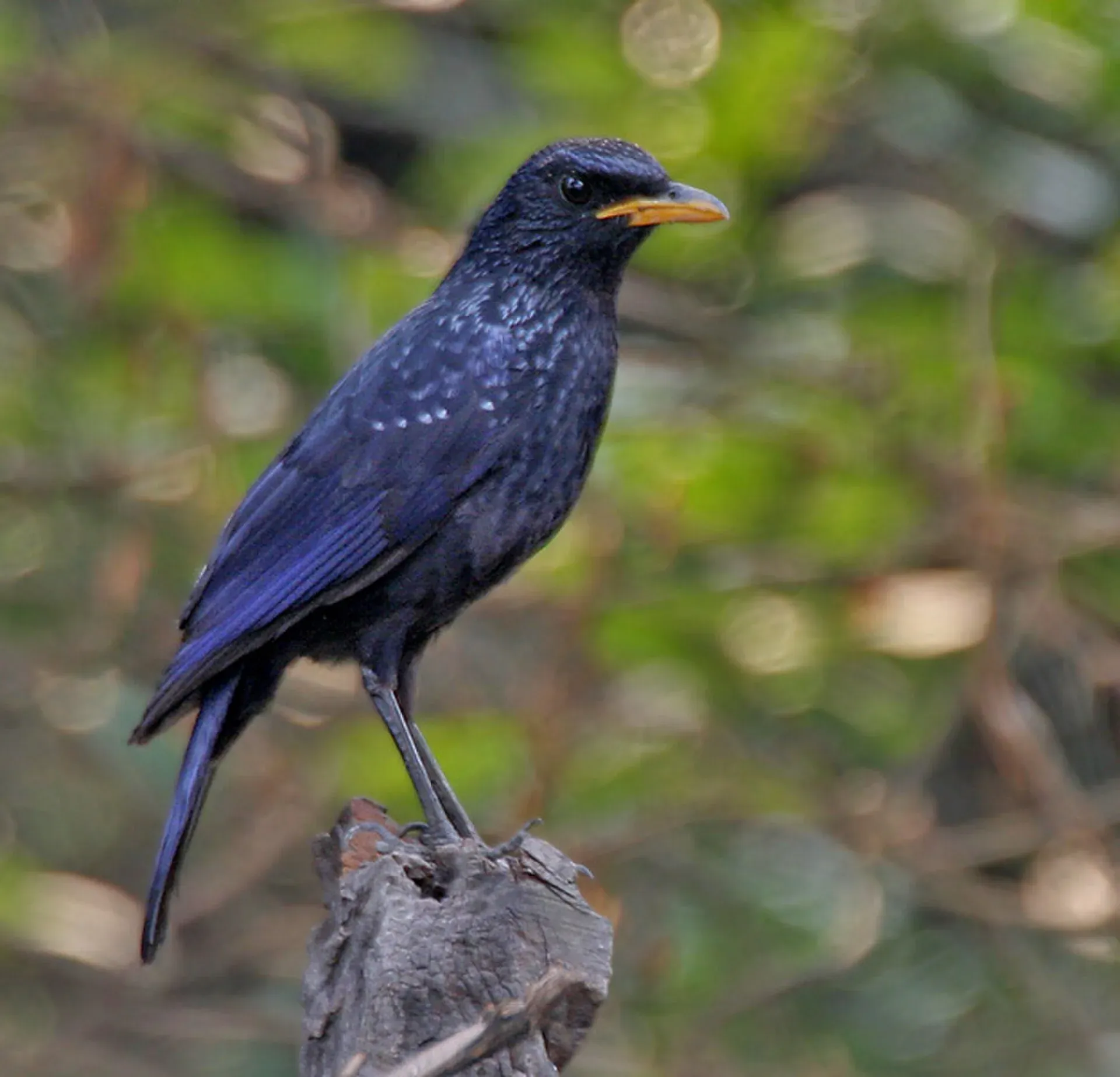
Photo: J.M.Garg, with thanks · CC BY-SA 3.0 · via Wikimedia Commons · temporary stand-in photo

Blue Whistling Thrush
A large, dark blue thrush of rocky mountain streams, known for its loud, human-like whistle at dawn and dusk. In Pakistan it lives in the hill and mountain forests of the north.
Identification
The blue whistling thrush is a big, stocky bird, 29 to 35 cm long. At a glance it looks black. In good light the plumage is deep violet-blue, with small pale spangles on the tips of the feathers. The bill and legs are black, and males and females look alike. It is the largest member of the Old World flycatcher family. It hops over wet rocks and, when alarmed, spreads and droops its tail. The alarm call is a shrill kree. The song is a loud, human-like whistle, usually at dawn and dusk.
Note on names: Wikipedia now calls Myophonus caeruleus the Chinese whistling thrush and says it breeds in central and eastern China. Many field guides and checklists still use "blue whistling thrush" for the Himalayan birds seen in Pakistan. We have used the older, familiar name.
Status
IUCN Red List: Least Concern (BirdLife International, 2016).
Where and when in Pakistan
The species is listed in a bird study of Margalla Hills National Park above Islamabad, and a wildlife photograph records it at Basho meadows near Skardu. Look along shaded, rocky streams in hill forest. It is mostly a bird of the hills, and it may come lower to streams in winter. The old record of nesting around Murree rests on an 1870 nest and is disputed, so do not count on it there. It can be seen all year, but dawn and dusk, when it sings, are best.
Behaviour
It usually feeds alone or in pairs on the ground beside streams and in damp places. It turns over leaves and stones and eats snails, crabs, earthworms, insects and fruit. It batters snails and crabs on a rock before eating them. The nest is a cup of moss and roots on a ledge or in a hollow beside a stream. The breeding season in China is April to August.
Threats and conservation
It is not threatened globally. Locally it depends on clean, shaded streams, so clearing hill forest and polluting streams are the main concerns. There is no known Pakistan-specific population figures.
Birding etiquette
- Use binoculars or a telescope and keep your distance. Never use recorded calls to draw a bird in, and do not use flash.
- Stay away from nests and roosts, and keep dogs out of wetlands and nesting areas.
- Do not use drones near birds.
- Never buy a captive or trapped wild bird, or take part in trapping.
- Hire a licensed local guide where you can, and ask the local wildlife department about access and timing.
Sources and last checked
Last checked Confidence medium5 sources4 still to check
- Last checked
- Method
- Desk research from published sources
- Confidence
- medium
- Checked by
- trek.pk research team
Researched from published sources; not yet checked on the ground by our team. Spot something out of date? Report a mistake.
Sources
- Chinese whistling thrush (Blue whistling thrush) · Wikipedia · checked
- Whistling thrush · Wikipedia · checked
- Avian Assemblage Monitoring and Bioassessment of Margalla Hills National Park · Pakistan Journal of Zoology / Researchers Links · checked
- Myophonus caeruleus · BirdForum Opus · checked
- Myophonus caeruleus (IUCN Red List category) · GBIF, IUCN Red List checklist · checked
Still to be checked on the ground (4)
- Taxonomy: Wikipedia treats Myophonus caeruleus as the Chinese whistling thrush; confirm how eBird or the current checklist names the Himalayan bird in Pakistan
- Skardu record comes from a photograph; Pakistan site list needs eBird check
- Murree nesting record disputed
- Assessment year is taken from the IUCN citation shown on Wikipedia; the IUCN Red List and BirdLife pages could not be loaded to confirm it directly.