

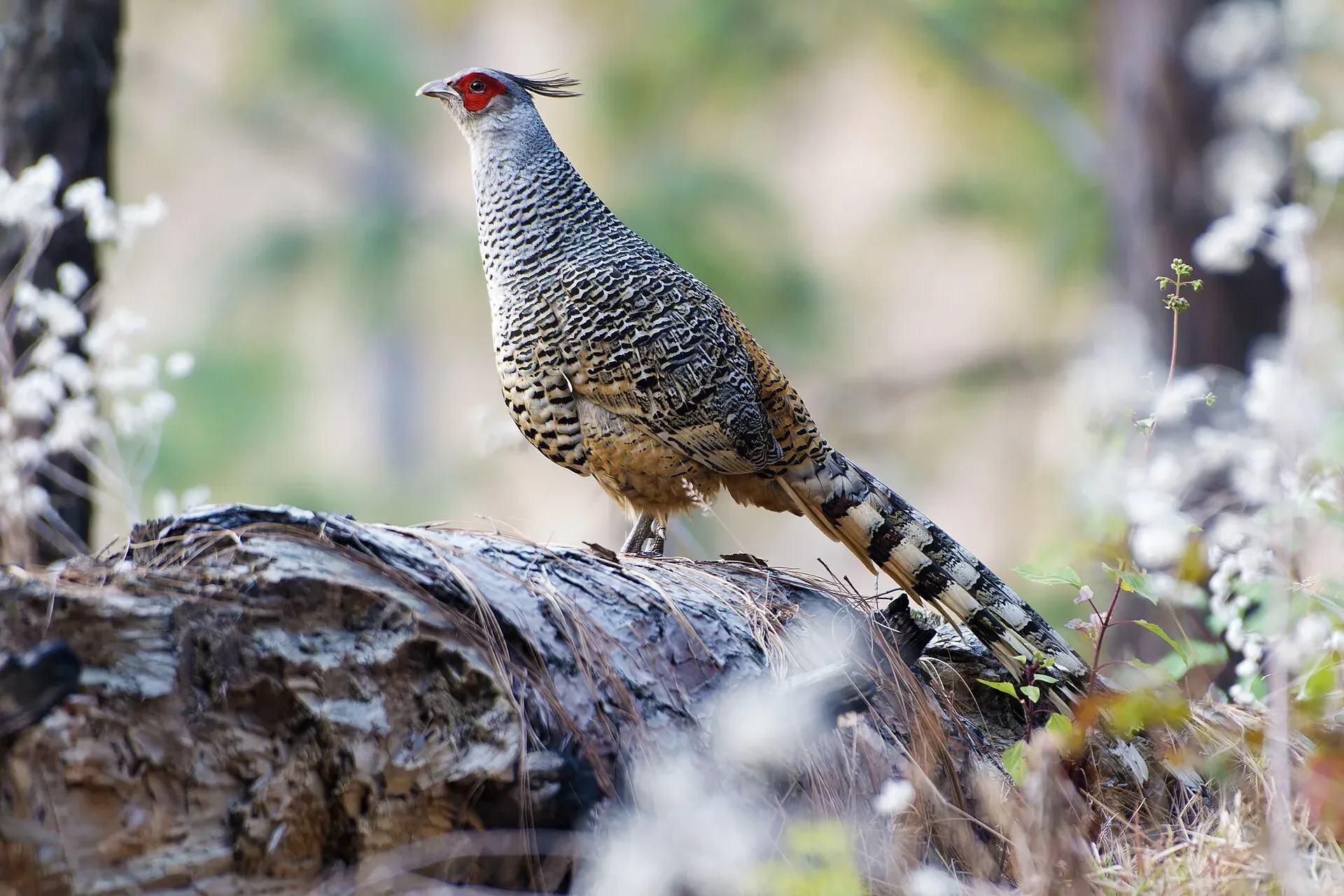
Photo: Shiv's fotografia, with thanks · CC BY-SA 4.0 · via Wikimedia Commons · temporary stand-in photo

Cheer Pheasant
A plain grey-buff pheasant with a long crest and long tail, found on steep Himalayan slopes. In Pakistan it is known from the Hazara hills of Khyber Pakhtunkhwa.
Overview
The cheer pheasant (Catreus wallichii), also called Wallich's pheasant, is the only member of its genus. It lacks the bright colours of many other pheasants, but it is a threatened bird of the western Himalaya, and Pakistan sits at the edge of its range.
Identification
- Plumage: buffy grey, with a long grey crest and a long tail of 18 feathers. The central tail feathers are much longer than the rest.
- Female: slightly smaller and darker, with a white collar limited to the chin and throat.
- Call: surveys count cheer pheasants by their dawn calls, so listen at first light in the breeding season.
Where and when to see it in Pakistan
The cheer pheasant lives in highlands and scrubland of the Himalaya, in India, Nepal and Pakistan. In Pakistan it is reported from the Hazara division of Khyber Pakhtunkhwa. Machiara National Park, in Azad Kashmir, lists it among its recorded birds, and the Palas valley has been surveyed using dawn call counts. It is found mainly above about 6,000 feet (roughly 1,800 m) and up to about 10,000 feet (roughly 3,000 m) in summer. It is a very difficult bird to find, and visiting without a local guide is not advised.
Behaviour
Males are monogamous. The birds breed on steep slopes in summer, with a clutch of 10 to 11 eggs. They are sensitive to human disturbance, as a study in India's upper Beas valley found.
Threats and conservation
The IUCN lists the cheer pheasant as Vulnerable (assessment published 2022). Habitat loss, a small population and hunting in some areas are the main concerns, and it is listed in CITES Appendix I. Attempts to reintroduce captive-bred cheer pheasants in Pakistan have been unsuccessful.
Birding etiquette
Keep your distance and use binoculars. Never play recorded calls near nests, and do not use flash. Stay on paths, keep dogs away, and follow the instructions of park staff and local guides.
Sources and last checked
Last checked Confidence medium4 sources2 still to check
- Last checked
- Method
- Desk research from published sources
- Confidence
- medium
- Checked by
- trek.pk research team
Researched from published sources; not yet checked on the ground by our team. Spot something out of date? Report a mistake.
Sources
- Cheer pheasant · Wikipedia · checked
- Catreus wallichii (assessment 2022) · IUCN Red List · checked
- Machiara National Park (existing trek.pk place page, citing BirdLife records) · trek.pk · checked
- Catreus wallichii (IUCN Red List category) · GBIF, IUCN Red List checklist · checked
Still to be checked on the ground (2)
- Current Pakistan sites and numbers (Wikipedia names only the Hazara division and gives no Pakistan population; the only figure is about 200 birds at Dhorpatan, Nepal)
- Call description (not in Wikipedia)