

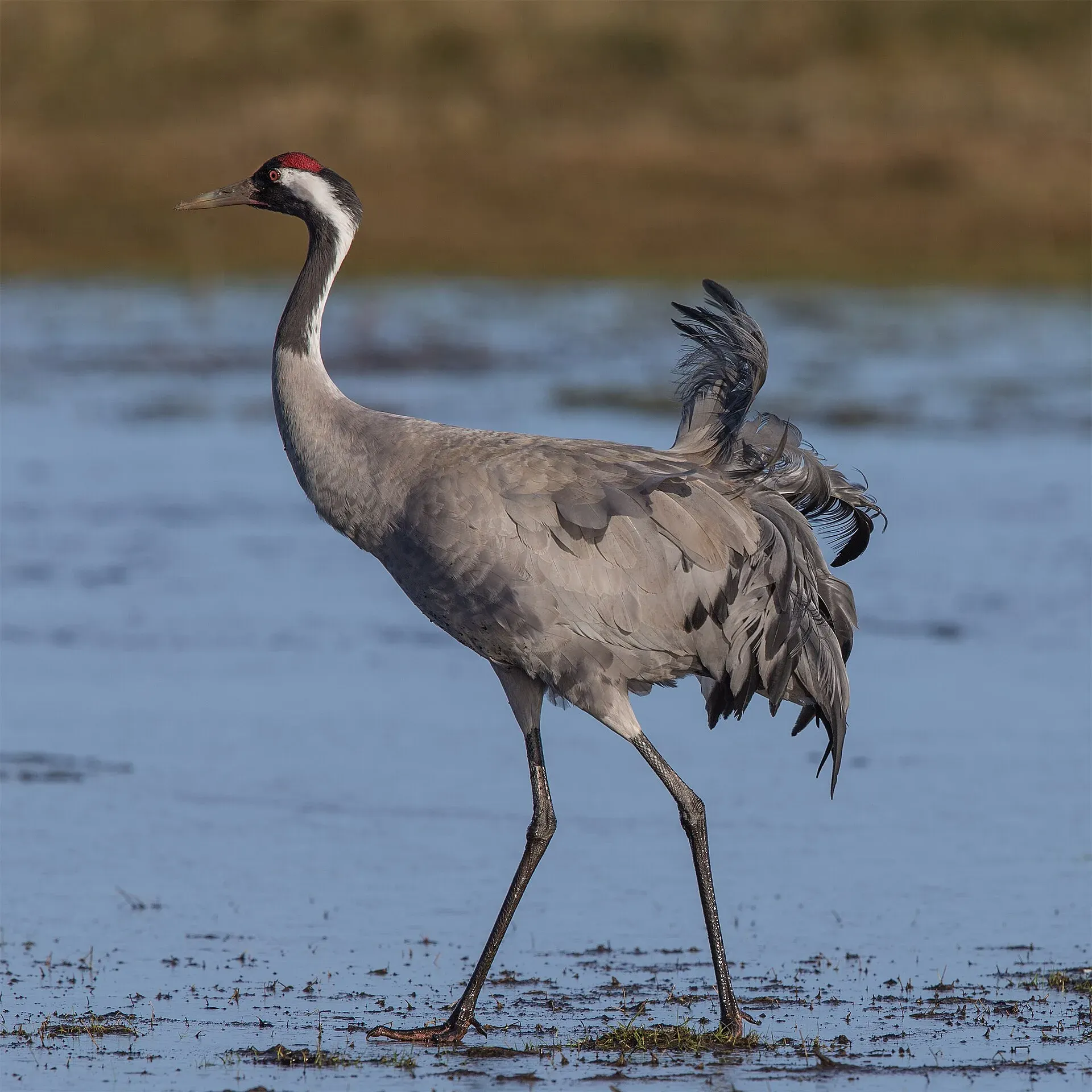
Photo: Andreas Trepte, with thanks · CC BY-SA 2.5 · via Wikimedia Commons · temporary stand-in photo

Common Crane
A tall grey crane with a red crown and a white stripe down the neck. It winters in northern South Asia, with small numbers passing through Balochistan.
Identification
The common crane (also called the Eurasian crane) is 100 to 130 cm long, with a wingspan of 180 to 240 cm and a weight of 3 to 6 kg. It is slate grey, with a black forehead, a bare red crown and a white streak running from behind the eye down the neck. The primaries and tail tip are black, and long feathers droop over the tail. Young birds are browner and have no drooping plumes. The call is a loud, piercing trumpeting.
Status
IUCN Red List: Least Concern (BirdLife International, 2025).
Where and when to see it in Pakistan
The northern Indian subcontinent, including Pakistan, is one of the three main wintering areas, used mostly by birds that breed in central Russia. Birds leave the breeding areas from August to October and return from February to May, so Pakistan sees them mainly from October to March. In Pakistan, passage is most often reported from Balochistan: a Zhob study counted 1,250 common cranes in autumn 2010 and 2,652 in spring 2011. Ask the district administration or local police about current conditions before you go. For foreign visitors: the UK FCDO advises against all travel to Balochistan, including Quetta (page updated 27 October 2026, checked 17 November 2026), so treat the Zhob stopover as a conservation story, not a trip plan.
Behaviour
Common cranes are monogamous and call loudly in duets. In winter they feed on waste grain in harvested fields and roost in shallow water. They migrate in V-shaped flocks, sometimes at great height.
Threats and conservation
Globally, habitat loss from dams, farming and wetland drainage, power-line collisions and disturbance are the main threats. In Pakistan, hunting during migration through Balochistan is a major concern. All cranes are protected there under the Balochistan Wildlife Act 2014, with penalties of a fine, imprisonment or both. In 2017 Dawn quoted WWF-Pakistan as saying fines were Rs 10,000 to 30,000 or two months in prison. WWF-Pakistan has called for stricter enforcement and community incentives.
Birding etiquette
- Use binoculars or a telescope and keep your distance. Never use recorded calls to draw a bird in, and do not use flash.
- Stay away from nests and roosts, and keep dogs out of wetlands.
- Do not use drones near birds.
- Never buy a captive or trapped wild bird, or take part in trapping.
- Hire a licensed local guide where you can, and ask the local wildlife department about access and timing.
Sources and last checked
Last checked Confidence medium6 sources3 still to check
- Last checked
- Method
- Desk research from published sources
- Confidence
- medium
- Checked by
- trek.pk research team
Researched from published sources; not yet checked on the ground by our team. Spot something out of date? Report a mistake.
Sources
- Common crane · Wikipedia · checked
- Common Crane – BirdLife DataZone factsheet · BirdLife International · checked
- Ecology: Balochistan's Siberian secret · Dawn · checked
- Population assessment of migratory cranes at district Zhob, Balochistan · Researchers Links · checked
- Pakistan travel advice · UK FCDO · checked
- Grus grus (IUCN Red List category) · GBIF, IUCN Red List checklist · checked
Still to be checked on the ground (3)
- Pakistan passage counts (Zhob study page returned access denied on 17 November 2026, so the 1,250 and 2,652 figures could not be re-checked)
- Where in Punjab and Sindh the species can be seen reliably
- Hero photo not from Pakistan