

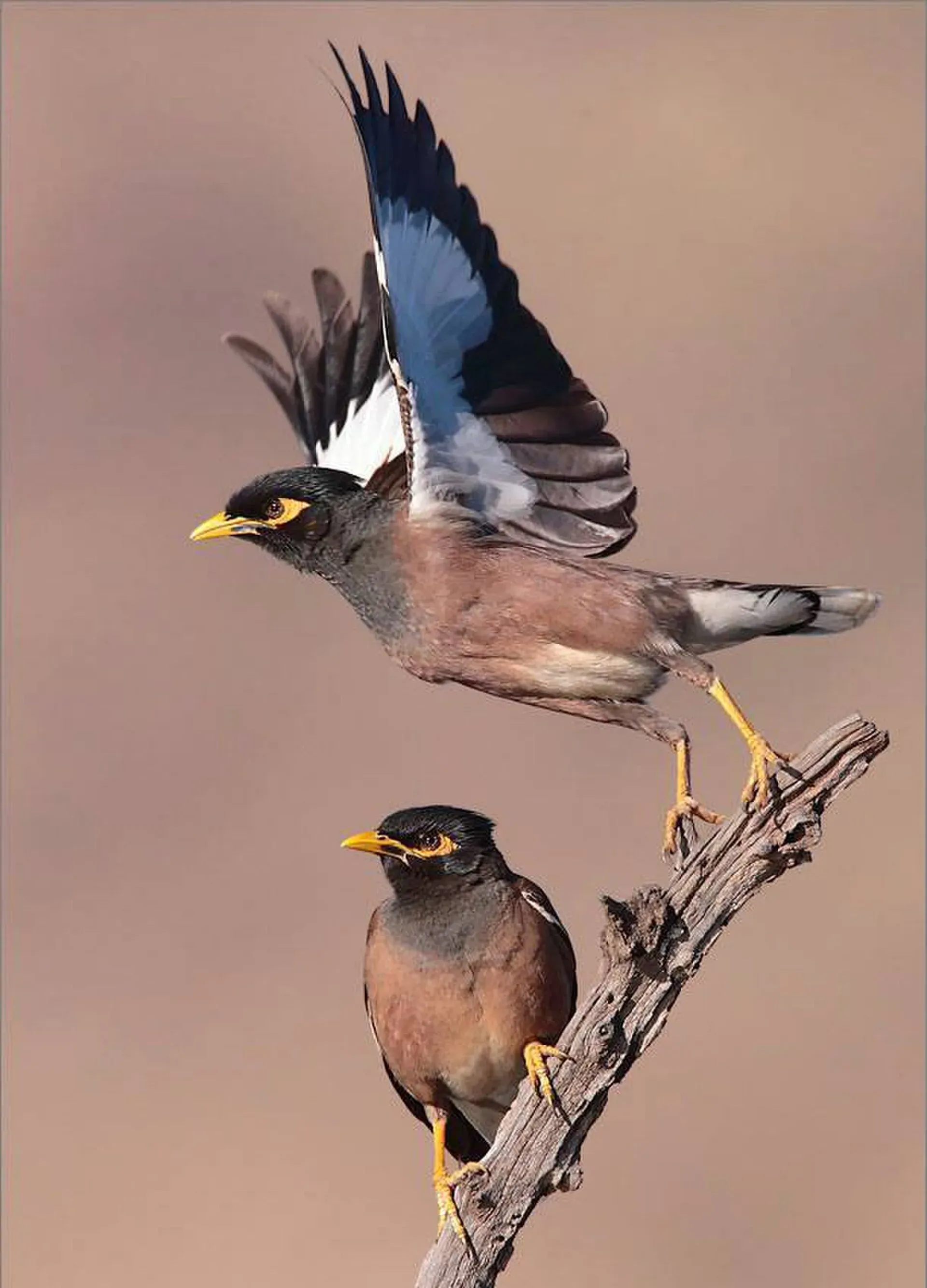
Photo: Gerrie van Vuuren, with thanks · CC BY-SA 4.0 · via Wikimedia Commons · temporary stand-in photo

Common Myna
A bold brown starling with a yellow bill, yellow eye patch and white wing flashes. It is one of the most familiar birds in Pakistan's towns, fields and gardens.
Identification
The common myna is a stocky, brown starling, about 23 cm long. It has a black head, a bright yellow bill, and a bare yellow patch behind the eye. It has yellow legs and a white patch in each wing that flashes in flight. It walks on the ground with a confident strut. Its calls are a noisy mix of croaks, squawks, chirps, whistles and clicks.
Status
IUCN Red List: Least Concern (BirdLife International assessment, 2017 edition of the Red List). It is native to Pakistan. Elsewhere, where people have introduced it, it is listed as one of the world's 100 worst invasive species.
Where and when in Pakistan
It is a very common resident found throughout the country, and surveys in Punjab regularly rank it among the commonest birds. It was classed as very common in urban habitats in Gujranwala, and a survey at a Lahore safari zoo in 2014 to 2015 counted 327 individuals. Look in gardens, markets, farmland, roadsides and city parks all year, from the Sindh plains to hill towns. A study on the Punjab University campus in Lahore, however, reported a long-term decline, so numbers are not equal everywhere.
Behaviour
Mynas are omnivores that eat insects, grubs, fruit, grain and scraps from human waste. They roost together in large, noisy flocks, sometimes with crows and parakeets. They are thought to pair for life, and they nest in holes in trees and walls and readily use nest boxes. The clutch is usually four to six eggs. In the Himalaya it breeds from sea level to about 3,000 m.
Threats and conservation
There is no global concern. Within Pakistan there is no known national population study. In its introduced range abroad, it competes with native hole-nesting birds, which is not a concern here.
Birding etiquette
- Use binoculars or a telescope and keep your distance. Never use recorded calls to draw a bird in, and do not use flash.
- Stay away from nests and roosts, and keep dogs out of wetlands and nesting areas.
- Do not use drones near birds.
- Never buy a captive or trapped wild bird, or take part in trapping.
- Hire a licensed local guide where you can, and ask the local wildlife department about access and timing.
Sources and last checked
Last checked Confidence medium4 sources2 still to check
- Last checked
- Method
- Desk research from published sources
- Confidence
- medium
- Checked by
- trek.pk research team
Researched from published sources; not yet checked on the ground by our team. Spot something out of date? Report a mistake.
Sources
- Common myna · Wikipedia · checked
- Status of wild birds and mammals in urban habitats of Gujranwala city, Punjab, Pakistan · Journal of Zoology, University of the Punjab · checked
- Avian assemblage at Lahore Safari Zoo, 2014 to 2015 (survey results) · Pakistan Journal of Zoology / Researchers Links · checked
- Acridotheres tristis (IUCN Red List category) · GBIF, IUCN Red List checklist · checked
Still to be checked on the ground (2)
- Safari zoo and campus figures are site-specific
- No national population estimate found