

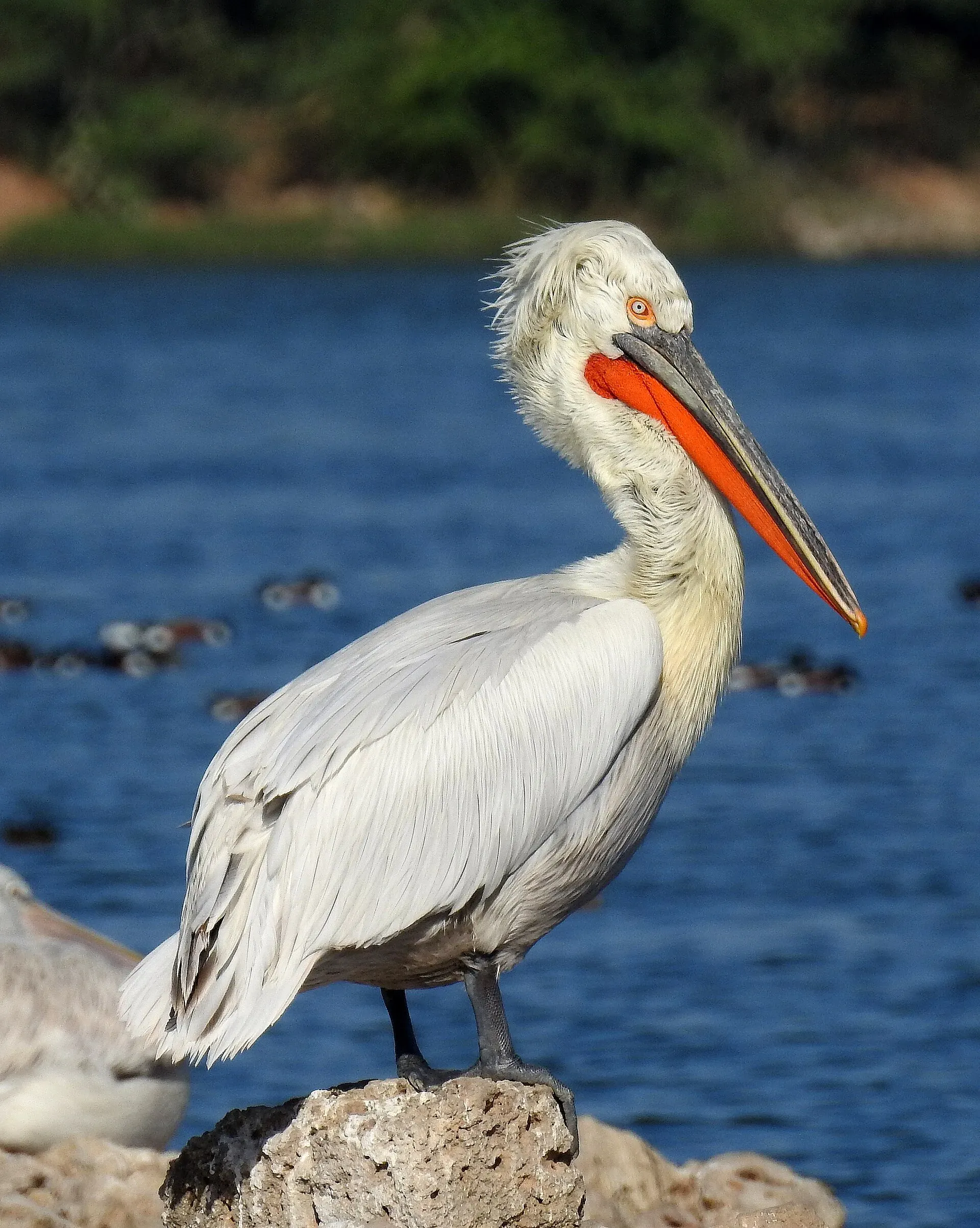
Photo: Dr. Raju Kasambe, with thanks · CC BY-SA 4.0 · via Wikimedia Commons · temporary stand-in photo

Dalmatian Pelican
The world's largest pelican, with a shaggy crest and grey legs. It is a Near Threatened winter visitor to wetlands on the Indus plain.
Identification
The Dalmatian pelican is the largest pelican, 1.6 to 1.8 m long with a wingspan of usually 2.7 to 3.2 m. It has a shaggy crest of curly feathers on the back of the head, and grey legs. The great white pelican has a smooth head and pinkish legs. In the breeding season the pouch turns orange-red, and in winter the plumage is duller and can look like a great white's. In flight, the wings look grey above, with black tips.
Status
IUCN Red List: Near Threatened (BirdLife International, 2018). It is listed on CITES Appendix I.
Where and when to see it in Pakistan
It is a winter visitor. A 2022 Express Tribune report says migratory waterbirds, including pelicans, stay in Sindh for about four months, December to March, at places such as Keenjhar Lake, Haleji Lake and the coast near Karachi and Badin. We have not found exact arrival and departure dates for this species. BirdLife has linked it to the Outer Indus Delta, and the Ramsar listing for Haleji Lake names it among its waterbirds, but we have no current counts. Ask the Sindh Wildlife Department before you go.
Behaviour
It is less social than other pelicans and often fishes alone or in pairs. It cannot dive deep, so it fishes in shallow water. Sometimes it forms a semicircle with others to drive fish to shore.
Threats and conservation
Worldwide, drainage of wetlands is the main driver of decline, followed by shooting, power-line collisions and disturbance. In Pakistan, hunting and disturbance have been reported to reduce wintering numbers. In June 2026 the Express Tribune reported that the Sindh Wildlife Department released four pelicans at Haleji Lake Wildlife Sanctuary after seizing them from a truck travelling from Dadu to Karachi. The report does not name the species. Never buy a pelican or take part in capture.
Birding etiquette
- Use binoculars or a telescope and keep your distance. Never use recorded calls to draw a bird in, and do not use flash.
- Stay away from nests and roosts, and keep dogs out of wetlands.
- Do not use drones near birds.
- Never buy a captive or trapped wild bird, or take part in trapping.
- Hire a licensed local guide where you can, and ask the local wildlife department about access and timing.
Sources and last checked
Last checked Confidence medium7 sources3 still to check
- Last checked
- Method
- Desk research from published sources
- Confidence
- medium
- Checked by
- trek.pk research team
Researched from published sources; not yet checked on the ground by our team. Spot something out of date? Report a mistake.
Sources
- Dalmatian pelican · Wikipedia · checked
- Dalmatian Pelican – BirdLife DataZone factsheet · BirdLife International · checked
- Outer Indus Delta (IBA, Pakistan) · BirdLife International · checked
- Haleji Lake Ramsar Information Sheet · Ramsar Sites Information Service · checked
- Migratory birds flock to Sindh · The Express Tribune · checked
- Four pelicans released at Haleji Lake · The Express Tribune · checked
- Pelecanus crispus (IUCN Red List category) · GBIF, IUCN Red List checklist · checked
Still to be checked on the ground (3)
- Current wintering numbers in Sindh (BirdLife and Ramsar pages would not load)
- Exact arrival and departure months for Dalmatian pelican in Sindh
- Species of the four pelicans released at Haleji in June 2026 (the report does not say)