

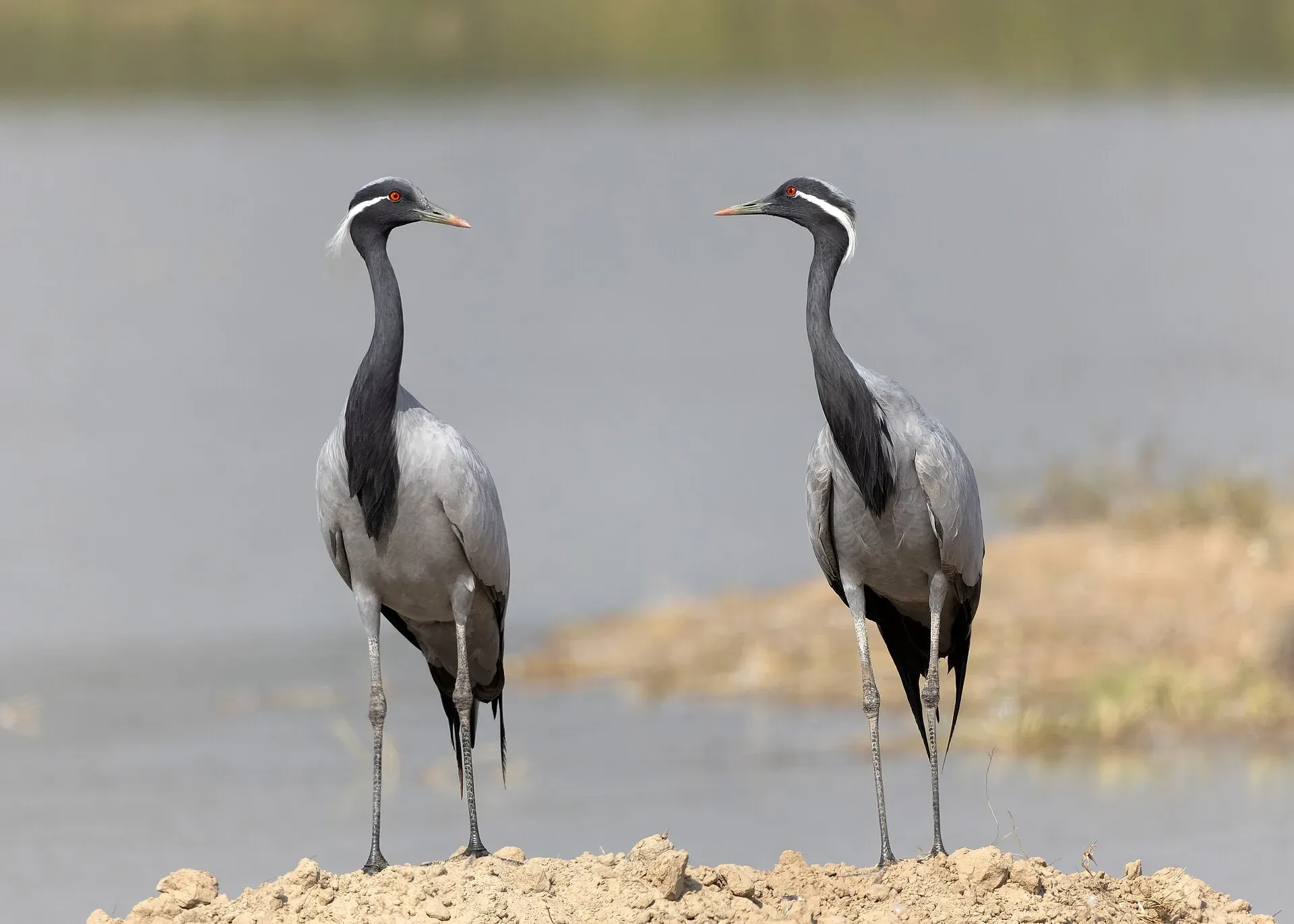
Photo: Tisha Mukherjee, with thanks · CC BY-SA 4.0 · via Wikimedia Commons · temporary stand-in photo

Demoiselle Crane
The smallest crane, grey with black neck plumes and white ear tufts. Huge flocks pass through Balochistan on the Indus Flyway each autumn and spring, but hunting is a serious problem.
Identification
The demoiselle crane is the smallest of the cranes, 85 to 100 cm long, with a wingspan of 155 to 180 cm and a weight of 2 to 3 kg. It looks like a slim, elegant common crane. It is grey, with a black head and neck, a white stripe running back from the eye, and a long black plume of neck feathers that hangs over the chest. The call is loud and trumpet-like, and higher than the common crane's.
Status
IUCN Red List: Least Concern (BirdLife International, 2018). Some Pakistani news reports describe it as endangered, which reflects local pressure and not the global rating.
Where and when to see it in Pakistan
Demoiselle cranes breed across central Eurasia. Eastern populations winter in the western Indian subcontinent, and Pakistan is on their route through the Indus Flyway. Passage is in autumn and spring: birds leave Siberia in September or October and are back on their breeding grounds by the end of April. In Pakistan the main passage is through Balochistan: researchers list Quetta, Zhob, Loralai, Noshki, Chagai, Kharan and Lasbela as corridors, and a Zhob study counted 4,710 demoiselle cranes in autumn 2010 and 35,688 in spring 2011. Zhob is the best known stopover. Ask the district administration or local police about current conditions before you go. For foreign visitors: the UK FCDO advises against all travel to Balochistan, including Quetta (page updated 27 October 2026, checked 17 November 2026), so treat the Zhob stopover as a conservation story, not a trip plan.
Behaviour
Cranes roost at night in shallow water and feed by day on farmland. They travel in noisy skeins at great height,.
Threats and conservation
Hunting is the main pressure. Trappers use tamed decoy cranes and weighted lines thrown into flocks, and a local estimate quoted in Dawn is at least 2,000 to 5,000 cranes captured each season along the Zhob river. All cranes are protected under the Balochistan Wildlife Act 2014, but enforcement is hard. Dawn reports that no dedicated funding exists for crane protection at district or provincial level.
Birding etiquette
- Use binoculars or a telescope and keep your distance. Never use recorded calls to draw a bird in, and do not use flash.
- Stay away from nests and roosts, and keep dogs out of wetlands.
- Do not use drones near birds.
- Never buy a captive or trapped wild bird, or take part in trapping.
- Hire a licensed local guide where you can, and ask the local wildlife department about access and timing.
Sources and last checked
Last checked Confidence medium7 sources2 still to check
- Last checked
- Method
- Desk research from published sources
- Confidence
- medium
- Checked by
- trek.pk research team
Researched from published sources; not yet checked on the ground by our team. Spot something out of date? Report a mistake.
Sources
- Demoiselle crane · Wikipedia · checked
- Demoiselle Crane – BirdLife DataZone factsheet · BirdLife International · checked
- Ecology: Balochistan's Siberian secret · Dawn · checked
- Population assessment of migratory cranes at district Zhob, Balochistan · Researchers Links · checked
- Crane migration through Baluchistan, Pakistan: a preliminary report · Journal article via BioStor · checked
- Pakistan travel advice · UK FCDO · checked
- Anthropoides virgo (IUCN Red List category) · GBIF, IUCN Red List checklist · checked
Still to be checked on the ground (2)
- Zhob counts (4,710 in autumn 2010 and 35,688 in spring 2011) come from a journal abstract; confirm in the full paper
- Passage months: Dawn gives departure from Siberia in September or October and return by the end of April; exact dates in Balochistan are not published