

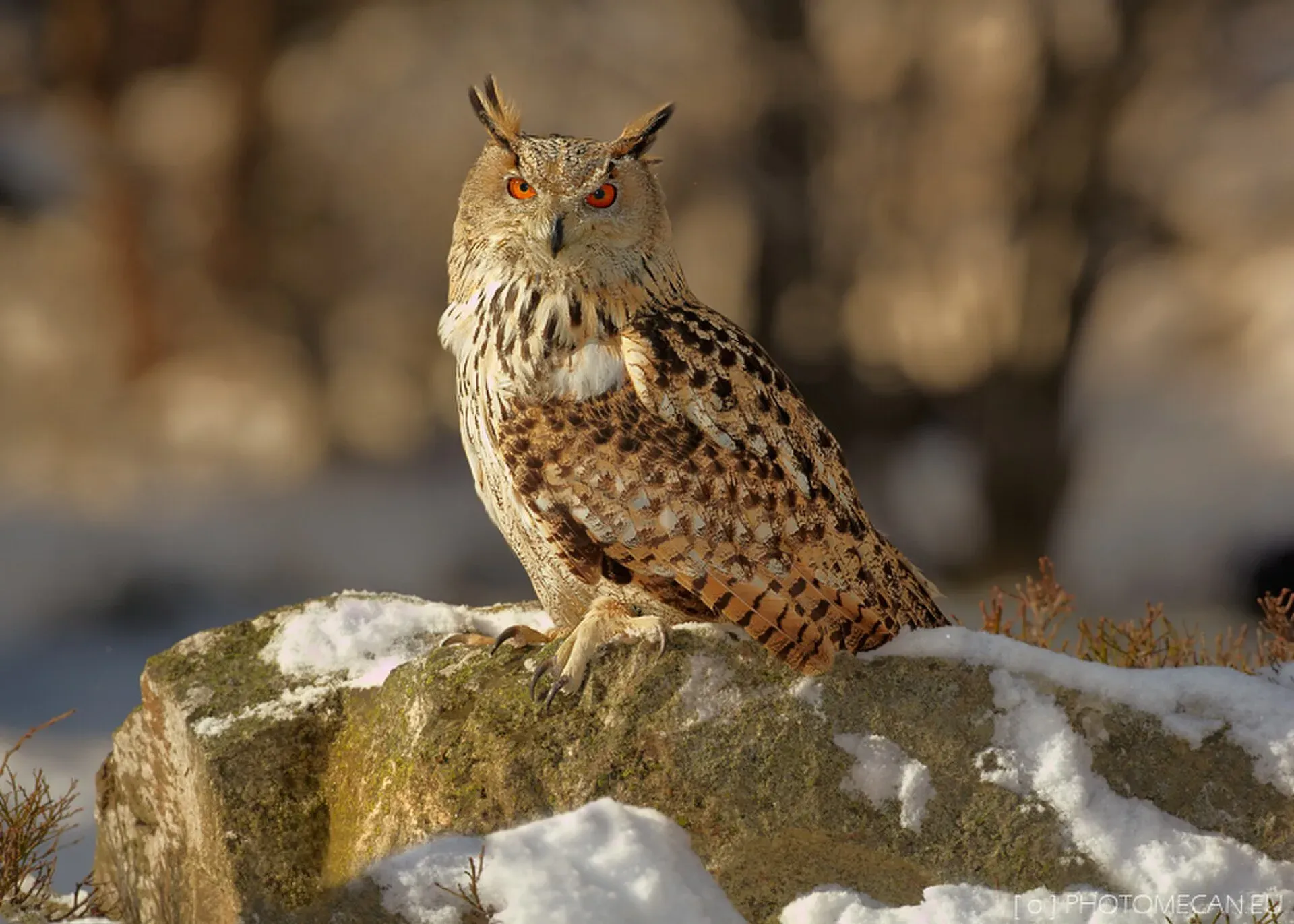
Photo: Martin Mecnarowski, with thanks · CC BY-SA 3.0 · via Wikimedia Commons · temporary stand-in photo

Eurasian Eagle-Owl
One of the largest owls in the world, with orange eyes and long ear tufts. In Pakistan the pale Himalayan form lives in rocky mountains, and it is rarely seen.
Identification
The Eurasian eagle-owl is one of the largest owls. Females reach about 75 cm in length, with a wingspan of up to 188 cm, and males are slightly smaller. It has a bulky body, erect ear tufts and bright orange eyes. The upperparts are mottled tawny and dark brown. In northern Pakistan the Himalayan subspecies, hemachalana, is paler than European birds. The call is a deep, booming hoot.
Status
IUCN Red List: Least Concern (BirdLife International, 2017). It is also listed in CITES Appendix II.
Where and when in Pakistan
The Himalayan form ranges from Pakistan through Kashmir and Ladakh, and reaches 4,500 m in the Himalaya. It is described in northern Pakistan and northern Balochistan. A June 1994 survey in Sai valley, just south of Gilgit, found villagers saying the owl was uncommon. A roost there was on a cliff at about 2,450 m, and local people dislike owls. A 1985 count at Zangi Nawar lake in the Chagai desert gave 25 to 30 birds. Look at rocky cliffs, gorges and ruins, at dawn and dusk, especially in Gilgit-Baltistan. The Himalayan form is partly migratory in some places and may move to lower ground in cold winters. In European studies calling peaks from late autumn to winter; we have no Himalayan call dates.
Behaviour
It is mostly nocturnal and strongly territorial. It hunts small mammals such as rodents and rabbits, but also birds and larger prey, as well as reptiles and insects. A note on its diet in northern Pakistan exists in the Biodiversity Heritage Library. Nests are usually on cliff ledges or in rock crevices, and the female does the brooding.
Threats and conservation
Elsewhere, the main causes of death are electrocution on power lines and persecution. Dawn reports that habitat loss, poaching and urbanisation are pushing many Pakistani owls toward decline. The 1994 survey team also warned that logging and overgrazing in Sai and neighbouring valleys would affect the owl and its prey.
Birding etiquette
- Use binoculars or a telescope and keep your distance. Never use recorded calls to draw a bird in, and do not use flash.
- Stay away from nests and roosts, and keep dogs out of wetlands and nesting areas.
- Do not use drones near birds.
- Never buy a captive or trapped wild bird, or take part in trapping.
- Hire a licensed local guide where you can, and ask the local wildlife department about access and timing.
- Never disturb a nest or roost, and never share the exact location of an eagle-owl.
Sources and last checked
Last checked Confidence medium5 sources5 still to check
- Last checked
- Method
- Desk research from published sources
- Confidence
- medium
- Checked by
- trek.pk research team
Researched from published sources; not yet checked on the ground by our team. Spot something out of date? Report a mistake.
Sources
- Eurasian eagle-owl · Wikipedia · checked
- Pakistan's vanishing owls: habitat loss, poaching, urbanisation push species toward decline · Dawn · checked
- A note on the food habits of Eurasian eagle owl Bubo bubo in northern Pakistan · Biodiversity Heritage Library · checked
- Eagle-owl records from Sai valley, northern Pakistan (Zahler and Dietemann, Forktail) · Forktail via Pakistan birding archive · checked
- Bubo bubo (IUCN Red List category) · GBIF, IUCN Red List checklist · checked
Still to be checked on the ground (5)
- Current Gilgit-Baltistan sites are not confirmed by an official source (and we do not publish exact sites)
- No population estimate for Pakistan exists in the sources we could read; Dawn (2025) says comprehensive owl population data for Pakistan is lacking
- The subspecies name is spelled hemachalana, hemalachana and hemalachanus in different sources
- Calling and breeding months in the Himalaya are not documented; the months shown follow European patterns
- IUCN year (2017) is taken from the citation on Wikipedia, not confirmed on the IUCN Red List page