

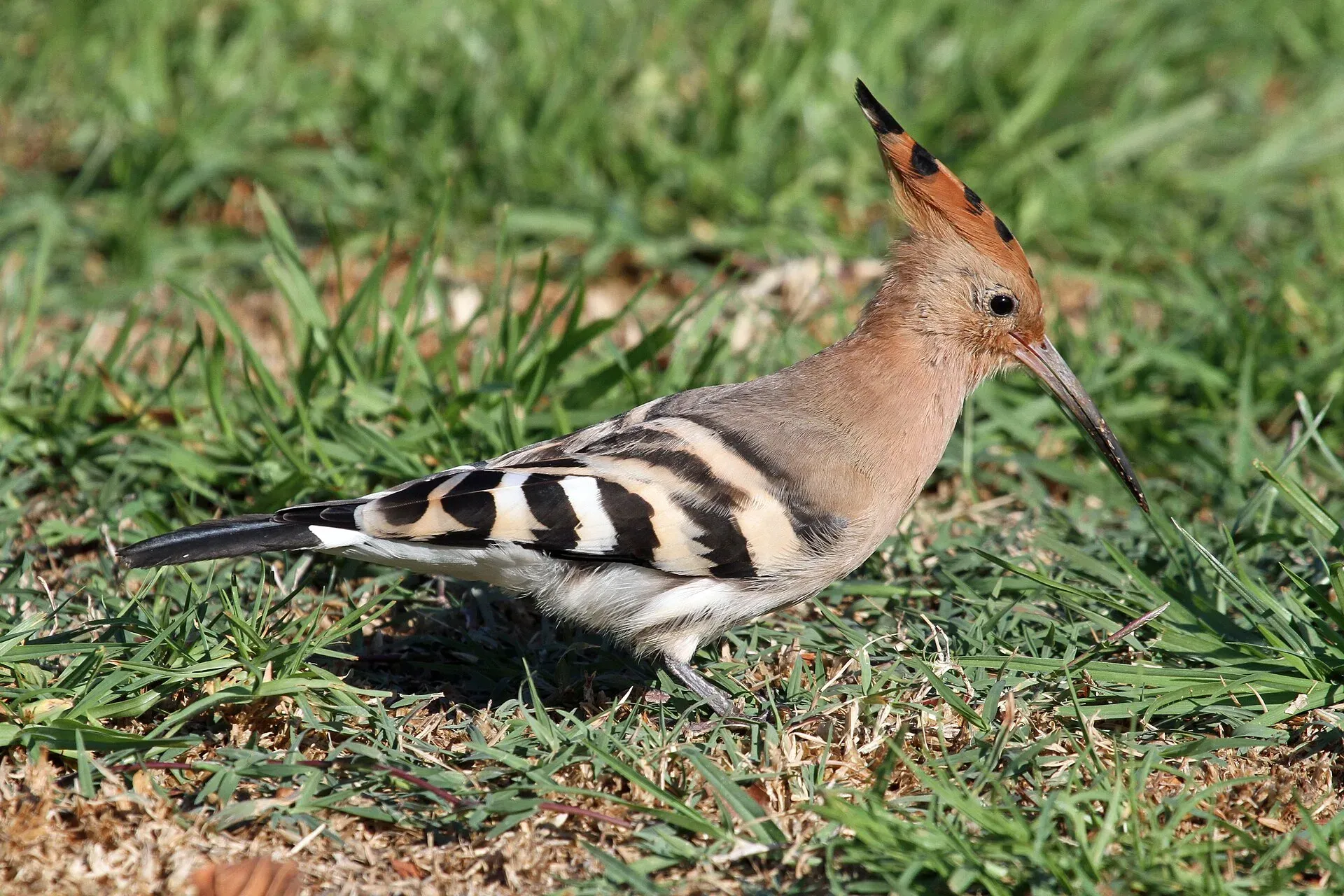
Photo: Greg Schechter, with thanks · CC BY 2.0 · via Wikimedia Commons · temporary stand-in photo

Eurasian Hoopoe
A cinnamon bird with a tall crest, black-and-white wings and a long curved bill. It is known in Urdu as hudhud and appears across Pakistan, with seasons that vary by region.
Identification
The Eurasian hoopoe is 25 to 32 cm long, with a wingspan of 44 to 48 cm. It is cinnamon-pink, with black-and-white striped wings, a broad white band across a black tail, a long, narrow, down-curved bill and a tall crest that it raises and lowers. The call is a soft "oop-oop-oop".
Status
IUCN Red List: Least Concern, listed as common hoopoe (BirdLife International 2020 assessment). The global population has been declining since 2008.
Where and when to see it in Pakistan
A 2013 Dawn feature on the hoopoe (hudhud) describes its pattern by region: a resident in the Punjab plains, seen in autumn and winter in Sindh, a summer bird in Balochistan and a summer visitor only in the northern areas. Many birds in Sindh are passing through. Look on lawns, parks, fields and forest edges. The Gilgit-Baltistan species list records it as resident, summer breeder, winter visitor and passage migrant, so sources differ and the pattern is not simple.
Behaviour
It probes soil and lawns for insects, usually alone. It nests in holes in trees and buildings from early to mid-spring, laying several eggs (about seven in the subtropics, more in cooler regions, according to Wikipedia). The female incubates for 15 to 18 days while the male feeds her. In the Quran the hudhud appears in the story of Sulaiman (Surah An-Naml).
Threats and conservation
Habitat loss and over-hunting are named as causes of decline. Lawns and fields without pesticide help.
Birding etiquette
- Use binoculars or a telescope and keep your distance. Never play recorded calls to draw a bird in, and do not use flash.
- Stay away from nests and roosts, and keep dogs out of wetlands and nesting areas.
- Do not use drones near birds.
- Never buy a captive or trapped wild bird, or take part in trapping or hunting.
- Hire a licensed local guide where you can, and ask the local wildlife department about access and timing.
Sources and last checked
Last checked Confidence medium3 sources
- Last checked
- Method
- Desk research from published sources
- Confidence
- medium
- Checked by
- trek.pk research team
Researched from published sources; not yet checked on the ground by our team. Spot something out of date? Report a mistake.
Sources
- Eurasian hoopoe · Wikipedia · checked
- Wildlife: Whooping it up (Zahrah Nasir, 9 August 2013) · Dawn · checked
- Upupa epops (IUCN Red List category) · GBIF, IUCN Red List checklist · checked