

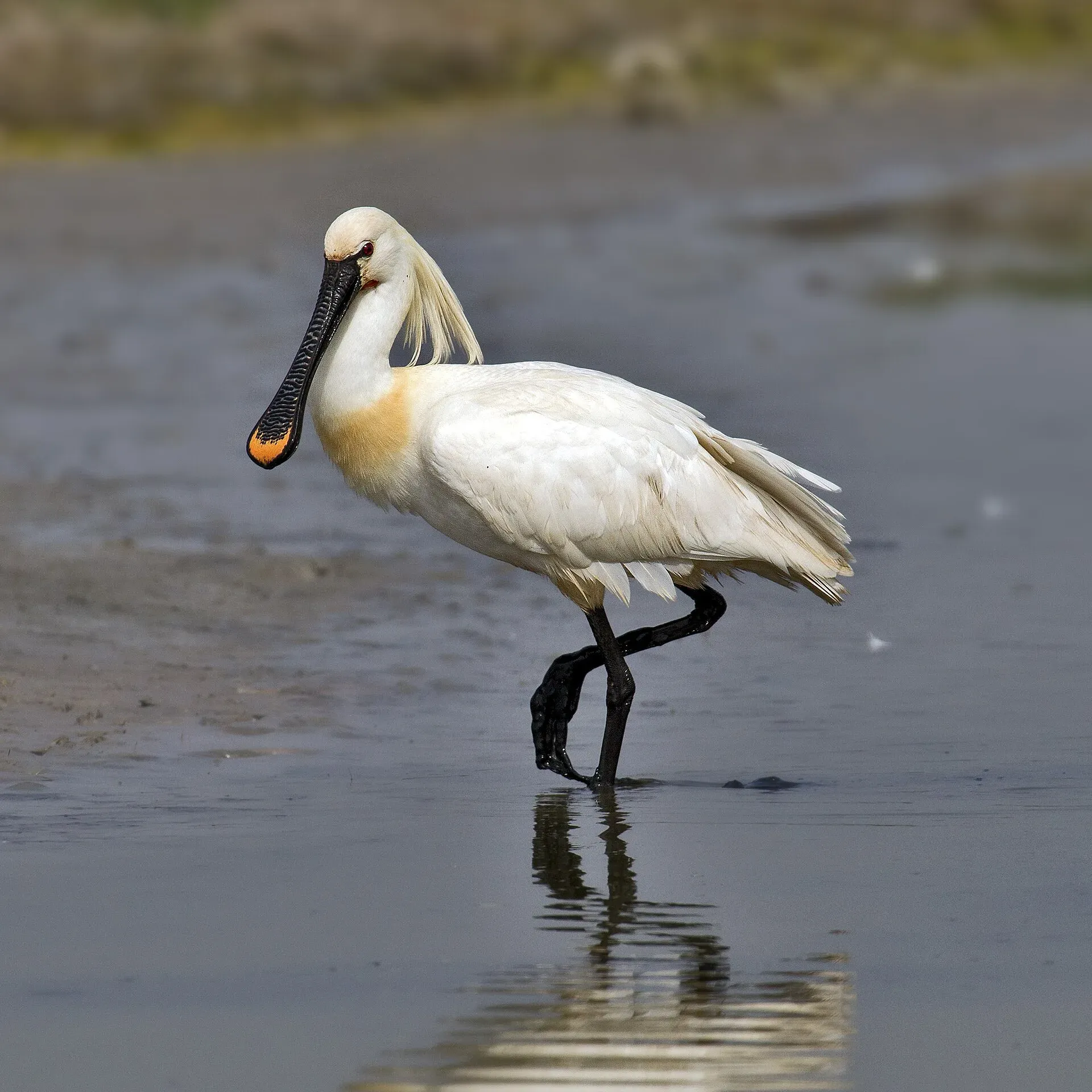
Photo: Andreas Trepte, with thanks · CC BY-SA 2.5 · via Wikimedia Commons · temporary stand-in photo

Eurasian Spoonbill
A white wading bird with a long, flat, spoon-tipped black bill. Some breed in southern Pakistan, and others winter on the Indus plains and coast.
Identification
The Eurasian spoonbill is a large white wader. Breeding adults have black legs, a black bill with a yellow tip, a yellow patch on the breast and a crest on the nape. Non-breeding birds lack the crest and breast patch. Young birds have a pale bill and black tips on the primaries. In flight it keeps the neck stretched out, unlike herons. The African spoonbill, which can overlap in winter, has red legs and a red face.
Status
IUCN Red List: Least Concern (BirdLife International, 2019).
Where and when to see it in Pakistan
The species breeds in southern Pakistan as well as India and Sri Lanka. Birds in warmer parts of Asia are resident or move only locally, while northern breeders migrate south, so winter numbers rise in the cooler months. Look at shallow, sheltered wetlands: the species uses marshes, lakes, rivers, lagoons, estuaries and mangroves. Sindh's large wetlands, such as Haleji Lake and Keenjhar Lake, are the places to try, but precise breeding sites are not documented here, so ask local staff.
Behaviour
The spoonbill sweeps its bill from side to side in shallow water and filters out insects, snails, small fish, frogs and tadpoles. It is mostly silent, and feeds mainly in the morning and evening. It roosts communally and sometimes flies up to 15 km from feeding areas.
Threats and conservation
The main threats are drainage and pollution of wetlands, especially loss of reed swamps, and disturbance at colonies. Egg and chick collecting has happened in the past. Colonies should be left alone.
Birding etiquette
- Use binoculars or a telescope and keep your distance. Never use recorded calls to draw a bird in, and do not use flash.
- Stay away from nests and roosts, and keep dogs out of wetlands.
- Do not use drones near birds.
- Never buy a captive or trapped wild bird, or take part in trapping.
- Hire a licensed local guide where you can, and ask the local wildlife department about access and timing.
Sources and last checked
Last checked Confidence medium4 sources4 still to check
- Last checked
- Method
- Desk research from published sources
- Confidence
- medium
- Checked by
- trek.pk research team
Researched from published sources; not yet checked on the ground by our team. Spot something out of date? Report a mistake.
Sources
- Eurasian spoonbill · Wikipedia · checked
- Eurasian Spoonbill – BirdLife DataZone factsheet · BirdLife International · checked
- Sindh Wildlife Department reports nearly 15% drop in migratory birds amid drying wetlands · Arab News · checked
- Platalea leucorodia (IUCN Red List category) · GBIF, IUCN Red List checklist · checked
Still to be checked on the ground (4)
- Breeding sites in Pakistan (Wikipedia says only 'southern Pakistan')
- Wintering numbers on Sindh wetlands (no figures found)
- Hero photo not from Pakistan
- IUCN Least Concern, BirdLife 2019, confirmed on Wikipedia