

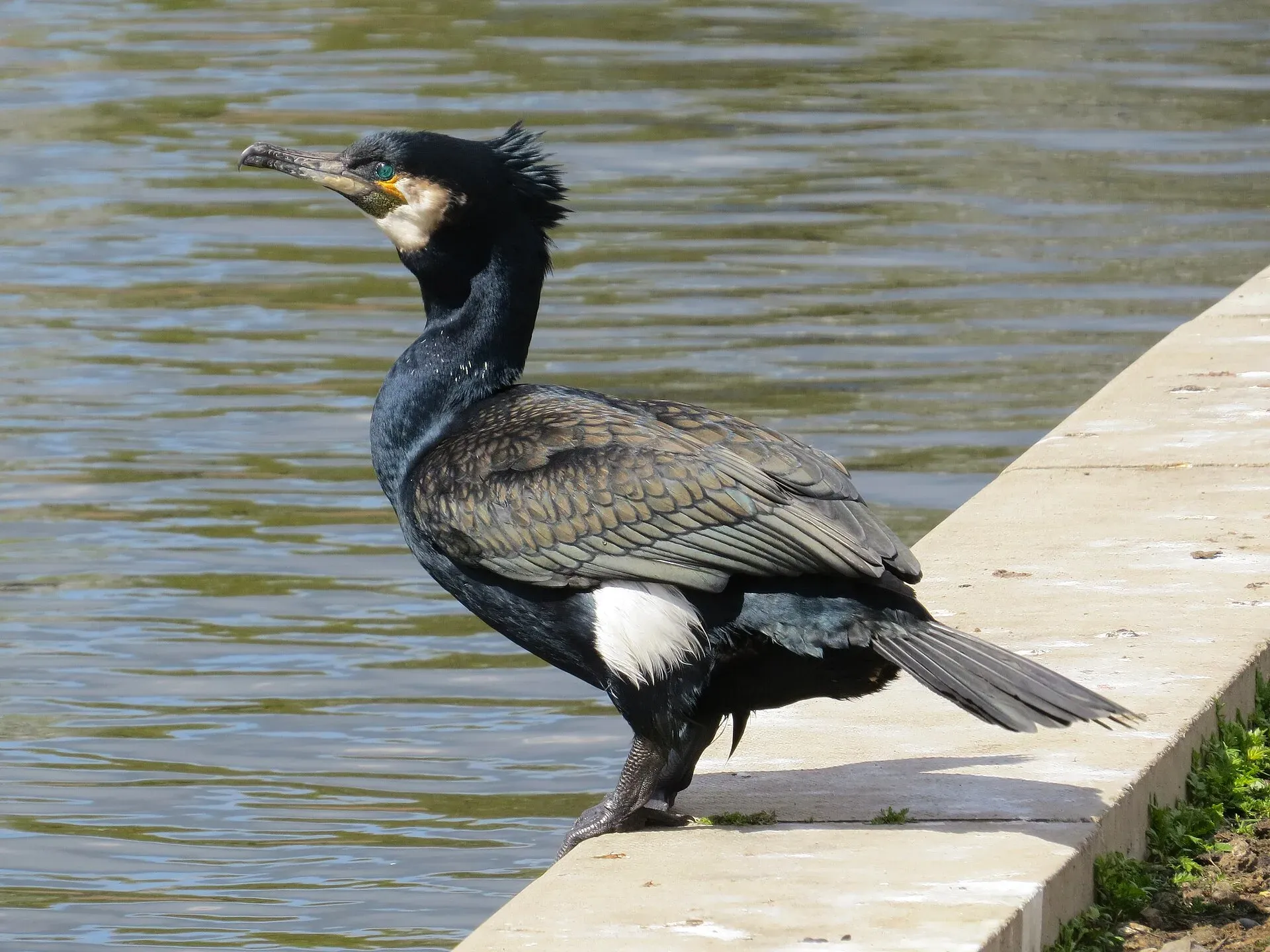
Photo: MPF, with thanks · CC BY-SA 4.0 · via Wikimedia Commons · temporary stand-in photo

Great Cormorant
A big, black, hook-billed diving bird that perches with wings held out to dry. In Pakistan it is seen on lakes, reservoirs, rivers and the coast, mainly in winter.
Identification
The great cormorant is a large, dark water bird. Weights vary widely across its range, from about 1.5 to 5.3 kg. It has a heavy hooked bill, a long neck and mostly black plumage with a bronze sheen. Breeding birds show white patches on the thigh and white filoplumes on the head. It often sits on posts, rocks and trees with its wings spread to dry. It swims low in the water and dives for fish.
Status
IUCN Red List: Least Concern (BirdLife International, 2018).
Where and when in Pakistan
The Asian form, sinensis, is the widespread continental subspecies. Status in Pakistan varies by site. A Gharo Creek (Thatta) survey recorded it as a winter visitor, while BirdLife's site factsheet lists it as a resident at Haleji Wildlife Sanctuary. Look from November to March at lakes, reservoirs, large rivers, creeks and the Sindh coast. Haleji, Keenjhar and the Indus are sensible places to start. The Zoological Survey of Pakistan runs a winter waterbird census at these wetlands.
Behaviour
It feeds by diving, foot-propelled, and catches fish in its bill. Dives last 1 to 3 minutes, to a maximum depth of about 9.5 m. It nests in colonies near wetlands, in trees or on cliffs, and pairs reuse nest sites. In other countries fishermen use cormorants to catch fish, and the same fish-eating habit leads to conflict with fishermen.
Threats and conservation
It was once hunted nearly to extinction in parts of Europe, but numbers recovered. In Pakistan, the main concerns are for its wetlands. Haleji Lake's inflow from the Indus began to fall in 2000 and stopped in 2018, according to a Tribune report, and a 2025 survey found shortages at Manchar, Keenjhar, Hamal and Haleji. Avian influenza has killed many cormorants in colonies elsewhere.
Birding etiquette
- Use binoculars or a telescope and keep your distance. Never use recorded calls to draw a bird in, and do not use flash.
- Stay away from nests and roosts, and keep dogs out of wetlands and nesting areas.
- Do not use drones near birds.
- Never buy a captive or trapped wild bird, or take part in trapping.
- Hire a licensed local guide where you can, and ask the local wildlife department about access and timing.
Sources and last checked
Last checked Confidence medium5 sources2 still to check
- Last checked
- Method
- Desk research from published sources
- Confidence
- medium
- Checked by
- trek.pk research team
Researched from published sources; not yet checked on the ground by our team. Spot something out of date? Report a mistake.
Sources
- Great cormorant · Wikipedia · checked
- Haleji Wildlife Sanctuary IBA, Pakistan · BirdLife International DataZone · checked
- Avian Diversity and its Associated Threats in Gharo Creek, District Thatta, Sindh, Pakistan · Researchers Links · checked
- Sindh's Haleji Lake faces ecological crisis · The Express Tribune · checked
- Phalacrocorax carbo (IUCN Red List category) · GBIF, IUCN Red List checklist · checked
Still to be checked on the ground (2)
- Resident versus winter-visitor status differs between sources (Gharo Creek survey: winter visitor; BirdLife Haleji factsheet: resident, but its table did not load on re-check)
- Counts per site not found