

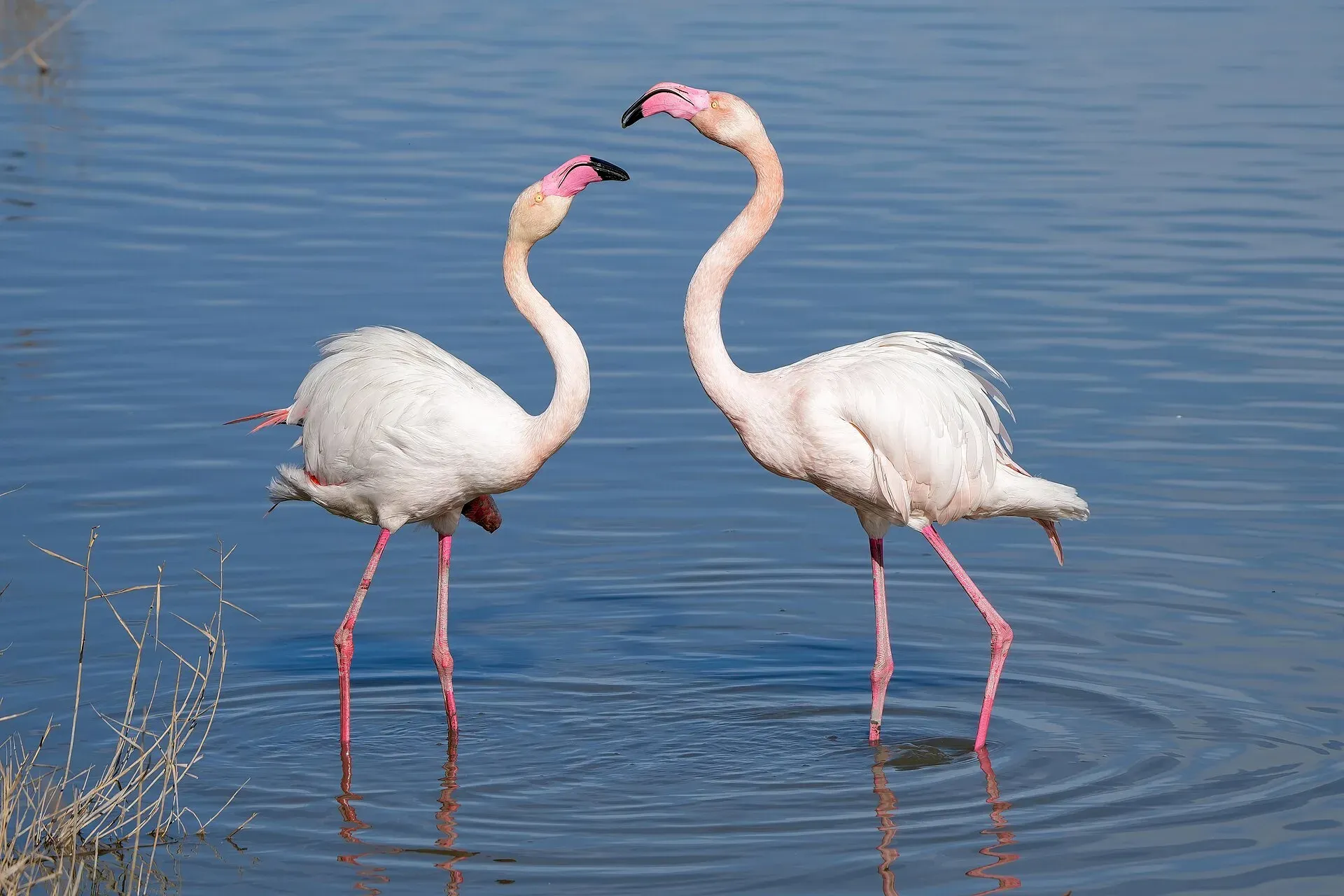
Photo: Giles Laurent, with thanks · CC BY-SA 4.0 · via Wikimedia Commons · temporary stand-in photo

Greater Flamingo
A tall, pale-pink flamingo with a pink bill that has a black tip. In Pakistan it is seen on coastal flats and lagoons, mainly in the cooler months.
Identification
The greater flamingo is the larger of the two flamingos found in Pakistan. It is 110 to 150 cm tall and weighs 2 to 4 kg. The plumage is pinkish white, with red wing coverts and black flight feathers that show in flight. The bill is pink with a black tip, and the legs are entirely pink. The call is a goose-like honk. Young birds are greyer and paler, with dark legs. The lesser flamingo is smaller, with a dark red bill.
Status
IUCN Red List: Least Concern (BirdLife International, 2018, amended 2019).
Where and when to see it in Pakistan
Greater flamingos are found on the coasts of Pakistan, India, Bangladesh and Sri Lanka. Look for them on mudflats and shallow, salty lagoons: the Karachi coast near Clifton has been described as an important wintering area for shorebirds and flamingos. In Sindh, the Sindh Wildlife Department counts waterbirds across about 30 major wetlands each winter. In 2024 to 2025 it counted 545,258 migratory waterbirds. Arab News reported that Nareri Lagoon in Badin held the most birds (155,068) and that the Rann of Kutch was among the worst hit by drought. Which Sindh sites hold greater flamingos in a given winter is not recorded. Keenjhar Lake, Haleji Lake, the Indus Delta and Jubho Lagoon are listed there as Sindh's Ramsar sites. The counts are winter counts, so ask the department about water levels and recent sightings before you go.
Behaviour
Flamingos feed with the head down, filtering shrimps, algae, small crustaceans and larvae from the mud. They breed in big colonies, laying a single egg on a mud mound. Chicks have grey down. A flamingo can live 30 to 40 years in the wild.
Threats and conservation
Pollution in water supplies, loss of shallow wetlands and disturbance are the main concerns. The Sindh Wildlife Department blames shrinking wetlands, shortage of water, low rain and climate change for the 14.68 per cent fall in the 2024 to 2025 count compared with the year before. Keep your distance, because a flock that takes flight burns energy it may need.
Birding etiquette
- Use binoculars or a telescope and keep your distance. Never use recorded calls to draw a bird in, and do not use flash.
- Stay away from nests and roosts, and keep dogs out of wetlands.
- Do not use drones near birds.
- Never buy a captive or trapped wild bird, or take part in trapping.
- Hire a licensed local guide where you can, and ask the local wildlife department about access and timing.
Sources and last checked
Last checked Confidence medium5 sources3 still to check
- Last checked
- Method
- Desk research from published sources
- Confidence
- medium
- Checked by
- trek.pk research team
Researched from published sources; not yet checked on the ground by our team. Spot something out of date? Report a mistake.
Sources
- Greater flamingo · Wikipedia · checked
- Greater Flamingo – BirdLife DataZone factsheet · BirdLife International · checked
- Sindh Wildlife Department reports nearly 15% drop in migratory birds amid drying wetlands · Arab News · checked
- Avifauna of coastal wetlands of Karachi · Berkut journal · checked
- Phoenicopterus roseus (IUCN Red List category) · GBIF, IUCN Red List checklist · checked
Still to be checked on the ground (3)
- Which Sindh sites hold greater (not lesser) flamingos in a given winter (the Arab News report names only lesser flamingo)
- Months of presence (the best-months field is not backed by a source we could open again)
- Hero photo not from Pakistan