

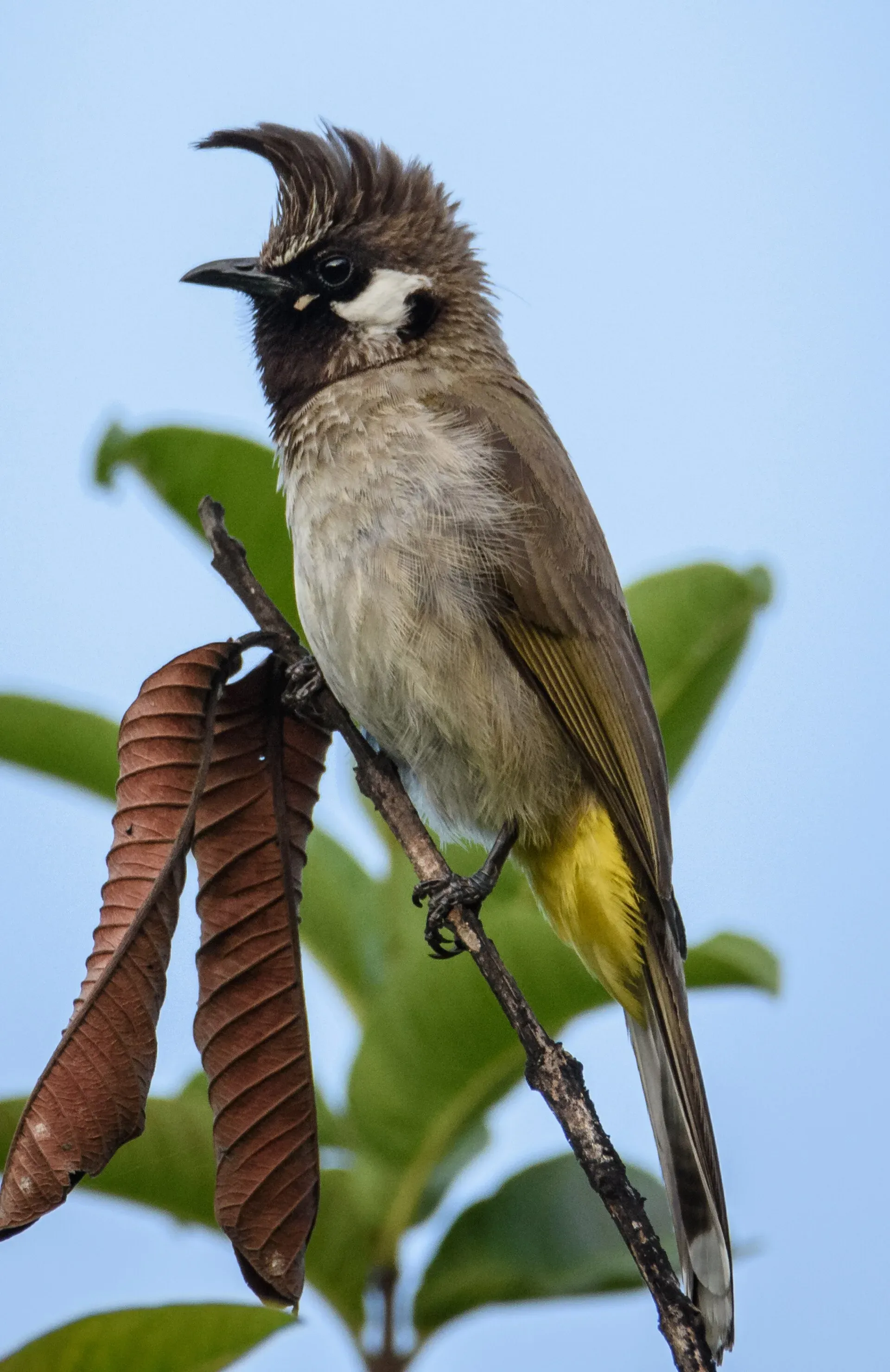
Photo: Shree Ram Khatri, with thanks · CC BY-SA 4.0 · via Wikimedia Commons · temporary stand-in photo

Himalayan Bulbul
A crested bulbul with a black head, white cheeks and a yellow patch under the tail. It is a resident of Pakistan's foothills, gardens and wooded valleys.
Identification
The Himalayan bulbul, also called the white-cheeked bulbul, is about 18 cm long. It has a black head and crest, white cheeks, a brown back and long brown tail and a pale yellow underside. Sexes look alike. The song is a four-part whistle, a little like an oriole's.
Status
IUCN Red List: Least Concern (BirdLife International, 2016).
Where and when to see it in Pakistan
Wikipedia gives its range as the northern Indian subcontinent, especially Kashmir and the Himalayan foothills, in forest, shrubland, gardens and parks. Look all year in foothill gardens, parks and scrub; there are no known site-by-site records, so ask local birders.
Behaviour
It eats insects, small invertebrates, berries, fruit, seeds, buds and nectar. The nest is a cup in a bush or on a low branch, with usually three eggs incubated for about 12 days. Chicks leave the nest at 9 to 11 days, and up to three broods are raised each year. Adults are very territorial in the breeding season.
Threats and conservation
No specific threats are named for the species. Trapping and loss of wooded habitat are possible risks in general, but there is no known Pakistan data.
Birding etiquette
- Use binoculars or a telescope and keep your distance. Never play recorded calls to draw a bird in, and do not use flash.
- Stay away from nests and roosts, and keep dogs out of wetlands and nesting areas.
- Do not use drones near birds.
- Never buy a captive or trapped wild bird, or take part in trapping or hunting.
- Hire a licensed local guide where you can, and ask the local wildlife department about access and timing.
Sources and last checked
Last checked Confidence medium3 sources2 still to check
- Last checked
- Method
- Desk research from published sources
- Confidence
- medium
- Checked by
- trek.pk research team
Researched from published sources; not yet checked on the ground by our team. Spot something out of date? Report a mistake.
Sources
- Himalayan bulbul · Wikipedia · checked
- Himalayan Bulbul Pycnonotus leucogenys - factsheet · BirdLife International · checked
- Pycnonotus leucogenys (IUCN Red List category) · GBIF, IUCN Red List checklist · checked
Still to be checked on the ground (2)
- No Pakistan site records found (ask local birders or check eBird)
- Breeding months in Pakistan are not given in any source we could open