

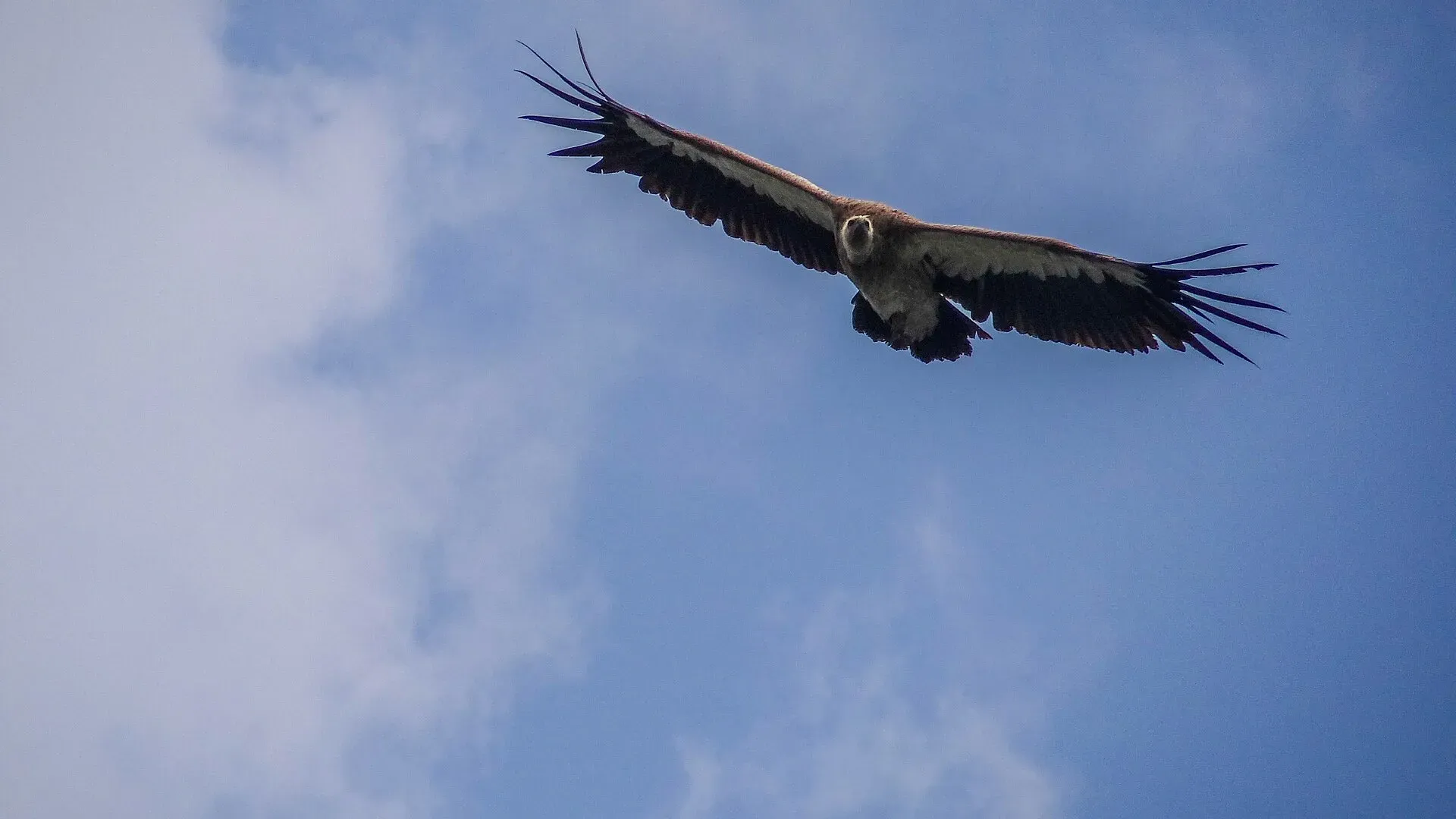
Photo: Rox-zee, with thanks · CC BY-SA 4.0 · via Wikimedia Commons · temporary stand-in photo

Himalayan Griffon
A huge pale vulture that glides over high mountain valleys. Chitral surveys found it nesting in cliffs, but food shortage and veterinary drugs threaten vultures.
Overview
The Himalayan griffon, or Himalayan vulture (Gyps himalayensis), is the second-largest Old World vulture and one of the heaviest birds in the Himalaya. Do not confuse it with the Eurasian griffon, a similar species.
Identification
- Size: 6 to 12.5 kg, with a wingspan variously measured between about 2.56 and 3.1 m.
- Plumage: pale buff body and covert feathers, contrasting with dark flight and tail feathers. Adults have a long, pale brown ruff with white streaks, yellowish bill and pale blue face skin.
- In flight: the long wing "fingers" are splayed, and there is a pale stripe along the underwing.
- Voice: a rattle when landing at a carcass, and grunts, hisses and cackles when feeding.
Where and when to see it in Pakistan
It lives mainly at 1,200 to 5,500 m. A study of Himalayan griffon colonies in Azad Jammu and Kashmir reported it from Chitral, Gilgit, Hunza, Baltistan and the Kaghan valley. In Chitral, four seasonal surveys of 12 valleys between December 2020 and December 2021, including Chitral Gol National Park, averaged about 36 griffons each season and found active nests in different valleys, showing a breeding population. Machiara National Park lists the Himalayan vulture. Look over cliffs and valley sides in the middle of the day, when the birds ride warm air.
Behaviour
They are social and found in flocks, often basking on rocks. They eat carrion, usually fleshy tissue rather than offal, and may follow livestock up the mountains. In a large party they can strip a carcass in about 30 minutes. They nest on cliff ledges, with the breeding season starting in January, and several pairs may share a cliff.
Threats and conservation
The IUCN lists the Himalayan griffon as Near Threatened (IUCN, 2017). The AJK study found food shortage a major factor in decline, and the Chitral survey reported little food because butchers put their waste in the River Chitral. It also found diclofenac sodium and other drugs on sale in veterinary shops. Diclofenac in livestock carcasses caused a collapse of other vulture species in South Asia. India has restricted its veterinary use, and press reports say Pakistan and Nepal have done the same.
Birding etiquette
Keep your distance and use binoculars. Never play recorded calls near nests, and do not use flash. Stay on paths, keep dogs away, and follow the instructions of park staff and local guides. Keep clear of cliff colonies, especially from January.
Sources and last checked
Last checked Confidence medium6 sources3 still to check
- Last checked
- Method
- Desk research from published sources
- Confidence
- medium
- Checked by
- trek.pk research team
Researched from published sources; not yet checked on the ground by our team. Spot something out of date? Report a mistake.
Sources
- Himalayan vulture · Wikipedia · checked
- Gyps himalayensis (assessment 2017) · IUCN Red List · checked
- Conservation of Threatened Vulture Species Through Research and Awareness Raising Programs in Chitral Pakistan (final report, 12 Feb 2022) · Rufford Foundation · checked
- Himalayan Griffon population in Azad Jammu and Kashmir · Pakistan Journal of Zoology · checked
- Diclofenac · Wikipedia · checked
- Gyps himalayensis (IUCN Red List category) · GBIF, IUCN Red List checklist · checked
Still to be checked on the ground (3)
- Current Pakistan population: no national estimate found; the 2020-21 Chitral survey averaged about 36 birds a season
- Whether the Chitral Gol colony still nests: the survey reports active nests in several valleys but does not name Chitral Gol
- Current Pakistani rules on veterinary diclofenac: only press reports found