

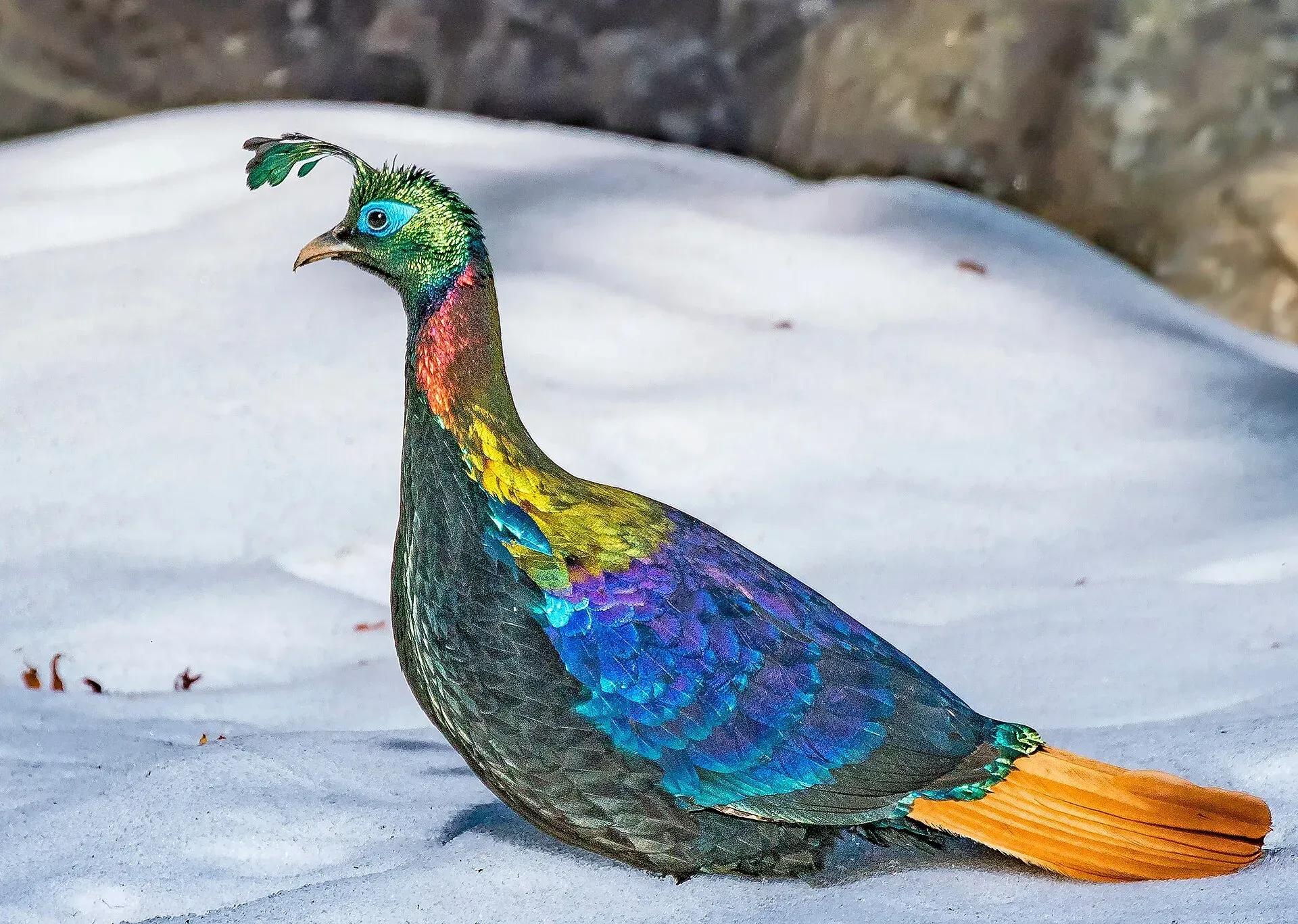
Photo: AJIT HOTA, with thanks · CC BY-SA 4.0 · via Wikimedia Commons · temporary stand-in photo

Himalayan Monal
The male Himalayan monal glows with a metallic green crest and a copper back. It lives in oak and conifer forest and alpine meadows in the northern mountains.
Overview
The Himalayan monal (Lophophorus impejanus), also called the Impeyan monal, is one of the most colourful pheasants in the world. In parts of northern Pakistan it is known as murgh zarin, "golden fowl".
Identification
- Size: a large landfowl, 61 to 76 cm long, weighing roughly 1.4 to 2.3 kg.
- Male: a long, metallic green crest, coppery feathers on the back and neck, and a bold white rump that shows in flight. The tail is rusty red.
- Female: much plainer, brown, with a white throat patch and a white stripe on the tail.
- Call: a published description is not yet included here, so ask local guides what to listen for.
Where and when to see it in Pakistan
The monal lives in upper temperate oak and conifer forest broken by grassy slopes, cliffs and alpine meadows, between about 2,400 and 4,500 m. It is most common at 2,700 to 3,700 m and moves down to about 2,000 m in winter. In Pakistan it has been recorded in Khyber Pakhtunkhwa, Kaghan, the Palas valley and Azad Kashmir, and trekking notes list monals among the birds of Chitral Gol National Park. Siran Valley and Ratti Gali Lake are also noted for monals in their forests. It is resident, but snow pushes it lower in winter, which can make it easier to spot at forest edges.
Behaviour
Monals feed on the ground, digging with the bill for tubers, nuts, shoots and insects. They can dig through snow to reach food. They are shy and often seen at dawn and dusk, or flying down a steep slope with a ringing call.
Threats and conservation
The IUCN lists the Himalayan monal as Least Concern (IUCN, 2016). Its main threat is hunting: the crest feathers are valuable and are worn as a mark of status. Studies in the western Himalaya found populations fell where hydroelectric projects brought disturbance. Wikipedia describes it as common in Khyber Pakhtunkhwa, but no recent national survey is cited.
Birding etiquette
Keep your distance and use binoculars. Never play recorded calls near nests, and do not use flash. Stay on paths, keep dogs away, and follow the instructions of park staff and local guides.
Sources and last checked
Last checked Confidence medium4 sources2 still to check
- Last checked
- Method
- Desk research from published sources
- Confidence
- medium
- Checked by
- trek.pk research team
Researched from published sources; not yet checked on the ground by our team. Spot something out of date? Report a mistake.
Sources
- Himalayan monal · Wikipedia · checked
- Lophophorus impejanus (assessment 2016) · IUCN Red List · checked
- Trekking in the Karakoram and Hindukush (fauna section; facts only) · Lonely Planet · checked
- Lophophorus impejanus (IUCN Red List category) · GBIF, IUCN Red List checklist · checked
Still to be checked on the ground (2)
- Call description (Wikipedia has none; needs a field-guide source)
- Current abundance in Pakistani valleys (Wikipedia: common in Khyber Pakhtunkhwa, up to five pairs per square mile in some areas; no recent survey)