

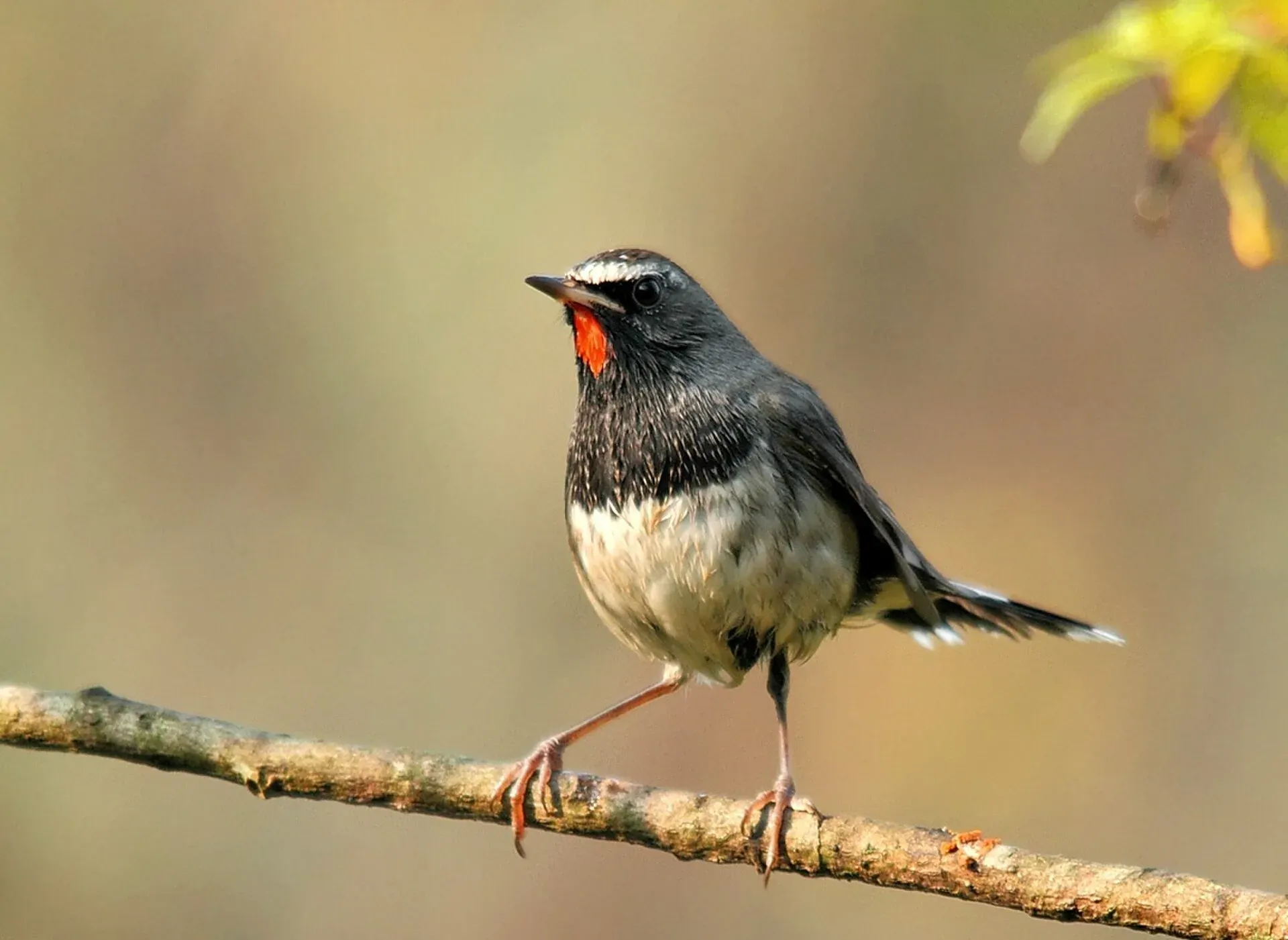
Photo: Rakeshkdogra, with thanks · CC BY-SA 3.0 · via Wikimedia Commons · temporary stand-in photo

Himalayan Rubythroat
A shy, small songbird of high shrubby slopes. The male has a scarlet throat, black breast and white tail corners. In Pakistan it is a summer bird of the northern mountains.
Identification
The male Himalayan rubythroat is slaty brown above, with a white forehead and white stripe over the eye. The centre of the throat is bright scarlet, framed by black on the sides of the throat and breast. The belly is white. The tail is blackish with white at the base and tips, and the white tail markings separate it from the Siberian rubythroat. The female is dull brownish grey with a whitish throat. It is a former "white-tailed rubythroat", and a 2016 study split off the Chinese rubythroat.
Status
IUCN Red List: Least Concern (BirdLife International, 2018).
Where and when in Pakistan
The nominate subspecies breeds in the Himalaya from northern Pakistan to central Nepal, and the Tien Shan form reaches north-east Afghanistan. It moves up the mountains in summer and down to lower, more southern ground in winter. In Pakistan, expect it in summer at higher altitudes, in open scrub and juniper edges (the juniper habitat is described for the Tien Shan form at 2,500 to 2,700 m). There is no confirmed list of its breeding sites in Pakistan on this page, so ask a local guide.
Behaviour
Adults are shy, though they sometimes sing from an open perch. They live alone or in pairs and eat mainly small insects such as beetles and ants. In the breeding season the male sings through the day from an exposed perch, a varied series of squeaky notes. The alarm call is a sharp, yapping skyap. The nest is a loose ball or cup in a shrub, sometimes on the ground in dense grass. The clutch is 4 to 6 eggs, and both parents feed the young.
Threats and conservation
It is not threatened globally. Nests are taken by martens and stoats, and cuckoos may parasitise them. In Pakistan, grazing and scrub cutting on high slopes could matter, but there is no local study to cite.
Birding etiquette
- Use binoculars or a telescope and keep your distance. Never use recorded calls to draw a bird in, and do not use flash.
- Stay away from nests and roosts, and keep dogs out of wetlands and nesting areas.
- Do not use drones near birds.
- Never buy a captive or trapped wild bird, or take part in trapping.
- Hire a licensed local guide where you can, and ask the local wildlife department about access and timing.
Sources and last checked
Last checked Confidence medium4 sources4 still to check
- Last checked
- Method
- Desk research from published sources
- Confidence
- medium
- Checked by
- trek.pk research team
Researched from published sources; not yet checked on the ground by our team. Spot something out of date? Report a mistake.
Sources
- Himalayan rubythroat · Wikipedia · checked
- Himalayan Rubythroat (himrub1) · eBird, Cornell Lab of Ornithology · checked
- Himalayan Rubythroat Calliope pectoralis · BirdLife International DataZone · checked
- Calliope pectoralis (IUCN Red List category) · GBIF, IUCN Red List checklist · checked
Still to be checked on the ground (4)
- Pakistan breeding sites and altitude need eBird or local guide confirmation (eBird blocked by a bot check)
- Naltar summer record removed: it came from a photo record that could not be opened
- Nest and altitude details come from the Tien Shan form, not Pakistan
- Assessment year (2018) is taken from the IUCN citation on Wikipedia; the BirdLife page was not re-opened