

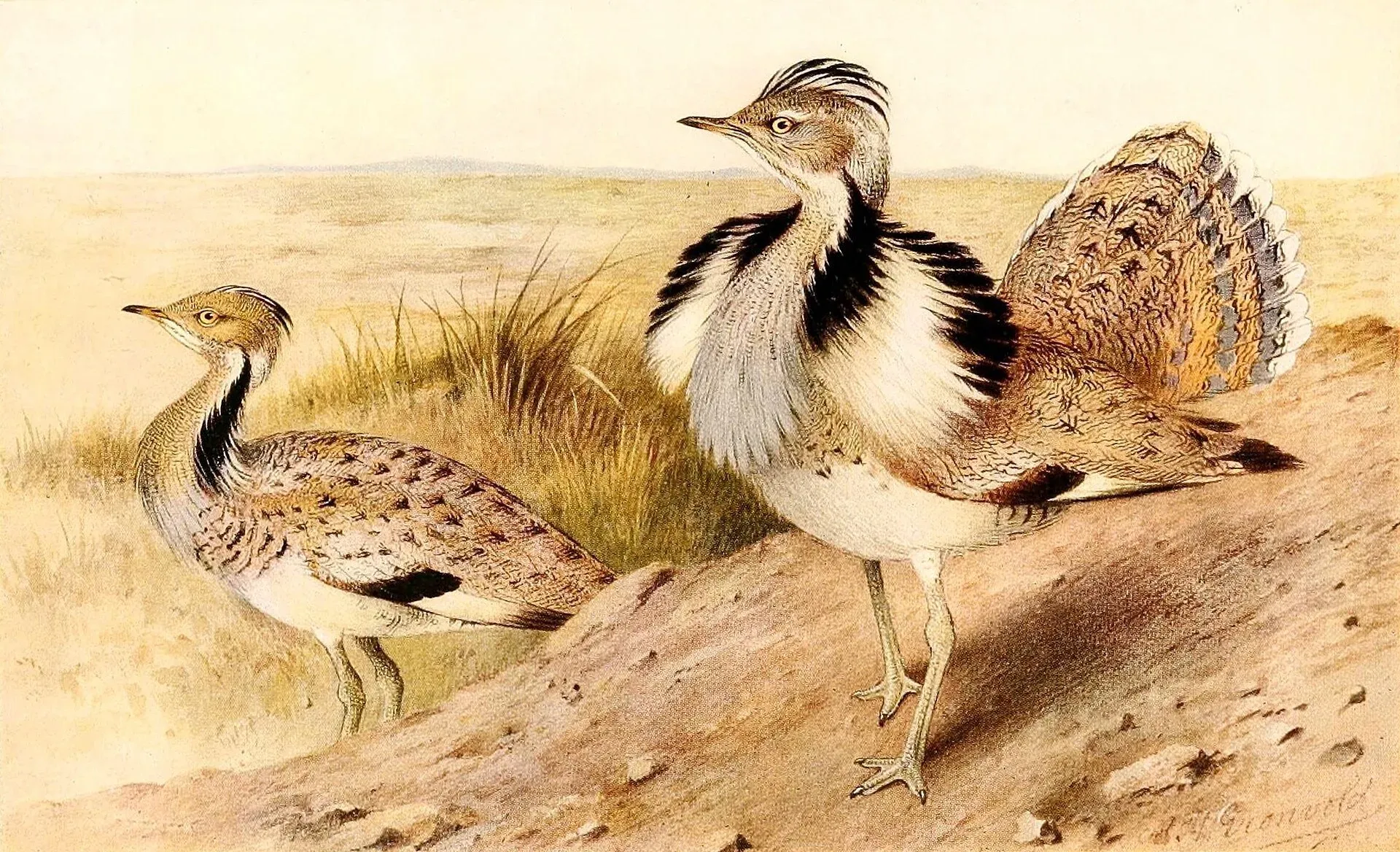
Photo: Henrik Grønvold, with thanks · Public domain (CC0) · via Wikimedia Commons · temporary stand-in photo

Houbara Bustard
The Asian houbara (MacQueen's bustard) is a pale desert bird that winters in Balochistan and other dry parts of Pakistan. It is Vulnerable, and hunting it is debated.
Overview
The Asian houbara (Chlamydotis macqueenii), also called MacQueen's bustard, is a large bustard of deserts and steppes. In Pakistan it is known as tiloor. It was long treated as a race of the African houbara and has been a separate species since 2003.
Identification
- Size: about 65 cm long, with a wingspan of around 140 cm.
- Plumage: brown above and white below, with black stripes down the sides of the neck. In flight the long wings show large areas of black and brown flight feathers and a white patch at the base of the primaries.
- Males and females look nearly alike; the female is smaller (males are 9 to 15 per cent larger on most measurements in a Pakistan study) and paler above. The displaying male shows a white crest and a black neck ruff.
- It walks and crouches in sparse scrub and relies on its camouflage.
Where and when to see it in Pakistan
Northern breeding birds winter further south, in Pakistan mainly in western Balochistan. They arrive from October to December and leave from mid to late March. Our pages on Hingol National Park and Rann of Kutch Wildlife Sanctuary list the houbara among their recorded birds, and Hazarganji-Chiltan National Park lists it as very rare. It is a very hard bird to see and sensitive to disturbance. Do not expect to find one without expert local help; winter is the only season to try.
Behaviour
It feeds on seeds, berries and insects and does not need to drink. The male displays on the ground, running with the neck feathers raised. The female alone nests and rears the chicks. When chased by a falcon, the bustard rises and spirals to avoid being struck.
Threats and conservation
The IUCN lists the Asian houbara as Vulnerable (IUCN, 2021). Hunting and loss of desert habitat to farming, roads and power lines are the main threats. Satellite tracking has followed birds from Mongolia to Afghanistan and Pakistan.
The hunting debate. Houbara hunting by falconers, including visitors from the Gulf, has been debated in Pakistan for years. In September 2015 the Supreme Court told governments to stop issuing houbara hunting licences. In January 2016 a five-judge bench lifted that ban on review petitions from the federal and provincial governments, who argued that regulated hunting helps conservation. One judge, Justice Qazi Faez Isa, dissented, and the court said the petitions would be heard again. We have not seen a later ruling. Supporters of regulated hunting point to permits and quotas, while Wikipedia notes that hunts for wealthy Arab visitors routinely exceed their quotas. Rules can change, so check the current position with the provincial wildlife department.
Birding etiquette
Keep your distance and use binoculars. Never play recorded calls near nests, and do not use flash. Stay on paths, keep dogs away, and follow the instructions of park staff and local guides. Never join or encourage illegal hunting.
Sources and last checked
Last checked Confidence medium5 sources2 still to check
- Last checked
- Method
- Desk research from published sources
- Confidence
- medium
- Checked by
- trek.pk research team
Researched from published sources; not yet checked on the ground by our team. Spot something out of date? Report a mistake.
Sources
- Asian houbara · Wikipedia · checked
- Chlamydotis macqueenii (assessment 2021) · IUCN Red List · checked
- Govt stopped from issuing hunting licences for houbara bustard (9 September 2015) · Dawn · checked
- SC lifts ban on houbara bustard hunting (22 January 2016) · The Express Tribune · checked
- Chlamydotis macqueenii (IUCN Red List category) · GBIF, IUCN Red List checklist · checked
Still to be checked on the ground (2)
- Current legal position on houbara hunting and any licences after the January 2016 ruling (no later source opened)
- Where in Pakistan the bird can currently be seen (Wikipedia: western Balochistan in winter)