

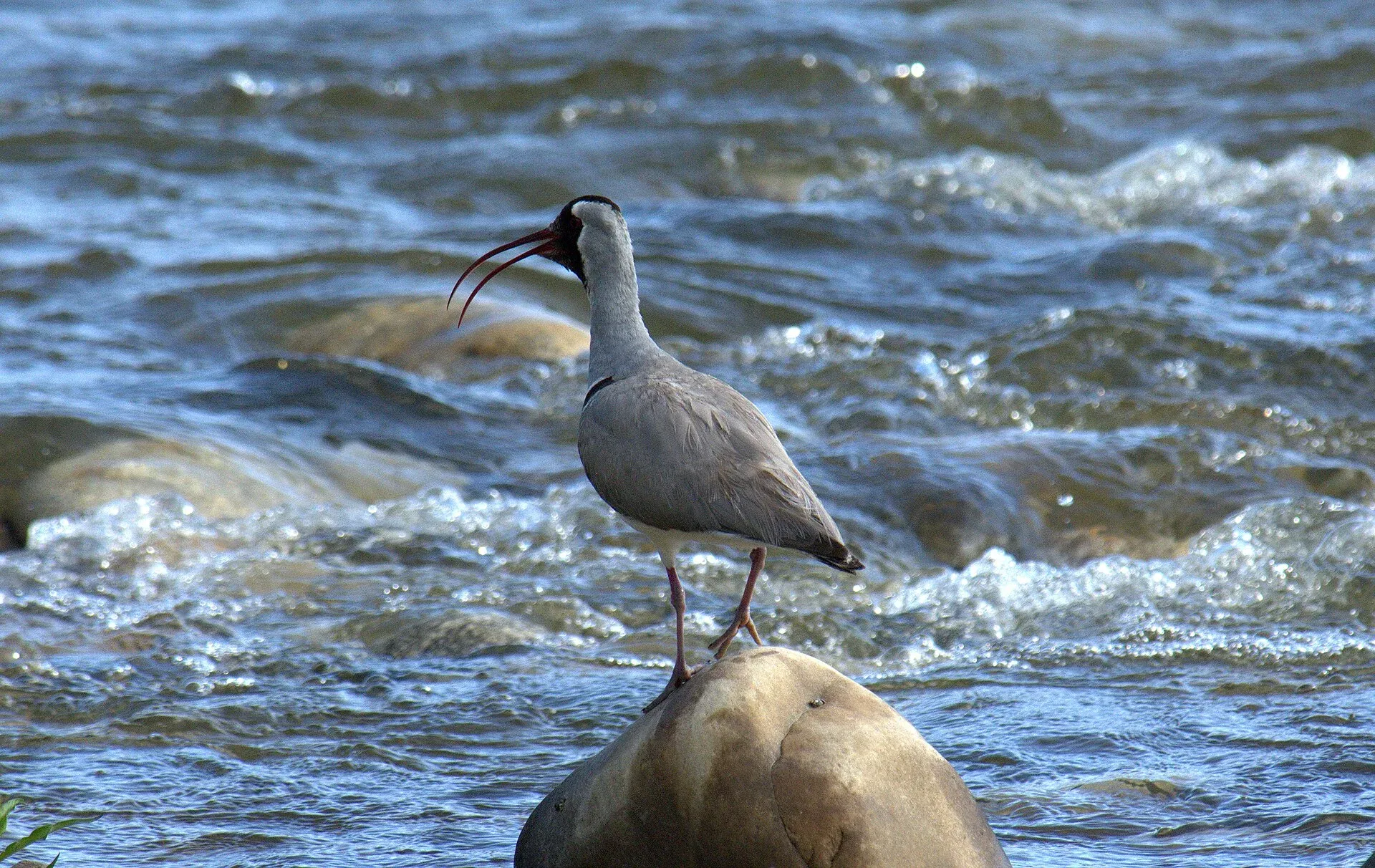
Photo: Dr. Raju Kasambe, with thanks · CC BY-SA 4.0 · via Wikimedia Commons · temporary stand-in photo

Ibisbill
A grey wader with a black face, a black breast band and a long, curved red bill, found on shingle-bed rivers of the Himalaya and neighbouring mountains.
Identification
The ibisbill is 38 to 41 cm long. It is grey above and white below, with a black face, a black band across the breast and a long, down-curved crimson bill. The legs are greyish purple. It is the only member of its family. The call is a ringing "klew-klew".
Status
IUCN Red List: Least Concern (BirdLife International, 2016).
Where and when to see it in Pakistan
The ibisbill breeds on shingle riverbeds with slow braided channels, mostly between 1,700 and 4,400 m, and drops to lower ground, down to about 100 m, outside the breeding season. In Pakistan that points to the clear rivers of the northern mountains in summer and to lower valleys in winter. Wikipedia's list of the birds of Pakistan includes it as a regular native species. We have no Pakistan site counts, so check recent eBird records before you go. A study on the Sindh river in Indian-administered Kashmir found birds moving to lower ground in autumn, when the largest group, 28 birds, was seen.
Behaviour
It feeds by probing under rocks and gravel for caddisfly and mayfly larvae and other small invertebrates. It is territorial and apparently monogamous, lays two to four eggs from late April to early May, and often crosses rivers by swimming. It is usually solitary in autumn and winter, though pairs and small flocks occur.
Threats and conservation
The range is not thought to be shrinking. The Kashmir study found sand and boulder mining and human presence were the main disturbances at its sites, and experts also point to dams that change river flow. These are not Pakistan-specific findings.
Birding etiquette
- Use binoculars or a telescope and keep your distance. Never play recorded calls to draw a bird in, and do not use flash.
- Stay away from nests and roosts, and keep dogs out of wetlands and nesting areas.
- Do not use drones near birds.
- Never buy a captive or trapped wild bird, or take part in trapping or hunting.
- Hire a licensed local guide where you can, and ask the local wildlife department about access and timing.
Sources and last checked
Last checked Confidence low4 sources3 still to check
- Last checked
- Method
- Desk research from published sources
- Confidence
- low
- Checked by
- trek.pk research team
Researched from published sources; not yet checked on the ground by our team. Spot something out of date? Report a mistake.
Sources
- Ibisbill · Wikipedia · checked
- Ibisbill: the poorly understood Himalayan waterbird faces threats, finds study · Mongabay India · checked
- List of birds of Pakistan · Wikipedia · checked
- Ibidorhyncha struthersii (IUCN Red List category) · GBIF, IUCN Red List checklist · checked
Still to be checked on the ground (3)
- Exact Pakistan sites and months are not documented in the sources we could read; check recent eBird records
- IUCN year (2016) is taken from the citation on Wikipedia, not confirmed on the IUCN Red List page
- Threats listed come from a study in Indian-administered Kashmir, not from Pakistan