

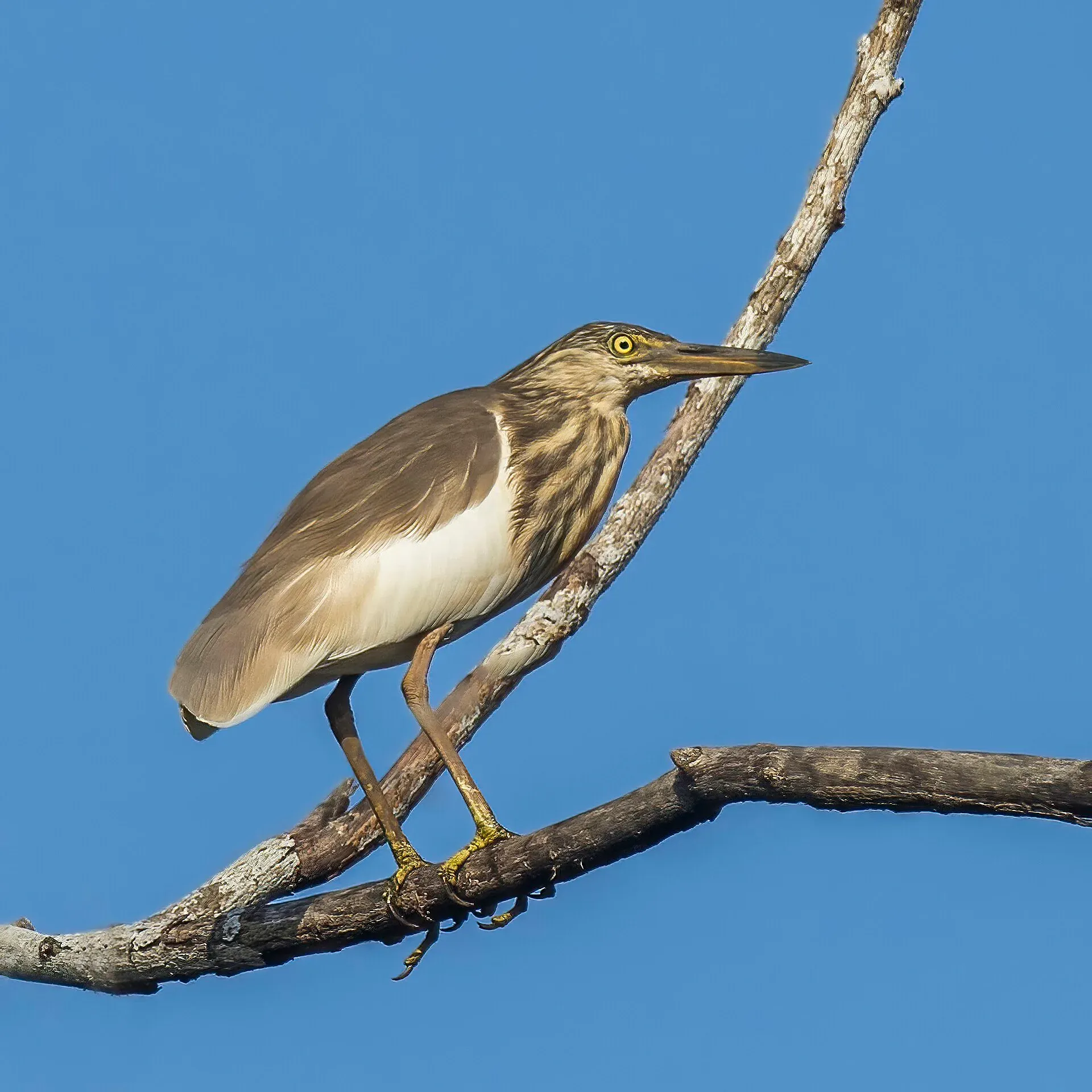
Photo: Charles J. Sharp, with thanks · CC BY-SA 4.0 · via Wikimedia Commons · temporary stand-in photo

Indian Pond Heron
A small, stocky heron that looks dull brown while it stalks the edge of a pond, then flashes bright white wings in flight. It is common on Pakistan's wetlands, canals and paddies.
Identification
The Indian pond heron, or paddybird, is small and stocky, with a short neck, short thick bill and a buff-brown streaked back. Its camouflage is excellent. When it takes off, the wings flash bright white. In summer, adults grow long neck feathers. It is very like the squacco heron but has a darker back, and it is usually silent apart from a harsh croak when alarmed.
Status
IUCN Red List: Least Concern (BirdLife International, 2016).
Where and when in Pakistan
It is a widespread resident. Dawn (2014) says it is found all over Sindh and Punjab and on the coast of Balochistan, reaching north only as far as the Swat valley because it avoids mountains, and a 2015 survey at Bajwat Wetland in Sialkot District listed it as abundant and resident. Look at ponds, canals, flooded fields, paddies and reservoir edges all year. The Zoological Survey of Pakistan's mid-winter waterbird census runs at wetlands such as Chashma Barrage, Haleji and Keenjhar, which are good places to look. The survey for the 2025 to 2026 census reported low water at several Punjab wetlands, while Sindh wetlands were full after the 2025 monsoon, with many birds.
Behaviour
It usually forages alone at the edge of water, often using floating plants such as water hyacinth. It eats crustaceans, aquatic insects, fish and tadpoles, and on dry ground it takes crickets and other insects. It stands still and flushes only at the last moment, which has led to folk beliefs that it is half-blind. Pairs nest in small colonies in trees, usually starting with the monsoon. They lay three to five eggs, and the young are fed mostly fish.
Threats and conservation
It is common and not threatened. In the past, its feathers were sold in the plume trade. Pollution and the drying of wetlands can reduce its feeding areas.
Birding etiquette
- Use binoculars or a telescope and keep your distance. Never use recorded calls to draw a bird in, and do not use flash.
- Stay away from nests and roosts, and keep dogs out of wetlands and nesting areas.
- Do not use drones near birds.
- Never buy a captive or trapped wild bird, or take part in trapping.
- Hire a licensed local guide where you can, and ask the local wildlife department about access and timing.
Sources and last checked
Last checked Confidence medium5 sources3 still to check
- Last checked
- Method
- Desk research from published sources
- Confidence
- medium
- Checked by
- trek.pk research team
Researched from published sources; not yet checked on the ground by our team. Spot something out of date? Report a mistake.
Sources
- Indian pond heron · Wikipedia · checked
- Wildlife: a slimy customer · Dawn · checked
- Bird survey of Bajwat Wetland, Sialkot · Journal of Animal and Plant Sciences (JAPS) · checked
- Newsletter January to March 2026 (Mid-Winter Waterbird Census) · Zoological Survey of Pakistan · checked
- Ardeola grayii (IUCN Red List category) · GBIF, IUCN Red List checklist · checked
Still to be checked on the ground (3)
- No counts for Haleji, Keenjhar or Chashma were found (the ZSP newsletter gives no species counts)
- Exact peak nesting months in Pakistan (Wikipedia says only that nesting begins with the monsoon)
- IUCN year (2016) comes from the citation shown on Wikipedia; IUCN and BirdLife pages could not be loaded