

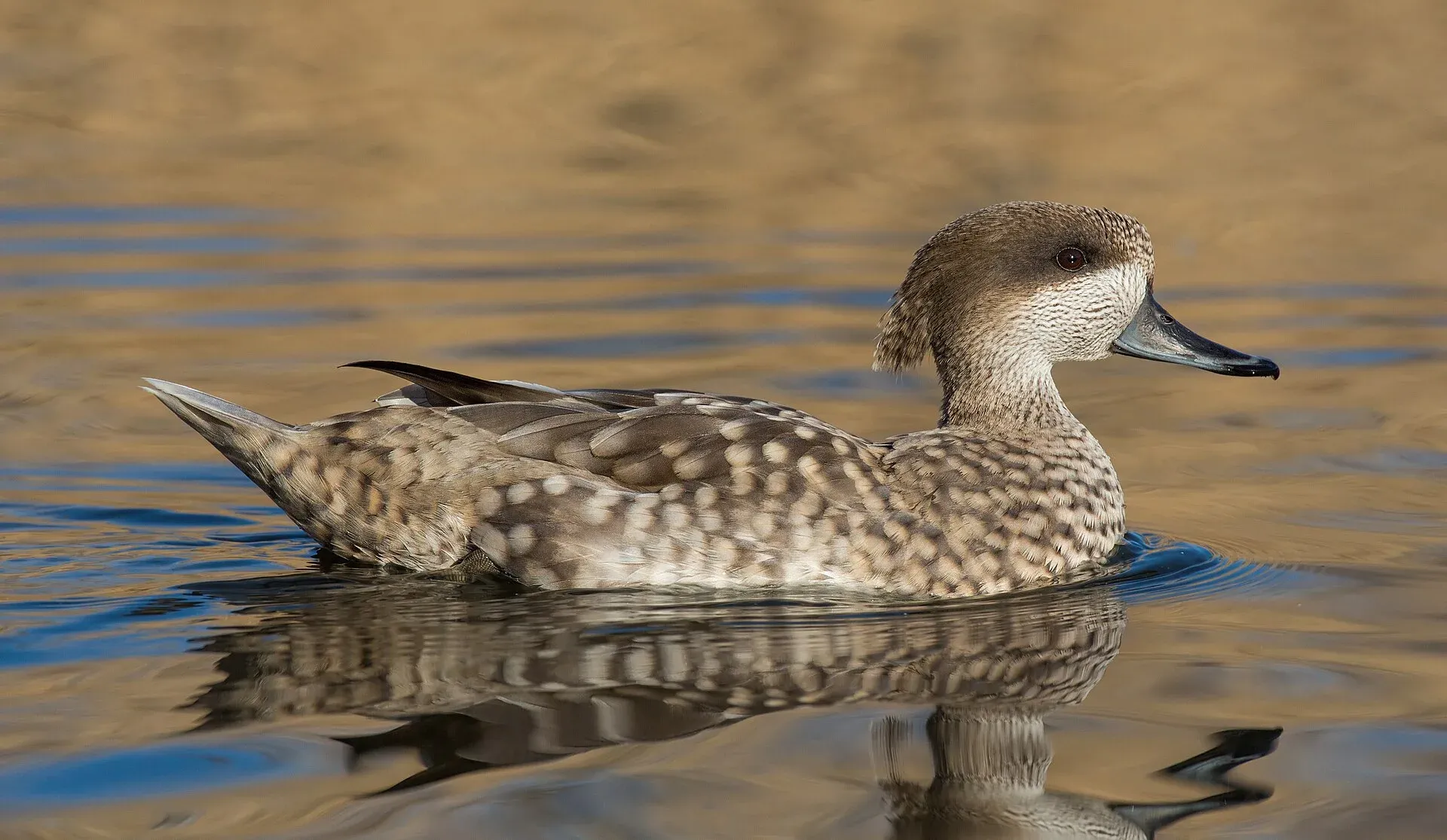
Photo: David Iliff, with thanks · CC BY-SA 3.0 · via Wikimedia Commons · temporary stand-in photo

Marbled Teal
A pale, sandy-brown duck with a dark eye patch and a shaggy head. In Pakistan it is a rare breeder and wanderer, with Sindh's lakes the best-known breeding area.
Identification
The marbled teal is a small duck, 39 to 42 cm long. Adults are pale sandy-brown with off-white blotches, a dark patch around the eye and a shaggy head. The wings look pale in flight, with no bright wing patch. It is a nervous, flighty bird.
Status
IUCN Red List: Near Threatened (BirdLife International, 2022).
Where and when to see it in Pakistan
This is a hard bird to find. A Sindh Wildlife Department survey reported in Dawn in July 2005 found about 30 pairs with around 100 chicks at Dang-i-wari Lake in the Nara Game Reserve in June and July, and breeding was also noted at Deh Akro-II Wildlife Sanctuary. The same report says it had bred at Zangi Nawar Lake in Balochistan until the 1980s, when the lake dried up. A 2019 study in the Journal of Animal and Plant Sciences concluded that its range in Pakistan has become more restricted. Ask the Sindh Wildlife Department about current access and conditions before planning a trip.
Behaviour
It lives in groups, even when nesting. It feeds in shallow water by dabbling or up-ending, taking seeds, small invertebrates and green plants. It breeds in shallow, often brackish wetlands with dense plants, and lays on the ground in thick cover at the water's edge. Many birds move around when pools dry out.
Threats and conservation
Wetland loss and hunting have cut its numbers worldwide. The species is listed as globally threatened, and the Dawn report says it has full protection under the Sindh Wildlife Protection Ordinance 1972. Drying lakes are a visible risk in Pakistan.
Birding etiquette
- Use binoculars or a telescope and keep your distance. Never play recorded calls to draw a bird in, and do not use flash.
- Stay away from nests and roosts, and keep dogs out of wetlands and nesting areas.
- Do not use drones near birds.
- Never buy a captive or trapped wild bird, or take part in trapping or hunting.
- Hire a licensed local guide where you can, and ask the local wildlife department about access and timing.
Sources and last checked
Last checked Confidence medium4 sources2 still to check
- Last checked
- Method
- Desk research from published sources
- Confidence
- medium
- Checked by
- trek.pk research team
Researched from published sources; not yet checked on the ground by our team. Spot something out of date? Report a mistake.
Sources
- Marbled teal · Wikipedia · checked
- Marbled teals found breeding in Sindh · Dawn · checked
- Mapping historic and current distribution of marbled teal in Pakistan · Journal of Animal and Plant Sciences · checked
- Marmaronetta angustirostris (IUCN Red List category) · GBIF, IUCN Red List checklist · checked
Still to be checked on the ground (2)
- Current breeding sites and numbers (the Dawn report dates from 2005; the 2019 study abstract names no sites)
- Whether the species still occurs at each Sindh lake