

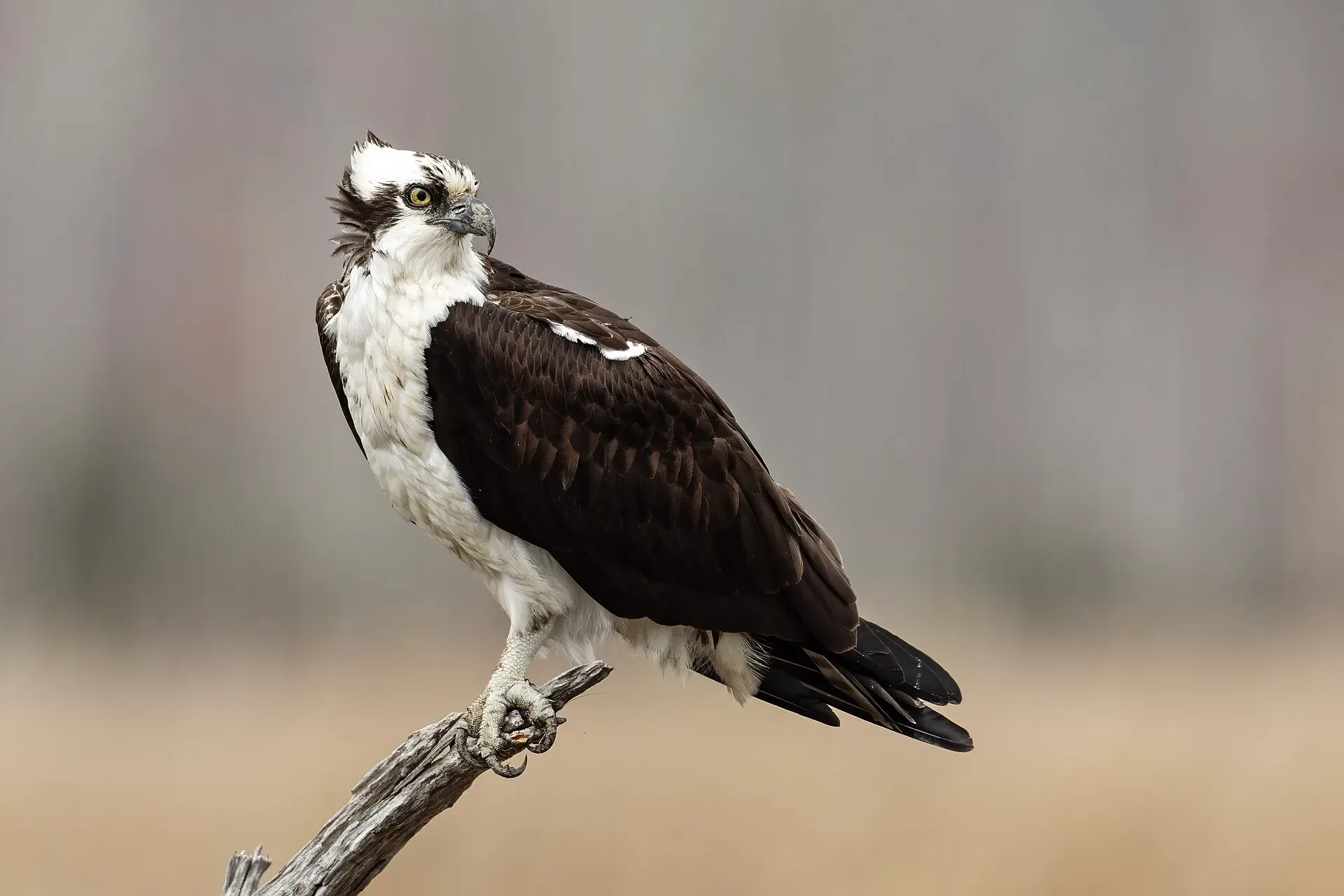
Photo: Chuck Homler / Focus On Wildlife, with thanks · CC BY-SA 4.0 · via Wikimedia Commons · temporary stand-in photo

Osprey
A fish-eating hawk with a white head and a dark eye stripe. In Pakistan it is mainly a winter visitor to lakes, rivers and the Sindh coast.
Identification
The osprey is 50 to 66 cm long, with a wingspan of 127 to 180 cm. It has dark brown upperparts, a white head with a dark stripe through the eye, and white underparts. In flight the long, narrow wings are held in a bent, gull-like shape, with dark patches at the wrist. The call is a series of sharp, whistled notes.
Status
IUCN Red List: Least Concern (BirdLife International, 2021).
Where and when to see it in Pakistan
Osprey is described as an uncommon to fairly common winter visitor to all parts of South Asia. Look from October to March at lakes, large rivers, reservoirs, creeks and the coast. A bird survey at Gharo Creek in Thatta district in 2020 to 2021 listed it as a winter visitor, and Indus Valley winter counts in the 1970s recorded it among the commoner raptors. Keenjhar Lake, the Indus and the Sindh coast near Karachi are sensible places to start. There is no confirmed record of osprey breeding in Pakistan.
Behaviour
About 99 per cent of an osprey's diet is live fish. It spots prey from 10 to 40 m up, hovers, then plunges feet first. Look for it on dead trees, poles and fish-farm posts beside open water.
Threats and conservation
The osprey was hit by DDT in other countries in the 1950s and 1960s, and recovered after the ban. Nests on power poles can also cause fires and outages, and nesting near overhead cables is a source of deaths.
Birding etiquette
- Use binoculars or a telescope and keep your distance. Never use recorded calls to draw a bird in, and do not use flash.
- Stay away from nests and roosts, and keep dogs out of wetlands.
- Do not use drones near birds.
- Never buy a captive or trapped wild bird, or take part in trapping.
- Hire a licensed local guide where you can, and ask the local wildlife department about access and timing.
Sources and last checked
Last checked Confidence medium5 sources3 still to check
- Last checked
- Method
- Desk research from published sources
- Confidence
- medium
- Checked by
- trek.pk research team
Researched from published sources; not yet checked on the ground by our team. Spot something out of date? Report a mistake.
Sources
- Osprey · Wikipedia · checked
- Osprey – BirdLife DataZone factsheet · BirdLife International · checked
- Avian Diversity and its Associated Threats in Gharo Creek, District Thatta, Sindh, Pakistan · Researchers Links · checked
- Raptors of the Indus Valley (winter surveys 1970-1974) · Journal article via Internet Archive · checked
- Pandion haliaetus (IUCN Red List category) · GBIF, IUCN Red List checklist · checked
Still to be checked on the ground (3)
- No confirmed breeding record found for Pakistan; Wikipedia describes it as a winter visitor across South Asia
- Peak months for each site are not documented
- IUCN year (2021) is taken from the citation on Wikipedia, not confirmed on the IUCN Red List or BirdLife pages