

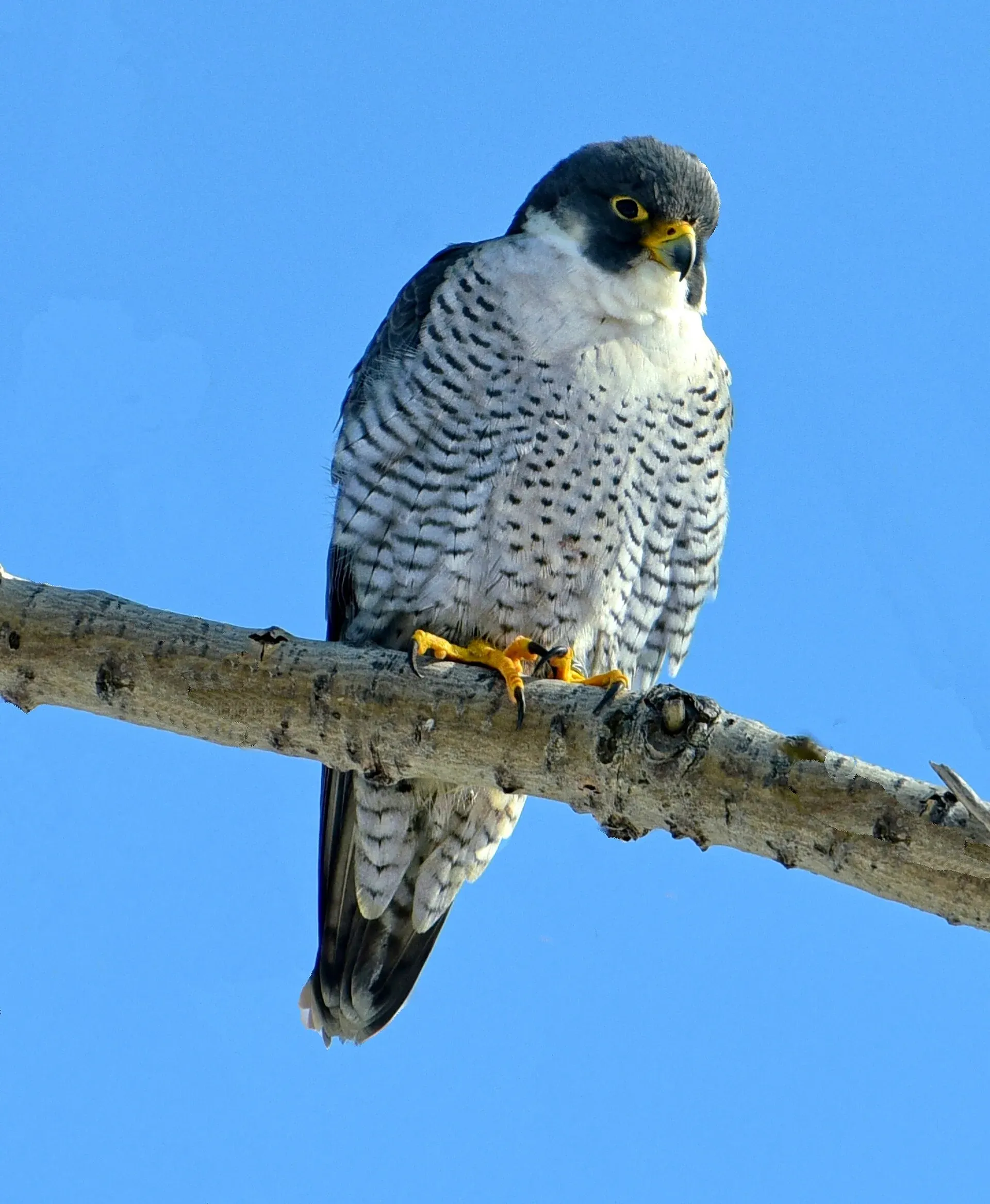
Photo: Mykola Swarnyk, with thanks · CC BY-SA 3.0 · via Wikimedia Commons · temporary stand-in photo

Peregrine Falcon
The peregrine is a fast bird-hunting falcon with a black head and moustache. Pakistan has resident hill birds and winter visitors, so it can be seen in several seasons.
Identification
The peregrine falcon is 34 to 58 cm long, with a wingspan of 74 to 120 cm. Females are up to 30 per cent bigger than males. Adults have a blue-grey back, a black head with a bold black "moustache", and pale underparts finely barred with dark. The cere and feet are yellow. Juveniles are browner with streaked underparts.
Status
IUCN Red List: Least Concern (BirdLife International, 2021). Some local populations are poorly known, so the global rating does not mean every population is secure.
Where and when to see it in Pakistan
South Asia holds several kinds of peregrine. The small, dark shaheen (peregrinator) is a non-migratory bird of the Indian subcontinent. The race babylonicus breeds in the Hindu Kush and Tian Shan, and the northern calidus migrates to South Asia in winter. In practice, watch cliffs, big towns and open wetlands from October to March for the best chance of a winter bird. For resident birds, look at cliff faces and tall buildings in hill country. Peregrines are widespread but never numerous, so patience matters.
Behaviour
The peregrine hunts birds, often pigeons and ducks, by diving at them from height. Radar studies have measured stoops of up to about 184 km/h, though much higher figures are widely quoted. It nests on ledges and cliffs and usually mates for life.
Threats and conservation
Organochlorine pesticides such as DDT thinned eggshells and caused big declines in Europe and North America before they were banned in the 1970s. Egg and chick collecting still happens. Falcons are also trafficked from Pakistan for the Gulf falconry trade, so never buy or handle a wild falcon.
Birding etiquette
- Use binoculars or a telescope and keep your distance. Never use recorded calls to draw a bird in, and do not use flash.
- Stay away from nests and roosts, and keep dogs out of wetlands.
- Do not use drones near birds.
- Never buy a captive or trapped wild bird, or take part in trapping.
- Hire a licensed local guide where you can, and ask the local wildlife department about access and timing.
Sources and last checked
Last checked Confidence medium4 sources3 still to check
- Last checked
- Method
- Desk research from published sources
- Confidence
- medium
- Checked by
- trek.pk research team
Researched from published sources; not yet checked on the ground by our team. Spot something out of date? Report a mistake.
Sources
- Peregrine falcon · Wikipedia · checked
- Peregrine Falcon – BirdLife DataZone factsheet · BirdLife International · checked
- Poachers' paradise: Gulf hunts fuel falcon trafficking in Pakistan · Dawn · checked
- Falco peregrinus (IUCN Red List category) · GBIF, IUCN Red List checklist · checked
Still to be checked on the ground (3)
- Best sites and seasons for each subspecies in Pakistan (Wikipedia does not mention Pakistan; the shaheen is a resident of the subcontinent, calidus a winter visitor to South Asia, babylonicus a small number of winter visitors)
- Assessment year (2021) could not be re-confirmed: Wikipedia gives no year and the BirdLife factsheet loaded without values
- Hero photo is not from Pakistan