

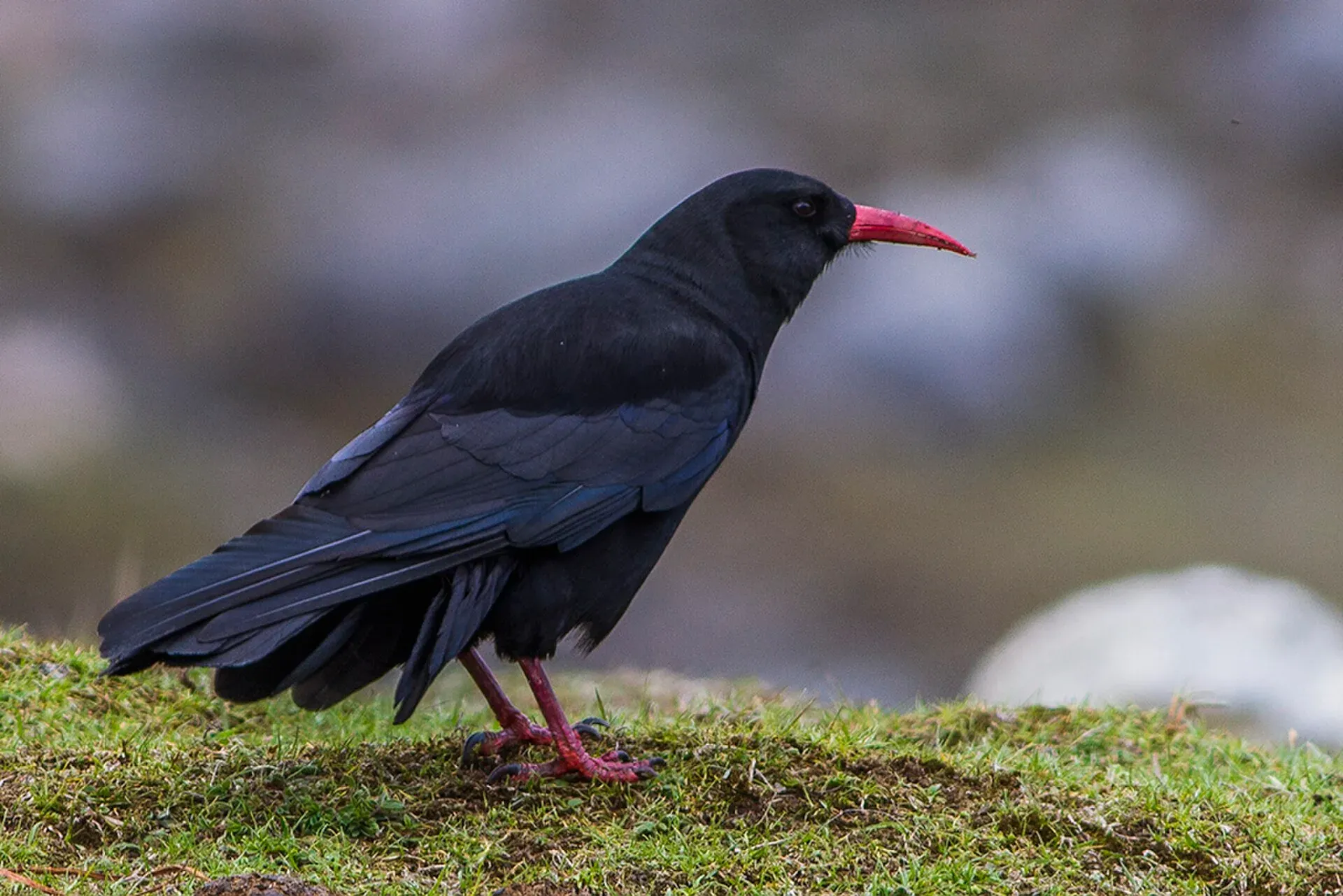
Photo: Dibyendu Ash, with thanks · CC BY-SA 3.0 · via Wikimedia Commons · temporary stand-in photo

Red-billed Chough
A glossy black crow of high mountains with a curved red bill and red legs. In northern Pakistan it forages on high pastures in summer and comes down to valley villages in winter.
Identification
The red-billed chough is a slim, glossy black member of the crow family, about 39 to 40 cm long in Europe. The bill is long, thin and curved, and bright red, and the legs are red too. In flight it is acrobatic, with widely spread wingtip feathers, and it gives a loud, ringing call. The Himalayan form is the largest of the subspecies and has a blue or purple gloss on its feathers. The similar yellow-billed chough has a short yellow bill.
Status
IUCN Red List: Least Concern (BirdLife International, 2016). Numbers have fallen in parts of Europe, but the species is not threatened globally.
Where and when in Pakistan
The Himalayan subspecies breeds from the Himalaya to western China, mainly at 2,400 to 3,000 m in that range, and it can reach very high summer pastures. In Gilgit-Baltistan, a travel blog dated December 2020 describes red-billed and yellow-billed choughs lining the paths that herders use to bring animals down to villages near 3,000 m in Upper Hunza. It reports the birds on the Karakoram Highway between Morkhun and Sost. Mixed groups are common, and the red-billed bird usually forms the larger flocks there. Wikipedia says the species forms large flocks in winter in the Himalaya. Records for Chitral and Deosai are not confirmed.
Behaviour
Choughs feed in flocks on short grazed grass. They take mostly insects, especially ants, and dig for grubs with the long bill. In the Himalaya they are also reported to break off ripening barley heads. Pairs bond for life and nest in caves or cliff crevices, building a stick nest lined with wool. They usually raise one brood a year.
Threats and conservation
In Europe, the loss of traditional grazing has cut numbers. No population study for Pakistan is cited here. Overgrazing, climate change and disturbance of cliff nests are possible concerns that need local research.
Birding etiquette
- Use binoculars or a telescope and keep your distance. Never use recorded calls to draw a bird in, and do not use flash.
- Stay away from nests and roosts, and keep dogs out of wetlands and nesting areas.
- Do not use drones near birds.
- Never buy a captive or trapped wild bird, or take part in trapping.
- Hire a licensed local guide where you can, and ask the local wildlife department about access and timing.
Sources and last checked
Last checked Confidence medium4 sources2 still to check
- Last checked
- Method
- Desk research from published sources
- Confidence
- medium
- Checked by
- trek.pk research team
Researched from published sources; not yet checked on the ground by our team. Spot something out of date? Report a mistake.
Sources
- Red-billed chough · Wikipedia · checked
- Red-billed Chough Pyrrhocorax pyrrhocorax · BirdLife International DataZone · checked
- In the mountainous areas of northern Pakistan, there are red-billed and yellow-billed crows · Indus Caravan (operator blog, supporting only) · checked
- Pyrrhocorax pyrrhocorax (IUCN Red List category) · GBIF, IUCN Red List checklist · checked
Still to be checked on the ground (2)
- Exact Pakistan breeding and winter sites need an eBird check
- Deosai and Chitral records not confirmed