

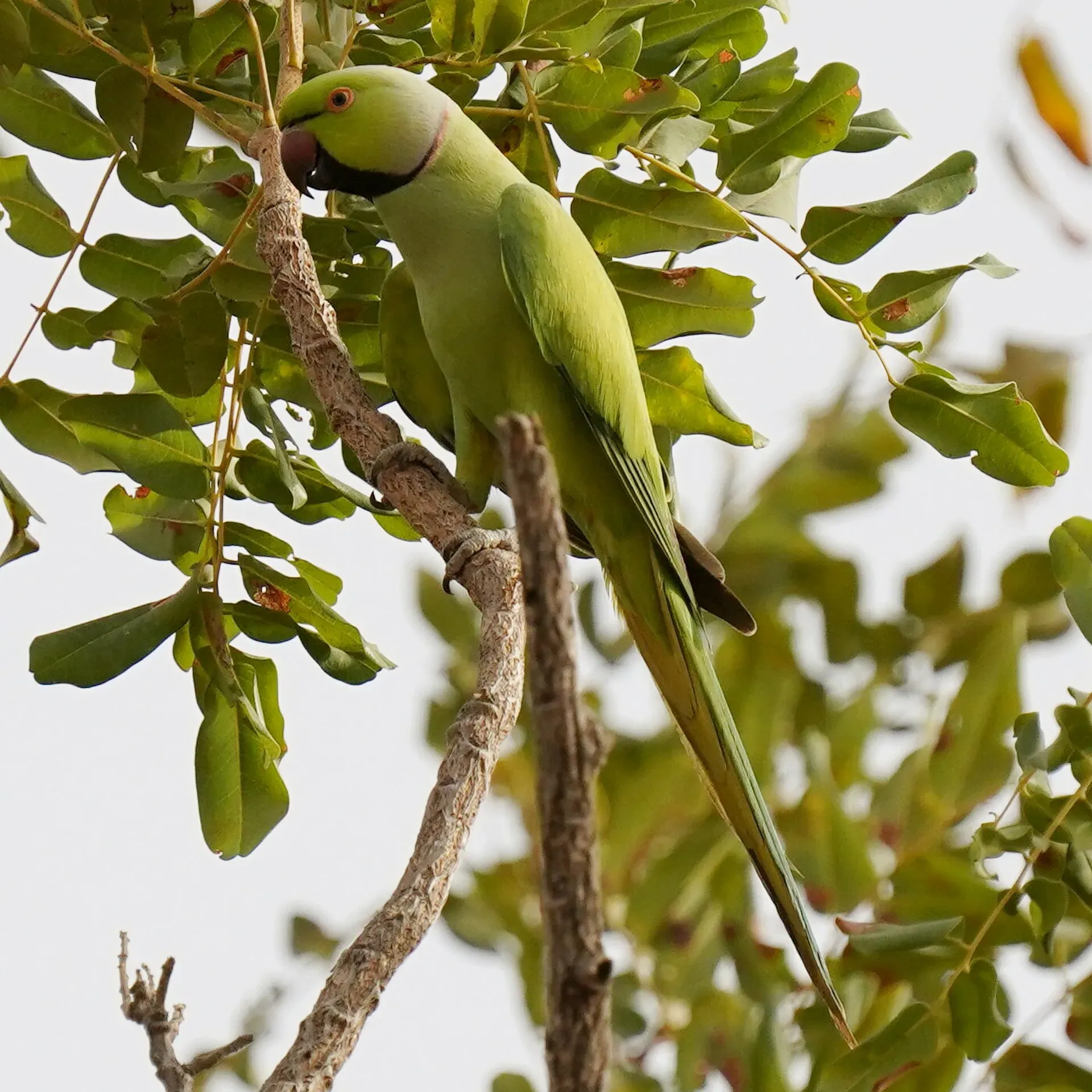
Photo: Daniel S. Katz, with thanks · CC BY 4.0 · via Wikimedia Commons · temporary stand-in photo

Rose-ringed Parakeet
A noisy green parakeet with a red bill and a long tail. It is common in Pakistani towns, orchards and fields, and is also the focus of a pet trade and a new licensing system in Punjab.
Identification
The rose-ringed parakeet is 37 to 43 cm long including the tail. It is bright green, with a red bill and a long blue-tinged tail. Adult males have a pink and black ring at the neck. Females and young birds have no ring, or only a pale shadow of one. It makes a noisy, squawking call. Asian birds are larger than African ones.
Status
IUCN Red List: Least Concern (BirdLife International, 2024). The population appears to be increasing worldwide.
Where and when to see it in Pakistan
The species is native to the Indus Valley eastwards and is resident in Pakistan all year. Wikipedia places the northern subspecies P. k. borealis here. It is at home in towns, orchards, groves and farmland, and it nests in tree holes. There is no reliable site list here; look in city parks and old trees at dawn and dusk when flocks fly to roost.
Behaviour
It eats buds, nectar, fruit, seeds and grain. It adapts well to cities. Wild flocks fly several miles to forage in farmland and orchards, and Wikipedia calls the species a major agricultural pest in places such as India. In northwest India pairs form from September to December and the young are cared for from April to June. We have not confirmed breeding times in Pakistan.
Threats and conservation
Capture for the pet trade has cut numbers in parts of the native range. Dawn reported in July 2017 that the population of green parrots in Pakistan was declining because of increased illegal trade. In September 2025 Dawn reported that Punjab had legalised keeping four local parakeet species, including this one, through licensing and registration, with each licensed bird ringed. Wild birds remain protected under Schedule 3 of the Punjab Wildlife Act, and no one may capture or net them. The Express Tribune reported in November 2025 that Punjab requires pet parrots to be registered through a departmental mobile app, and that a later phase may require breeder or dealer registration. The detailed mechanism had not been announced in September 2025. Check current rules with the local wildlife department.
Birding etiquette
- Use binoculars or a telescope and keep your distance. Never play recorded calls to draw a bird in, and do not use flash.
- Stay away from nests and roosts, and keep dogs out of wetlands and nesting areas.
- Do not use drones near birds.
- Never buy a captive or trapped wild bird, or take part in trapping or hunting.
- Hire a licensed local guide where you can, and ask the local wildlife department about access and timing.
Sources and last checked
Last checked Confidence medium5 sources4 still to check
- Last checked
- Method
- Desk research from published sources
- Confidence
- medium
- Checked by
- trek.pk research team
Researched from published sources; not yet checked on the ground by our team. Spot something out of date? Report a mistake.
Sources
- Rose-ringed parakeet · Wikipedia · checked
- Licencing for four local parakeet species allowed in Punjab · Dawn · checked
- Green parrots released after being confiscated from traffickers · Dawn · checked
- Punjab mandates parrot registration to curb smuggling · The Express Tribune · checked
- Psittacula krameri (IUCN Red List category) · GBIF, IUCN Red List checklist · checked
Still to be checked on the ground (4)
- Current Punjab licensing mechanism and fees (the Dawn article gives fees quoted by an official; no official notification was opened, so none are published)
- Breeding season in Pakistan (Wikipedia gives northwest India only)
- Pakistan-specific crop damage figures (Wikipedia describes pest status in places such as India)
- IUCN year (2024) is from the Wikipedia citation; the IUCN page was not opened