

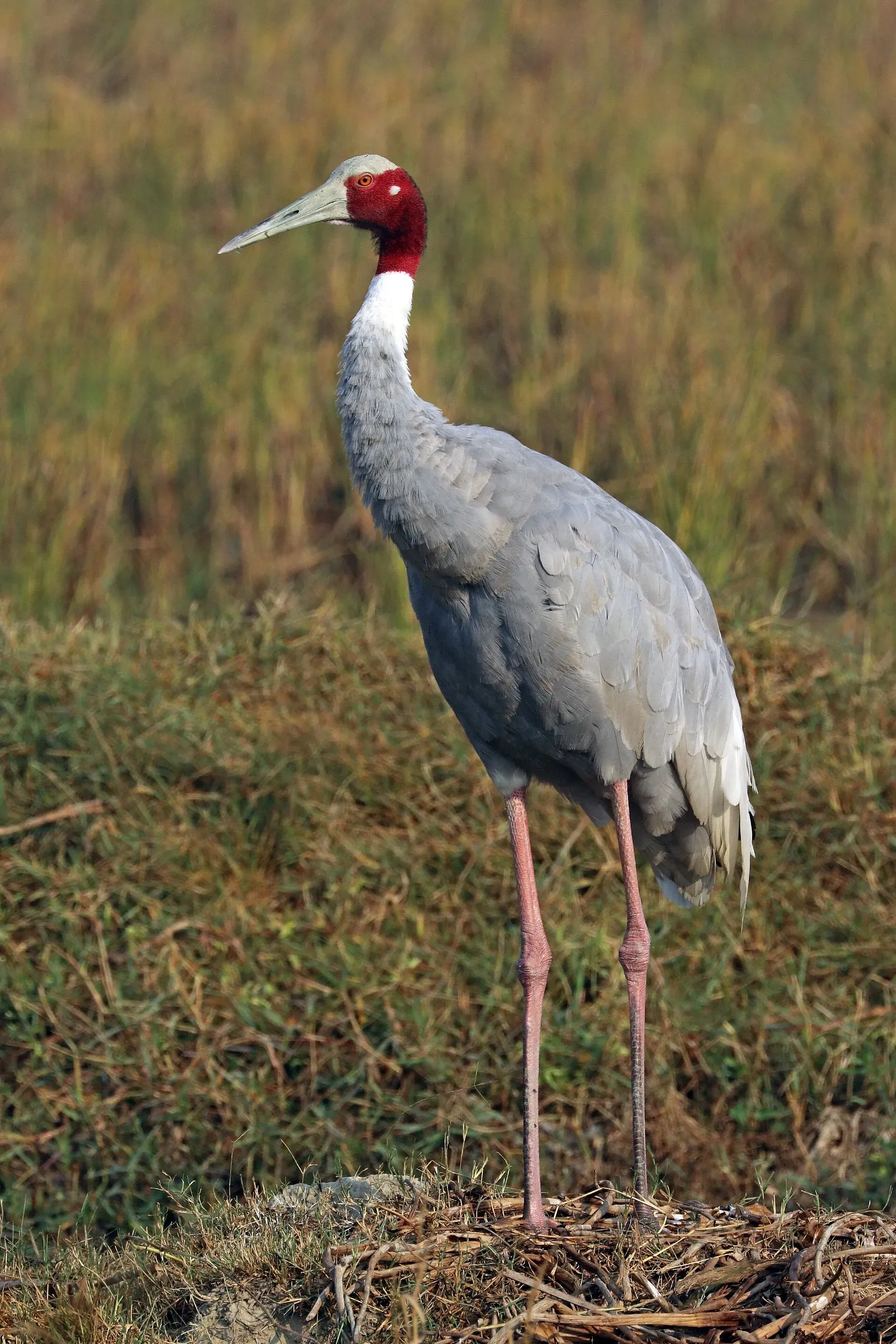
Photo: Charles J. Sharp, with thanks · CC BY-SA 4.0 · via Wikimedia Commons · temporary stand-in photo

Sarus Crane
The world's tallest flying bird, with a bare red head. In Pakistan it was once found in Tharparkar, Sindh, and is now extremely rare, so a sighting would be news.
Identification
The sarus crane is the tallest flying bird in the world, standing up to 1.8 m, with a wingspan of 2.2 to 2.5 m. It is grey, with a bare red head and upper neck, a pale crown and a long, greenish bill. The legs are pink. Indian birds have a white collar. Young birds have a fully feathered brown-grey head. In flight, the neck is held straight and the wingtips are black. Pairs call loudly together.
Status
IUCN Red List: Vulnerable (BirdLife International, 2025). The global population is about 16,000 mature individuals, and most of them live in South Asia, mainly India.
Where and when to see it in Pakistan
Do not expect to see one. The sarus crane has always been scarce in Pakistan, and records come almost entirely from Tharparkar district in Sindh, near the Indian border. Dawn reported in May 2012 that a single pair was seen at Nagarparkar earlier that year, after a flock was recorded there in 1999. A conservationist quoted by Dawn said the area was once a breeding ground, that the birds left after one of a flock was shot in 1999, and that they could breed again if the habitat is left undisturbed. No breeding was confirmed. Wikipedia says the bird has not been seen in Tharparkar since the late 1980s, and Dawn says that before the 2012 pair it was last seen there in 1999. Because sources disagree on the last record, treat Pakistan as an area of occasional, unconfirmed records. Nagarparkar is close to the Indian border, and the FCDO page lists a 5-mile India-border zone and warnings for parts of Sindh. Check the current advice at gov.uk before travelling.
Behaviour
Sarus cranes are largely non-migratory. They pair for life, defend territories with duet calls and dancing, and nest on reed platforms in shallow water, mostly in the monsoon. They eat insects, plant tubers, seeds, frogs and small fish.
Threats and conservation
Wetland drainage and conversion, egg collecting, hunting, pesticide poisoning and power-line strikes are the main threats named by the IUCN. In Pakistan, the main need is to protect wetlands and fields in Tharparkar and keep the area quiet.
Birding etiquette
- Use binoculars or a telescope and keep your distance. Never use recorded calls to draw a bird in, and do not use flash.
- Stay away from nests and roosts, and keep dogs out of wetlands.
- Do not use drones near birds.
- Never buy a captive or trapped wild bird, or take part in trapping.
- Hire a licensed local guide where you can, and ask the local wildlife department about access and timing.
Sources and last checked
Last checked Confidence low5 sources3 still to check
- Last checked
- Method
- Desk research from published sources
- Confidence
- low
- Checked by
- trek.pk research team
Researched from published sources; not yet checked on the ground by our team. Spot something out of date? Report a mistake.
Sources
- Sarus crane · Wikipedia · checked
- Sarus Crane – BirdLife DataZone factsheet · BirdLife International · checked
- Sarus cranes seen in Pakistan after a decade · Dawn · checked
- Pakistan travel advice · UK FCDO · checked
- Antigone antigone (IUCN Red List category) · GBIF, IUCN Red List checklist · checked
Still to be checked on the ground (3)
- Whether the sarus crane still occurs in Pakistan: sources conflict (Wikipedia: not seen since the late 1980s; Dawn: a pair in 2012 and a flock in 1999). No later record found
- Nesting months in Pakistan are not documented; Wikipedia gives July to October (monsoon) for India
- Hero photo is not from Pakistan