

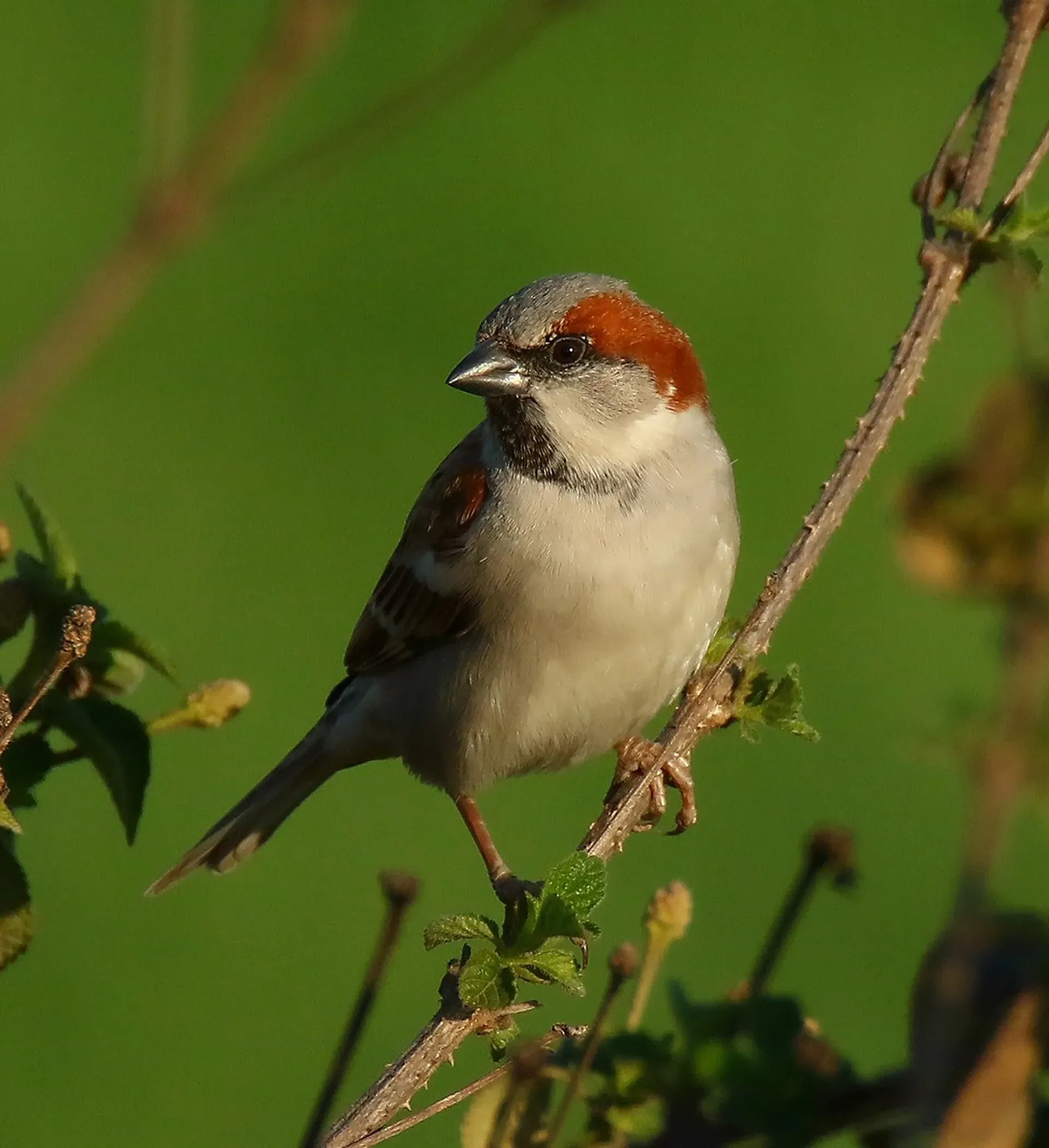
Photo: Imran Shah, with thanks · CC BY-SA 2.0 · via Wikimedia Commons · temporary stand-in photo

Sind Sparrow
A small, local sparrow of the Indus plains. The male has a chestnut stripe behind the eye. It lives in riverside thorn scrub and tall grass, mostly in Pakistan.
Identification
The Sind sparrow looks much like a house sparrow but is smaller, about 13 cm long. The breeding male has a short, narrow black bib and a broad chestnut stripe behind the eye. It has a grey crown and nape and a rufous lower back. The female has a darker, greyer head than a female house sparrow. The call is a soft, higher chup. It is also known as the Sind jungle sparrow.
Status
IUCN Red List: Least Concern (BirdLife International, 2016). It is fairly common and its range is expanding.
Where and when in Pakistan
This is a bird of the Indus valley, and Pakistan holds most of its range. It extends from the Indus delta north to the Kabul River near Nowshera, and along the lower reaches of the Punjab tributaries. A well-known photograph was taken at Head Marala in Punjab. It also breeds locally in Balochistan. Look in acacia and tamarisk scrub and tall grass near rivers, canals and wetlands. Taunsa Barrage Wildlife Sanctuary lies within this habitat. It can be seen all year, but breeding runs from April to September. In winter it moves short distances, sometimes into drier thickets.
Behaviour
It is social. It forages in groups of four to six, or up to about 30 in winter, with house sparrows and other seed-eaters, and nests in loose colonies. It eats mostly grass seeds and takes insects to feed young. The nest is an untidy dome of grass in a thorny tree or on a branch above water. Most pairs raise two clutches of three to five eggs.
Threats and conservation
No serious threats are known, and Wikipedia describes the species as fairly common and expanding its range.
Birding etiquette
- Use binoculars or a telescope and keep your distance. Never use recorded calls to draw a bird in, and do not use flash.
- Stay away from nests and roosts, and keep dogs out of wetlands and nesting areas.
- Do not use drones near birds.
- Never buy a captive or trapped wild bird, or take part in trapping.
- Hire a licensed local guide where you can, and ask the local wildlife department about access and timing.
Sources and last checked
Last checked Confidence medium3 sources2 still to check
- Last checked
- Method
- Desk research from published sources
- Confidence
- medium
- Checked by
- trek.pk research team
Researched from published sources; not yet checked on the ground by our team. Spot something out of date? Report a mistake.
Sources
- Sind sparrow · Wikipedia · checked
- Indus Valley Endemic Bird Area (EBA 373) · BirdLife International DataZone · checked
- Passer pyrrhonotus (IUCN Red List category) · GBIF, IUCN Red List checklist · checked
Still to be checked on the ground (2)
- Current sites in Pakistan need an eBird check (eBird blocked automated access)
- No dedicated Pakistan survey found