

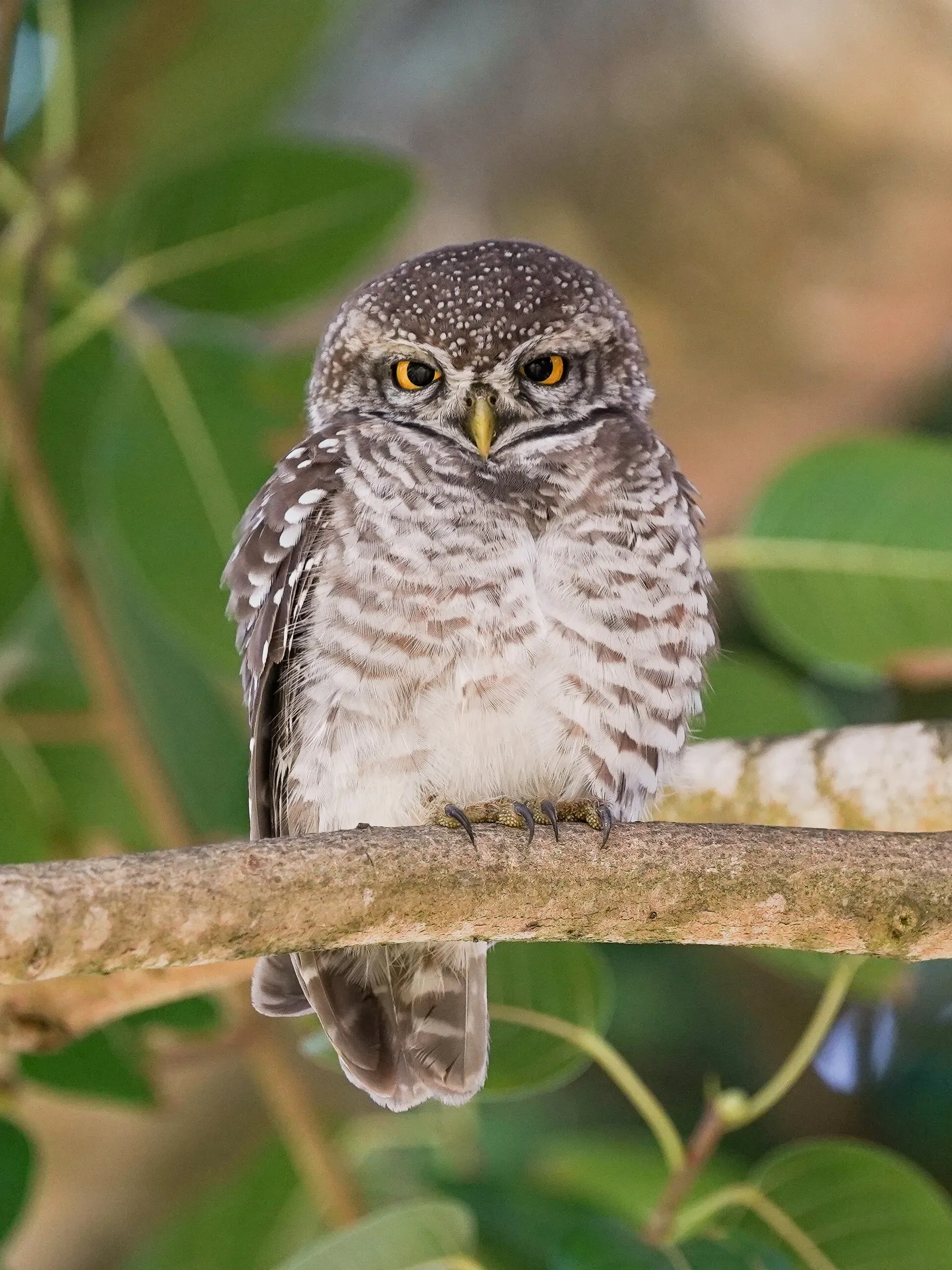
Photo: Timothy A. Gonsalves, with thanks · CC BY-SA 4.0 · via Wikimedia Commons · temporary stand-in photo

Spotted Owlet
A small, stocky owl with white-spotted grey-brown upperparts and yellow eyes. It lives in towns, farmland and old buildings across Pakistan, and is often seen by day.
Identification
The spotted owlet is a small, stocky owl, about 21 cm long. The upperparts are grey-brown and heavily spotted with white. The underparts are white with brown streaks. It has a pale face, yellow eyes, and a white neckband and eyebrow. The flight is deeply undulating. The subspecies in Iran and Pakistan, albida, is a pale form. The call is a harsh, loud churring and chuckling that ends with chirwak-chirwak, given mainly at dawn and just after sunset.
Status
IUCN Red List: Least Concern (BirdLife International, 2024).
Where and when in Pakistan
A common resident that is seen all year. It is found in open country, farmland, orchards, old trees and human settlements. A 2009 to 2010 campus checklist in Lahore lists it as resident, and the species was studied at the University of Agriculture Faisalabad. Dawn lists it among at least 10 owl species recorded in Sindh, and notes that Pakistan has 16 owl species. Look in old avenue trees, ruins, mosque and school compounds and cracks in walls, and listen at dusk.
Behaviour
It is mostly nocturnal but is often seen by day, bobbing its head and staring when disturbed. Small birds sometimes mob it, which can lead you to its roost. It eats insects and small vertebrates, and in Pakistan studies it has been found to take mostly insects. Nests are in tree holes, wall cavities or rocky crevices. It usually lays three or four eggs and breeds from November to April.
Threats and conservation
Dawn reports that habitat loss, poaching and urbanisation are pushing Pakistan's owls toward decline, although expanding cities have created new nest sites for some species. Owls are sometimes associated with bad luck, which can lead to persecution or capture. Not all owl species are protected under Pakistan's wildlife laws.
Birding etiquette
- Use binoculars or a telescope and keep your distance. Never use recorded calls to draw a bird in, and do not use flash.
- Stay away from nests and roosts, and keep dogs out of wetlands and nesting areas.
- Do not use drones near birds.
- Never buy a captive or trapped wild bird, or take part in trapping.
- Hire a licensed local guide where you can, and ask the local wildlife department about access and timing.
- Never use a light on a roosting owl or disturb its daytime perch. Do not tell people where a roost is on social media.
Sources and last checked
Last checked Confidence medium5 sources2 still to check
- Last checked
- Method
- Desk research from published sources
- Confidence
- medium
- Checked by
- trek.pk research team
Researched from published sources; not yet checked on the ground by our team. Spot something out of date? Report a mistake.
Sources
- Spotted owlet · Wikipedia · checked
- Pakistan's vanishing owls: habitat loss, poaching, urbanisation push species toward decline · Dawn · checked
- Behaviour of the spotted owlet (Athene brama) at Faisalabad · Journal of Animal and Plant Sciences (JAPS) · checked
- Ornithofauna of the University of Veterinary and Animal Sciences, Lahore · Journal of Animal and Plant Sciences (JAPS) · checked
- Athene brama (IUCN Red List category) · GBIF, IUCN Red List checklist · checked
Still to be checked on the ground (2)
- Peak calling months in Pakistan (Wikipedia gives only dawn and just after sunset)
- No Karachi or Lahore population count found