

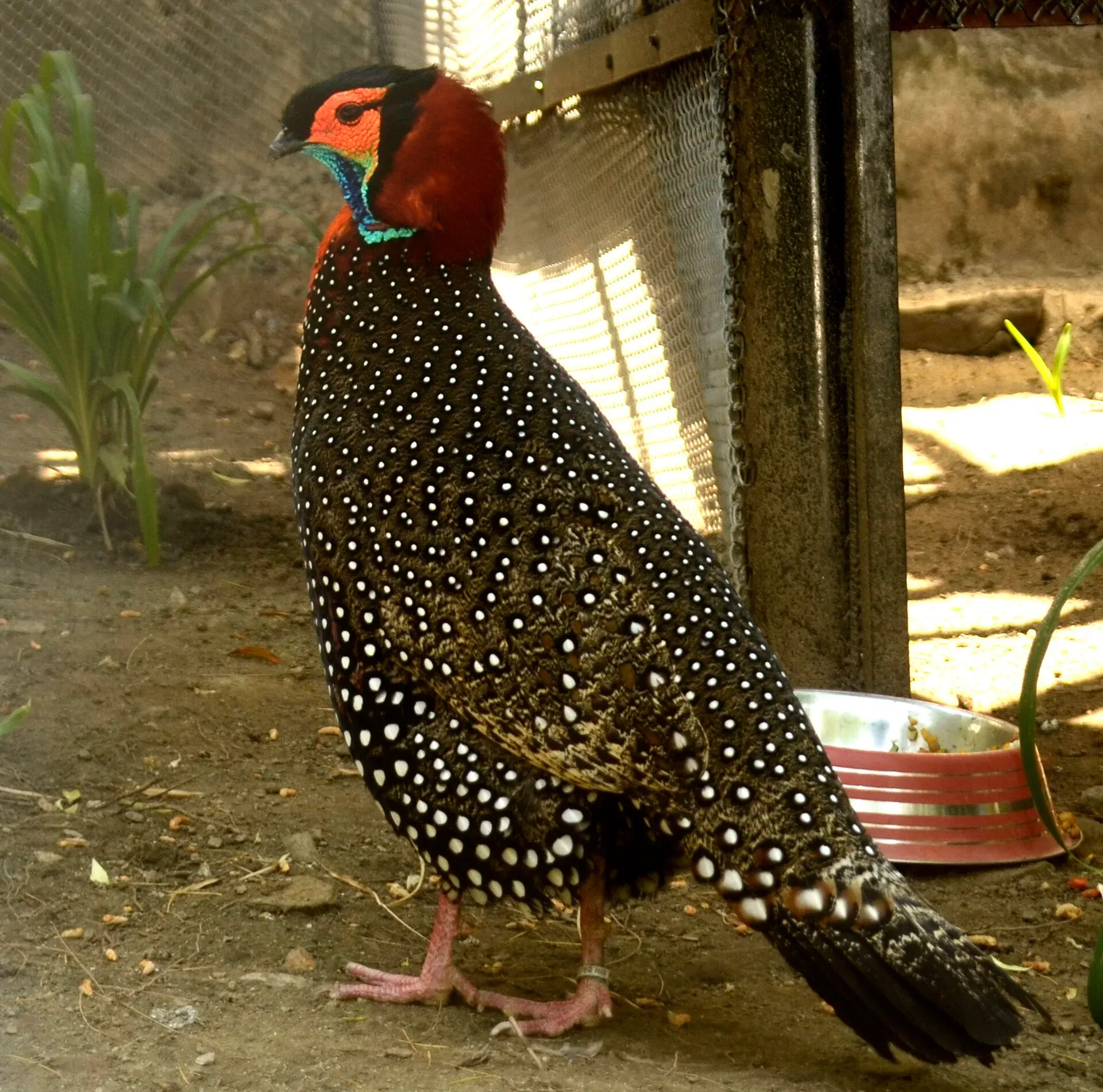
Photo: PJeganathan, with thanks · CC BY-SA 4.0 · via Wikimedia Commons · temporary stand-in photo

Western Tragopan
One of the rarest pheasants in the world. The male is dark with white spots, a blue throat and two blue horns. In Pakistan it lives in dense forest in Kohistan and the Kaghan valley.
Overview
The western tragopan (Tragopan melanocephalus) is a shy forest pheasant of the western Himalaya. It is globally threatened and one of the rarest living landfowl. Most visitors will not see one, but its forests are worth the trip for other wildlife.
Identification
- Size: males are about 55 to 60 cm long and weigh 1.8 to 2.2 kg. Females are 48 to 50 cm.
- Male: very dark grey and black with many white spots, deep crimson patches on the sides and back of the neck, a bare blue throat, red facial skin and a small black crest. In display he inflates the throat into purple lappets and raises two blue "horns".
- Female: pale brownish grey, finely marked, with black patches and white streaks.
- Call: a loud, ringing two-note wou-weee, repeated about once a second for long periods.
Where and when to see it in Pakistan
Pakistan holds one of the five known populations, in Kohistan and the Kaghan valley. The tragopan lives between about 1,750 and 3,600 m: in summer in upper temperate forest, and in winter in dense conifer and broadleaf forest at roughly 2,000 to 2,800 m. It keeps to thick undergrowth, so sightings are rare. Machiara National Park in Azad Kashmir lists it among its records. The breeding season is May and June, when males call.
Behaviour
Tragopans are mostly tree-dwelling but feed on the ground, taking leaves, shoots, seeds and insects. They roost in trees and nest in low tree hollows.
Threats and conservation
The IUCN lists the western tragopan as Vulnerable (assessment published 2025). The world population is estimated at fewer than 5,000. It is sensitive to disturbance and avoids sites such as hydroelectric project areas. Its feathers are traded, and CITES lists it in Appendix I to discourage that trade.
Birding etiquette
Keep your distance and use binoculars. Never play recorded calls near nests, and do not use flash. Stay on paths, keep dogs away, and follow the instructions of park staff and local guides. Do not search for nests or call-play for this species.
Sources and last checked
Last checked Confidence medium3 sources3 still to check
- Last checked
- Method
- Desk research from published sources
- Confidence
- medium
- Checked by
- trek.pk research team
Researched from published sources; not yet checked on the ground by our team. Spot something out of date? Report a mistake.
Sources
- Western tragopan · Wikipedia · checked
- Tragopan melanocephalus (assessment 2025) · IUCN Red List · checked
- Tragopan melanocephalus (IUCN Red List category) · GBIF, IUCN Red List checklist · checked
Still to be checked on the ground (3)
- Current Pakistan population and trend: only the world figure (fewer than 5,000) was found; no Pakistan count
- Whether current access rules apply in Kaghan and Kohistan forests: no official page found
- Breeding season (May and June): Wikipedia gives it without a citation