

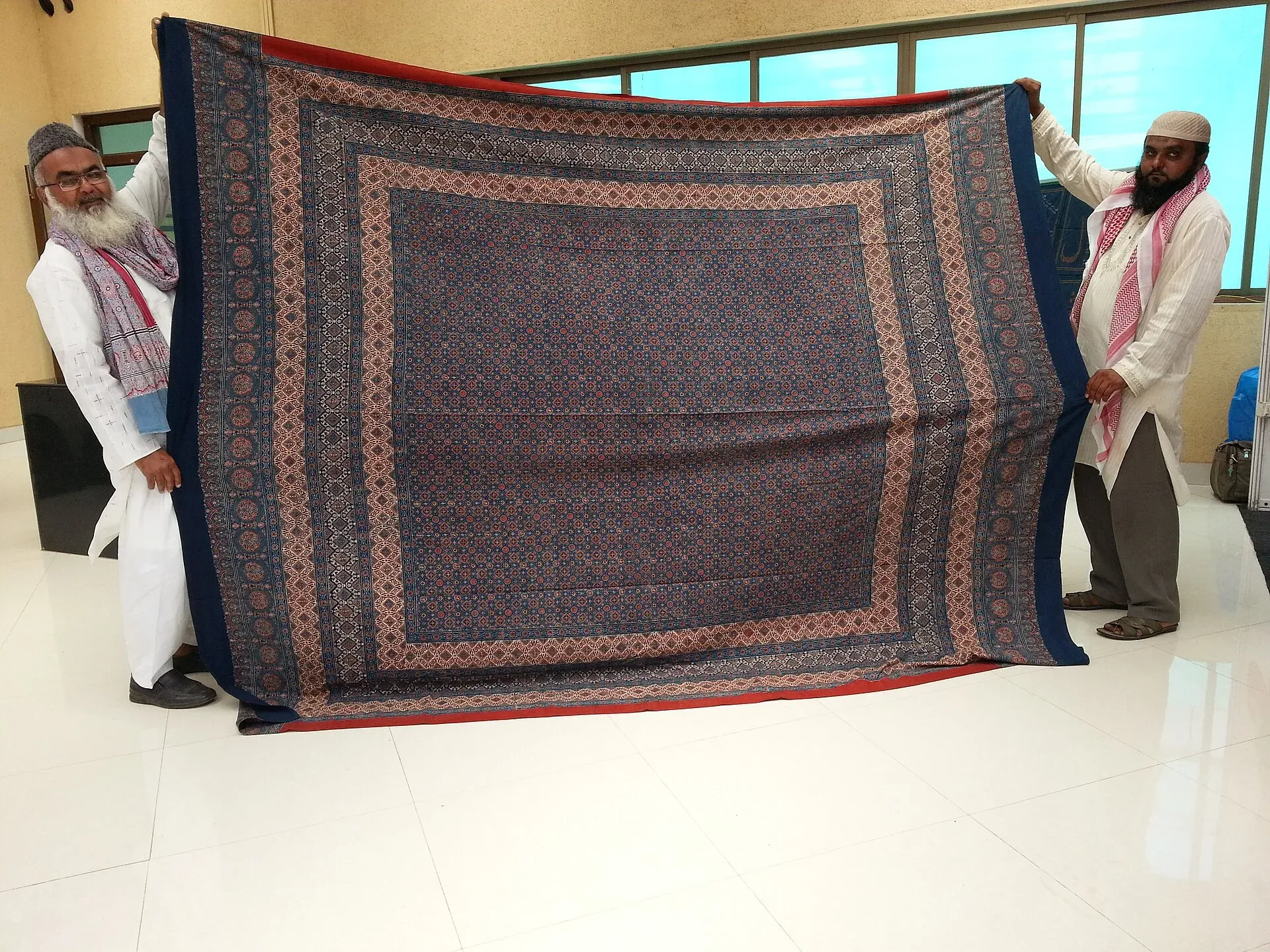
Photo: Visdaviva, with thanks · CC BY-SA 3.0 · via Wikimedia Commons · temporary stand-in photo

Ajrak (Sindh)
Ajrak is Sindh's block-printed cloth, usually deep indigo and crimson with white and black geometric patterns. It is given to guests as a mark of respect and worn as a shawl or wrap.
What it is
Ajrak is a block-printed cloth from Sindh and nearby Saraiki-speaking areas of southern Punjab. It is usually sold as a long, unstitched length that can be a shawl, a wrap or a dupatta. In Sindh it is also a gift of honour: hosts often place an ajrak, and a Sindhi cap, on a guest.
Materials and technique
The cloth is printed with carved wooden blocks using resist-dye methods, built up over several stages. Colours are deep indigo and crimson, with white and black to outline the motifs. Traditional ajrak uses vegetable and mineral dyes, and indigo is the key one. The central patterns have their own names, such as ghaleecho and ishq pech. Many designs are built from circles and a strict grid, often with rows of small dots between two lines. How neatly those dots are carved is one sign of a skilled block-maker.
Where it is made
Production is spread across Sindh. Matiari, Hala, Bhit Shah, Moro, Sukkur, Kandiaro and Hyderabad are all named as centres. You will find ajrak in bazaars of most Sindhi towns.
History
Ajrak is often linked to the Indus Valley. The stone bust known as the Priest-King from Mohenjo-daro wears a patterned shoulder cloth that some writers say resembles an ajrak. Treat this as tradition rather than proof of an unbroken craft. The name probably comes from Persian.
How to recognise good work
Look for sharp, even edges to the pattern, crisp dots, and colour that is deep but not painted on. Ask whether the dyes are natural. Chemical dyes have become common because they are cheaper, so natural dye is a real difference. Ask to see how both sides look: traditionally the print goes through the cloth, though check this with the maker.
Buying ethically
Ask who printed the cloth and whether they are a family workshop. Prefer buying from workshops and cooperatives directly where you can, and be willing to pay a fair price for natural-dye work. Prices vary a great deal, so we do not quote one. Machine-printed copies are common, and they are not the same craft.
Where to see it made
Block-printing workshops operate in the Hala and Matiari area and around Hyderabad. Visits are usually informal, so ask permission and go at a time that suits the workers.
Care
Wash by hand in cold water with a mild soap, and wash it separately at first as natural dyes can run. Dry in shade.
Safety
Sindh north of and including Nawabshah is covered by UK FCDO advice against all but essential travel. Sukkur and Khairpur fall in that area. Check the UK FCDO travel advice for Pakistan (still current on 17 November 2026) before you plan a trip.
Sources and last checked
Last checked Confidence medium3 sources3 still to check
- Last checked
- Method
- Desk research from published sources
- Confidence
- medium
- Checked by
- trek.pk research team
Researched from published sources; not yet checked on the ground by our team. Spot something out of date? Report a mistake.
Sources
- Ajrak · Wikipedia · checked
- Pakistan travel advice · UK FCDO · checked
- Pakistan travel advice · UK FCDO · checked
Still to be checked on the ground (3)
- Whether both sides are printed on genuine pieces (not stated in Wikipedia; ask makers)
- Current block-printing workshop areas open to visitors (Wikipedia lists Matiari, Hala, Bhit Shah, Moro, Sukkur, Kandiaro, Hyderabad as production centres; visiting rules not confirmed)
- Which plants and minerals are used in the dyes (only indigo is named in sources)