

Photo: EastReviser, with thanks · Public domain (CC0) · via Wikimedia Commons · temporary stand-in photo

Balochi Embroidery
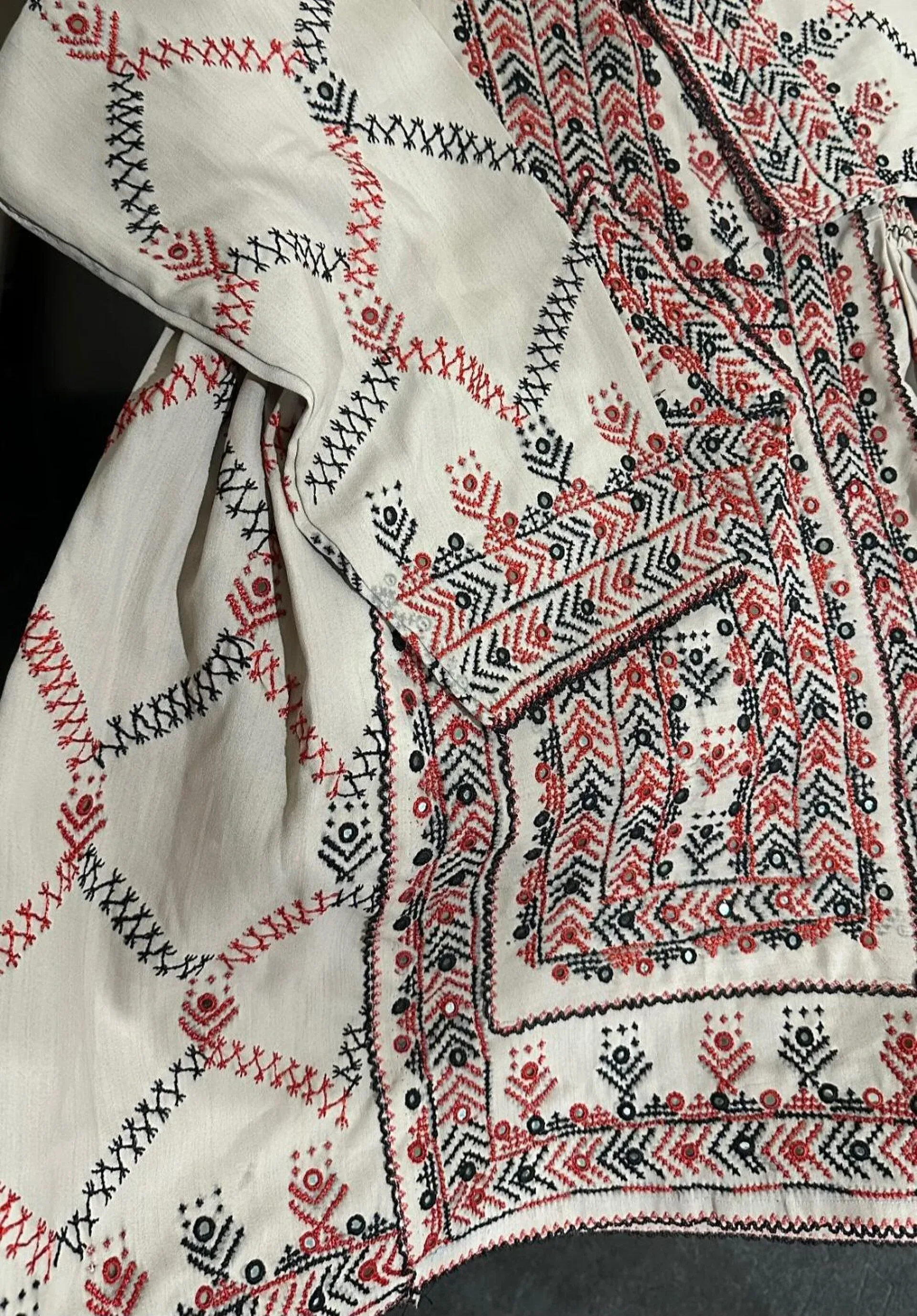
Balochi needlework is dense hand embroidery on dresses and household cloth, in geometric motifs with small mirrors. It is traditionally women's work, and each tribe has its own designs.
What it is
Balochi needlework is a hand embroidery tradition of the Baloch people of Balochistan, and also found in Iran and Afghanistan. It decorates women's clothing most often, and also cushions, curtains, tablecloths and men's clothing.
Materials and technique
The stitching is dense and detailed, often in bright thread on a dark or plain base cloth. Some designs add small pieces of mirror, called shisha, and bits of coloured cloth. Common motifs include arrows, chicken feet, diamonds and flowers. Each tribe has its own design language, and the patterns carry meaning to those who know them.
Who makes it
The craft has traditionally been practised only by women and passed down within families. A piece can take a long time to complete.
Where it is made
It is made by Baloch communities in Balochistan, and also in Afghanistan and Iran. There is no known source that names which Pakistani towns are strongest for it, so ask craft organisations or sellers where a piece was made.
History
The exact history is unknown. One theory ties it to Mehrgarh, the Neolithic site. Another connects it with silk production, and a third links it to Slavic migration. Treat these as theories rather than facts.
How to recognise good work
Check that the stitches are small and even and the mirrors are firmly held with thread, not glue. Turn the cloth over: the back should be tidy. The colours should hold when you rub the cloth with a damp white cloth. Machine embroidery is regular and flat, and it is a different product.
Buying ethically
Because the work is mostly done by women at home, ask how the seller pays the embroiderer. Cooperatives and women-led craft groups pass more money to makers. Pay a fair price for the long hours. We do not quote prices. Avoid sellers who cannot say who made a piece.
Where to see it made
Embroidery is made at home, so seeing it normally depends on a personal introduction. Do not enter homes uninvited and always ask before taking photographs.
Care
Hand wash in cold water with mild soap, do not wring, and dry flat in shade. Wash mirror work gently so the thread is not stressed.
Safety
Ask the district administration or local police about current conditions before you go. For foreign visitors: the UK FCDO advice is against all travel to Balochistan, including Quetta. Buy Balochi embroidery from craft markets in other cities or from reputable craft organisations instead. Check the UK FCDO travel advice for Pakistan (checked 17 November 2026) before you plan a trip.
Sources and last checked
Last checked Confidence low3 sources3 still to check
- Last checked
- Method
- Desk research from published sources
- Confidence
- low
- Checked by
- trek.pk research team
Researched from published sources; not yet checked on the ground by our team. Spot something out of date? Report a mistake.
Sources
- Balochi needlework · Wikipedia · checked
- Foreign travel advice: Pakistan · UK Foreign, Commonwealth & Development Office · checked
- Baloch people · Wikipedia · checked
Still to be checked on the ground (3)
- Sources for this craft are general references; local detail on Pakistani Baloch styles is thin
- Which Pakistani towns have strong embroidery traditions is not documented
- Quality tests are general advice