

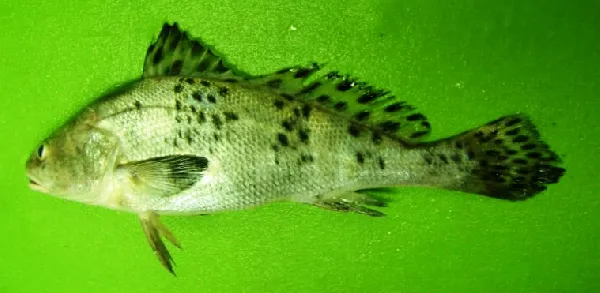
Photo: Hamid Badar Osmany, with thanks · CC BY 3.0 · via Wikimedia Commons · temporary stand-in photo

Blackspotted Croaker (Ghol)
A large coastal croaker whose swim bladder, sold dried as fish maw, fetches very high prices in East Asia. A specimen collected in Pakistan is photographed on Commons; Pakistan trade figures are not verified.
Overview
The blackspotted croaker (Protonibea diacanthus), known as black jewfish in Australia and called ghol in Pakistan, is a large croaker of the Indo-Pacific.
Identification
- Size: up to about 1.8 m (Wikipedia); FishBase gives 165 cm for females.
- Marks: three to five broad dark vertical bands on the body and small black spots on the head, back and fins. These fade as the fish grows.
- Swim bladder: carrot-shaped, with branches along both sides.
Where it lives in Pakistan
It lives in coastal waters, usually shallower than 60 m (FishBase: 5 to 100 m), over mud, and sometimes enters estuaries and tidal rivers. A photograph on Wikimedia Commons shows one collected in Pakistan, and marine jewfish and croakers are among the demersal fish taken in Pakistan's coastal waters (Wikipedia, Fishing in Pakistan).
Fish maw
The dried, salted swim bladder (fish maw) is sold in markets (FishBase), and Wikipedia says croaker maw fetches the highest prices of any fish maw. Wikipedia's page on the blackspotted croaker reports Indian catches selling for several thousand rupees per kilogram to buyers in the pharmaceutical trade, and says some East Asian buyers believe its organs are medicinal, although there is no evidence for this. We have not verified Pakistan's trade figures, prices or export routes.
Seasons
We have no verified Pakistan-specific season. FishBase gives a maximum age of about 8 years.
Conservation
The IUCN lists the blackspotted croaker as Near Threatened (IUCN, 2020). High prices for the swim bladder are a reason for care: Wikipedia's fish maw article links the trade to wildlife poaching worldwide.
Good to know
Fishing rules, licences and any closed seasons for the coast are set by the Sindh and Balochistan fisheries authorities and the federal Marine Fisheries Department, so check with the provincial Fisheries Department before you fish. We have no verified current rules to give here. Buy fish at the landing site or market rather than from roadside sellers you cannot check, ask before photographing fishermen, and never take or disturb marine life on a beach. Safety: For foreign visitors: the UK FCDO advises against all travel to Balochistan, including Quetta and Ziarat (page updated 27 October 2026; checked 17 November 2026). We do not recommend visiting the Balochistan coast as a tourist. The FCDO also notes an ongoing risk of terrorism across Pakistan.
Sources and last checked
Last checked Confidence low5 sources3 still to check
- Last checked
- Method
- Desk research from published sources
- Confidence
- low
- Checked by
- trek.pk research team
Researched from published sources; not yet checked on the ground by our team. Spot something out of date? Report a mistake.
Sources
- Blackspotted croaker · Wikipedia · checked
- Protonibea diacanthus (Blackspotted croaker) · FishBase · checked
- Fish maw · Wikipedia · checked
- Fishing in Pakistan · Wikipedia · checked
- Protonibea diacanthus (IUCN Red List category) · GBIF, IUCN Red List checklist · checked
Still to be checked on the ground (3)
- Pakistani local name and spelling (ghol), which is not yet checked against a Pakistani source
- Pakistan fish maw prices, volumes and export routes
- Any local rules on landing, sale or export