

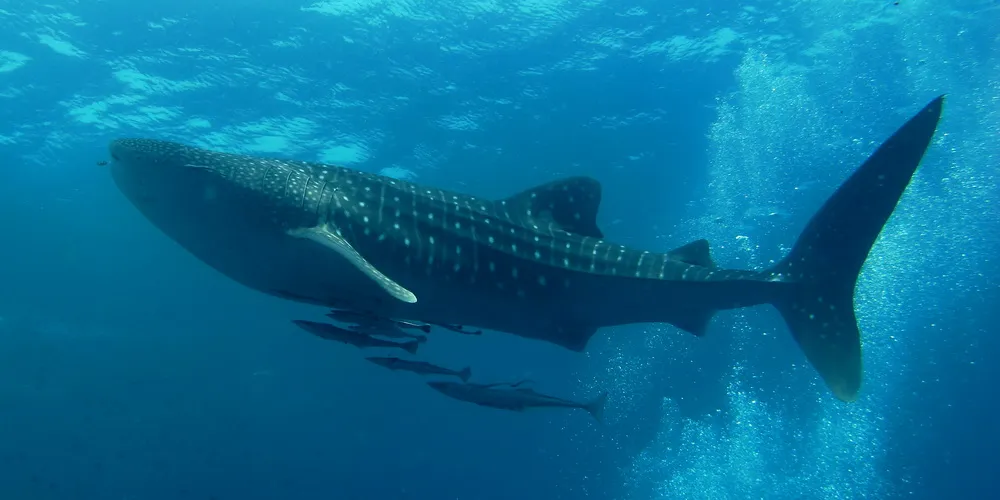
Photo: Abe Khao Lak, with thanks · CC BY-SA 4.0 · via Wikimedia Commons · temporary stand-in photo

Whale Shark
The world's largest fish, a gentle plankton-feeder. Pakistan's records are of rare, large individuals off Karachi, including a 40-foot female found floating in February 2012; the IUCN lists the species as Endangered.
Overview
The whale shark (Rhincodon typus) is the largest known living fish. It is a slow-moving filter feeder that eats plankton, krill, fish eggs and small schooling fish. Wikipedia describes it as docile and not a significant threat to humans.
Identification
- Size: the largest reliably recorded was 18.8 m long. Most are smaller.
- Marks: a broad flat head and a pattern of pale spots and stripes on a grey-blue back.
- Mouth: very wide, at the front of the head.
Records in Pakistan
On 7 February 2012 a whale shark was found floating off Karachi. The Express Tribune (10 February 2012) reported a 40.1-foot female of about 15 tonnes. The Marine Fisheries Department's director general said it was the second-largest fish found in Pakistan, and the paper said a 41.5-foot whale shark had been found off Karachi in 1947. Officials believed it had died naturally, since no marks were visible. Karachi Fish Harbour Authority officials said it was government property. Wikipedia places the find about 150 km off Karachi; the newspaper says it was floating near Bhit Shah Island. We have not reconciled the two.
We have found no verified recent sightings, and no verified details of WWF-Pakistan rescue or release work, so we do not describe either here.
Seasons
We have no verified season for whale sharks in Pakistani waters. Wikipedia lists seasonal feeding groups in places including the Persian Gulf and Gulf of Oman and off Gujarat in India.
Seeing it
There are no verified whale shark tours in Pakistan. Do not travel hoping to see one.
Conservation
The IUCN lists the whale shark as Endangered (IUCN, 2016). Wikipedia reports a global decline of about 50% over 75 years, with about 63% in the Indian and Pacific oceans, caused by bycatch, boat strikes and pollution. The species is in CITES Appendix II. India banned fishing of whale sharks in 2001. We have not verified its legal status in Pakistan.
If you find an entangled or stranded whale shark, contact the local fisheries or wildlife authorities and do not touch or cut the animal.
Good to know
We do not give Pakistan-specific legal advice here. Ask the Sindh or Balochistan wildlife or fisheries department about any rules before you go near a stranded or caught animal. Safety: For foreign visitors: the UK FCDO advises against all travel to Balochistan, including Quetta and Ziarat (page updated 27 October 2026; checked 17 November 2026). We do not recommend visiting the Balochistan coast as a tourist. The FCDO also notes an ongoing risk of terrorism across Pakistan.
Sources and last checked
Last checked Confidence low4 sources4 still to check
- Last checked
- Method
- Desk research from published sources
- Confidence
- low
- Checked by
- trek.pk research team
Researched from published sources; not yet checked on the ground by our team. Spot something out of date? Report a mistake.
Sources
- Whale shark · Wikipedia · checked
- Experts to cut up 40.1-foot long whale shark today · The Express Tribune · checked
- Fishing in Pakistan · Wikipedia · checked
- Rhincodon typus (IUCN Red List category) · GBIF, IUCN Red List checklist · checked
Still to be checked on the ground (4)
- WWF-Pakistan rescue and release work (the WWF-Pakistan website blocked automated reading and no article was found)
- Whale shark legal protection in Pakistan
- Recent sightings in Sindh and Balochistan waters
- Location of the February 2012 find (Wikipedia and Express Tribune differ)