

Photo: Yasir Dora, with thanks · CC BY-SA 4.0 · via Wikimedia Commons · temporary stand-in photo

Chaukhandi Tombs
A cemetery of tall, richly carved sandstone tombs on a ridge east of Karachi, about 27 km from the city on the Thatta road. Built by Baloch and Sindhi families in the 16th to 18th centuries; on Pakistan's UNESCO tentative list.
Overview
The Chaukhandi tombs are a graveyard of yellow-buff sandstone tombs on a low ridge in eastern Karachi, beside the road to Thatta. The Sindh Department of Antiquities puts it about 27 km from the city centre and says the graves are spread along the ridge for about 1.5 km. The carving is the reason to come: stacked slabs, many with horsemen, weapons and jewellery cut into the stone.
The tombs are in the same lower-Sindh funerary style as the much larger Makli Necropolis near Thatta, and are quicker to reach from Karachi.
Plan your visit
- Nearest town
- Karachi
- Getting there
Chaukhandi is about 31.6 km (roughly 35 minutes) by road from central Karachi (OSRM, checked 16 November 2026), on the old Karachi to Thatta road in Karachi's eastern outskirts. More
Best months
Nov – Feb
- Chaukhandi Tombs
- Related places nearby: Karachi, Makli Necropolis, Thatta, Ibrahim Hyderi
History
Accounts differ a little. The Sindh Department of Antiquities says the tombs belong to Baloch warrior families who settled here in the 17th and 18th centuries. Wikipedia gives the 16th to 18th centuries and links many graves to the Jokhio tribe, with Burfat, Jakhra, Shaikh and Kalmati Baloch families also buried here. Either way, the main building phase falls in the Mughal period. Wikipedia notes that scholars date the peak differently (first half of the 17th century, or the later 18th) and that the one tomb with a legible date reads AH 1169 (AD 1756).
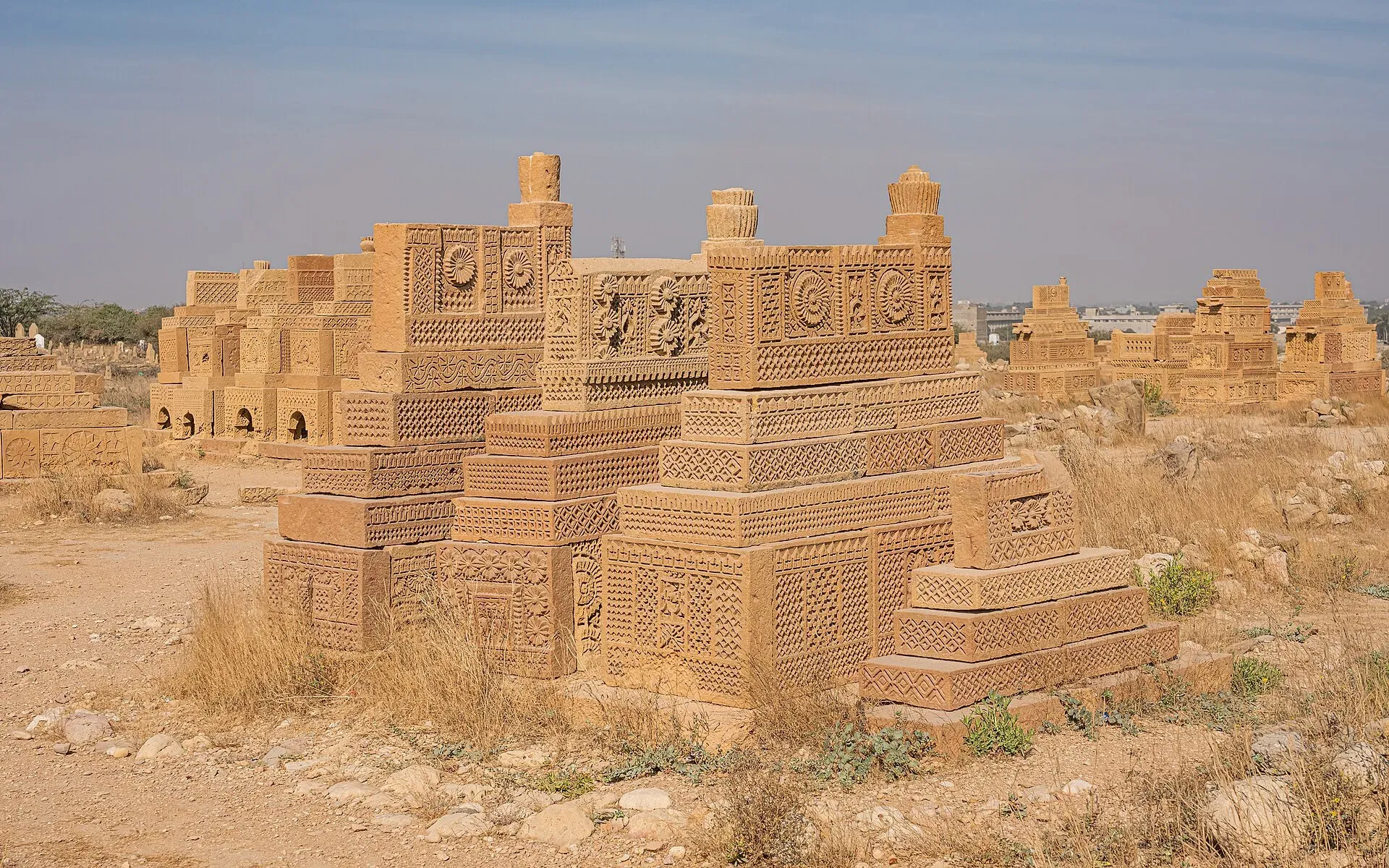
Photo: A.Savin, with thanks · Public domain (CC0) · via Wikimedia Commons · temporary stand-in photo

The name Chaukhandi is read in different ways: as a place name, as a domed pavilion, or as a four-walled enclosure around a grave. Each reading has objections, and the question is unresolved. Wikipedia also notes that the "Baloch tombs" label is disputed and that the original age and history remain unclear. Similar cemeteries exist in Lasbela and elsewhere in southern Balochistan. The earliest written reference to the Chaukhandi graves is a letter of 1851 to Sir Bartle Frere, and the first serious study was by H. D. Baskerville in 1917. Salome Zajadacz-Hastenrath's 1978 study photographed 50 cemeteries and tombs across Sindh and Balochistan and set out the first systematic typology. The tombs near Landhi were listed under the Ancient Monuments Preservation Act of 1904 in 1922.
Pakistan placed the tombs on its tentative list for UNESCO World Heritage in 1993. They are not an inscribed World Heritage Site (checked against Wikipedia's list, 16 November 2026).
What to see and do
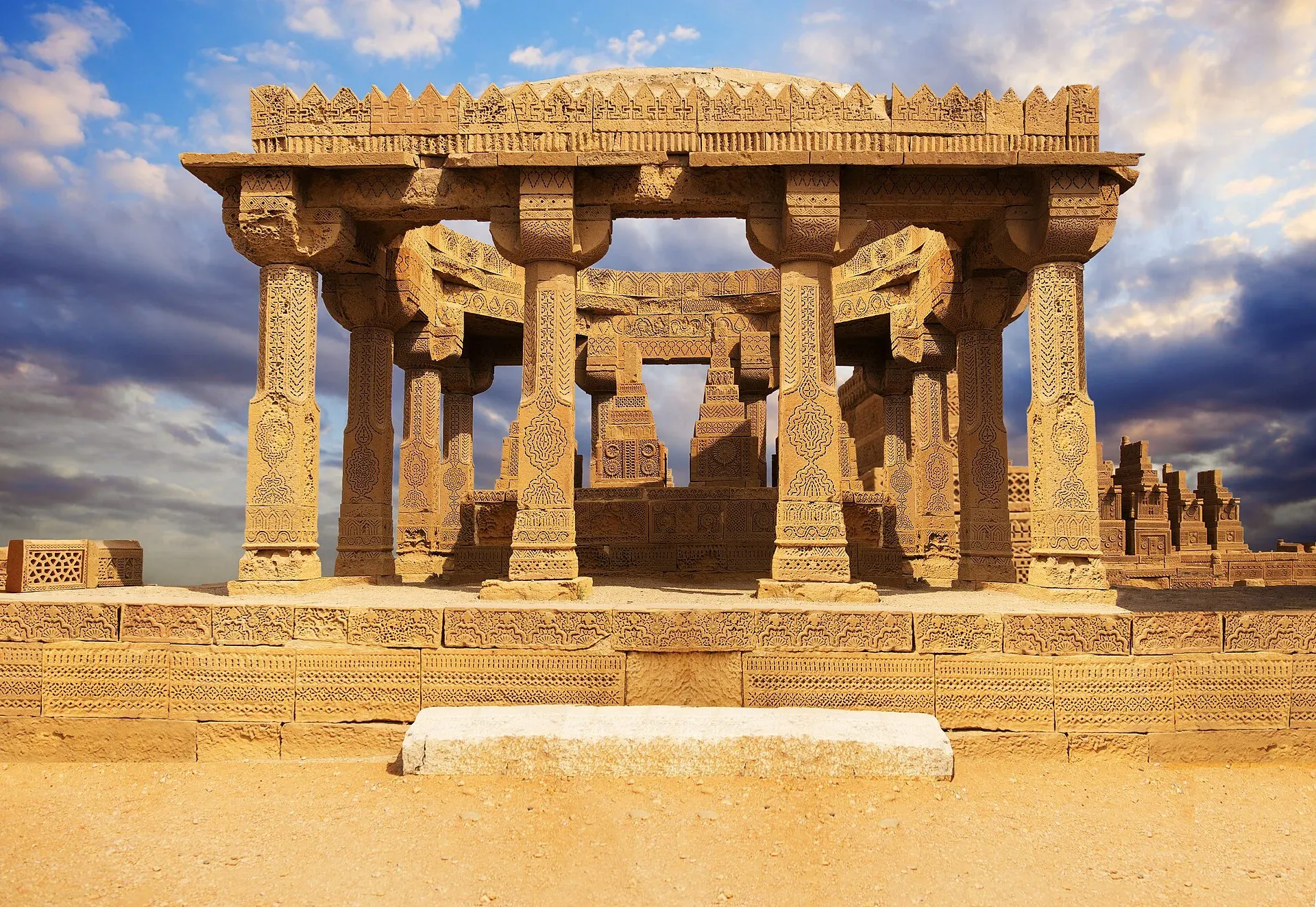
- The pyramid-shaped tombs. A typical grave has a sarcophagus of six vertical slabs (two long slabs on each side, one at the head and one at the foot). A second, smaller box of six slabs sits on top, giving a pyramid-like shape. The upper box is covered by four or five horizontal slabs, and a vertical slab on top is often carved at the north end into a knob called a crown or turban. Graves run north to south with the head to the north, so the dead face Mecca. Single graves or groups of up to eight stand on a shared platform.
- Carved horsemen. Male graves show a rider with shield, sword, bow and arrow. Some have a carved knob at the top that looks like a turban.
- Jewellery on women's graves. Female graves carry necklaces, bracelets, anklets and ringlets in stone.
- Canopied graves. Some groups stand under pillared canopies, and some tombs have arcade-like perforations in the lower casket or domed pavilion (chhattri) coverings.
- Geometric and written detail. Besides riders and jewellery, the stone carries geometric motifs, names and Quranic sayings. Human figures are mostly avoided apart from a few exceptions. The buff sandstone has often survived well in the dry climate.
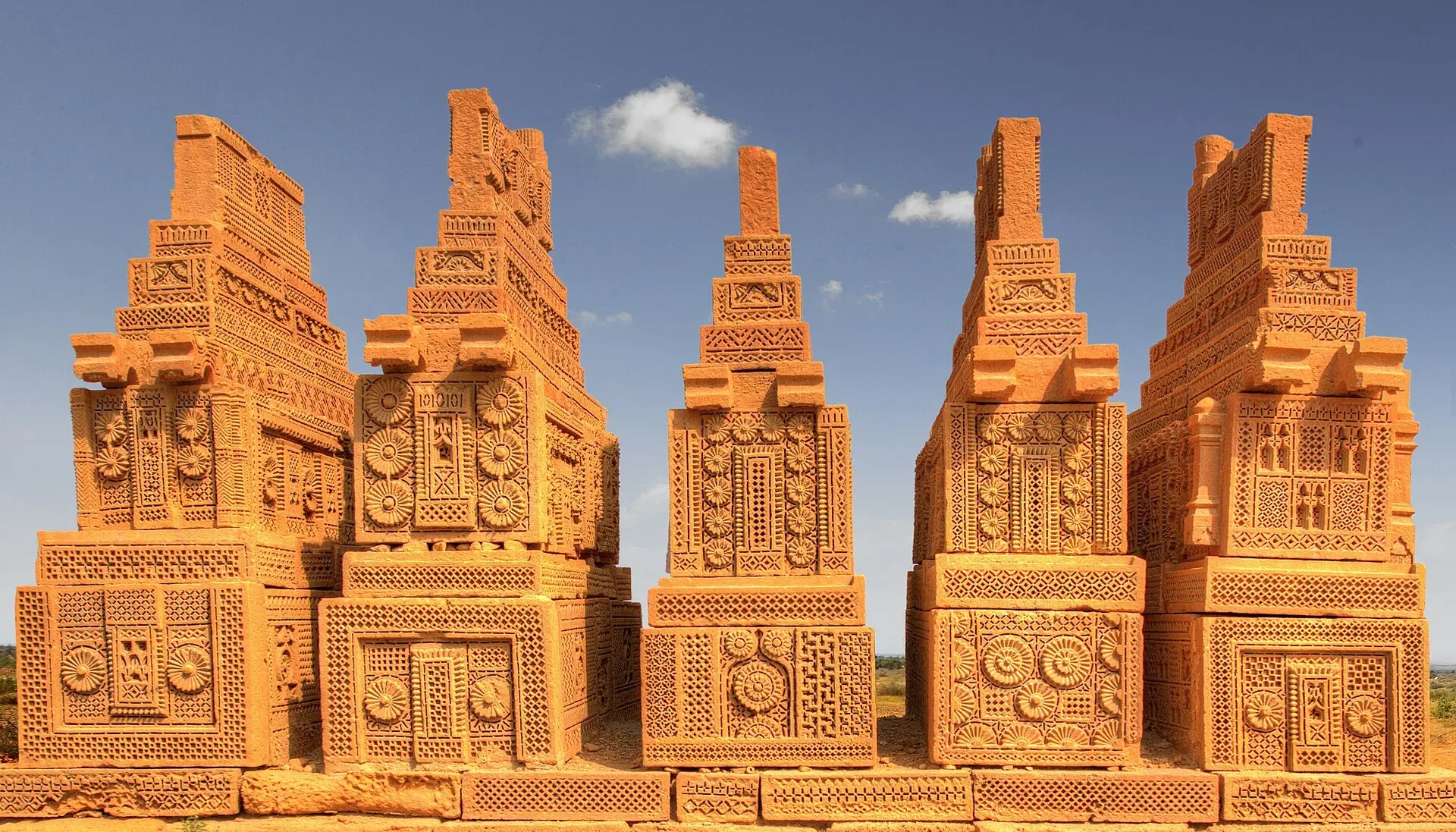
Photo: Yasir Dora, with thanks · CC BY-SA 4.0 · via Wikimedia Commons · temporary stand-in photo

An hour at the ridge
Allow about an hour. Walk the length of the ridge once to see the range of tomb forms, then pick out a rider grave, a woman's grave with its jewellery and a canopied group. Many visitors add Makli Necropolis and Thatta for a full day. Bring a camera and some patience for the light: early morning and late afternoon bring the carving into relief.
When to visit
November to February is the most comfortable time. The ridge has little shade, so avoid the middle of the day from April to September.
Where to stay and eat
Stay in Karachi; the tombs are a half-day trip, and there is little food or shelter at the site.
Good to know
- This is a graveyard. Walk only on clear paths, do not climb on or lean against the tombs, and dress modestly.
- Opening hours and fees are not published by the Sindh Antiquities website. Current fees will be added soon; check with the Directorate General of Antiquities & Archaeology, Government of Sindh.
- The site has seen weathering and little protective fencing. Take care with loose slabs.
- Karachi and the Thatta road are not covered by the UK FCDO's "against all travel" or "all but essential" lists (checked 16 November 2026), but conditions change; read the live page before you travel.
Highlights
- Hundreds of pyramid-shaped sandstone tombs on a ridge
- Carved horsemen, weapons and jewellery
- Same funerary style as Makli, closer to Karachi
- On Pakistan's UNESCO tentative list since 1993
Getting there
Chaukhandi is about 31.6 km (roughly 35 minutes) by road from central Karachi (OSRM, checked 16 November 2026), on the old Karachi to Thatta road in Karachi's eastern outskirts. Take a taxi, ride-hailing car or your own vehicle; a bus on the Thatta road will drop you at the main road but not at the gate. Karachi to Thatta is a further 75 km or so.
Tips
- Go in the morning or late afternoon for the best light.
- Check opening hours with the Sindh antiquities office before you set out.
- Stay off the graves and dress modestly.
- Combine with Makli Necropolis and Thatta for a full day.
Sources and last checked
Last checked Confidence medium6 sources5 still to check
- Last checked
- Method
- Desk research from published sources
- Confidence
- medium
- Checked by
- trek.pk research team
Researched from published sources; not yet checked on the ground by our team. Spot something out of date? Report a mistake.
Sources
- Chaukandi Graveyard, Karachi · Directorate General of Antiquities & Archaeology, Government of Sindh · checked
- Chaukhandi tombs · Wikipedia · checked
- List of World Heritage Sites in Pakistan (tentative list table) · Wikipedia (UNESCO site whc.unesco.org returned HTTP 403) · checked
- Pakistan Tourism Guide 2021 (Chaukhandi Tombs entry) · TDAP · checked
- OSRM driving route calculation · OSRM (OpenStreetMap routing) · checked
- Pakistan travel advice (warnings and insurance), updated 27 October 2026 · UK Foreign, Commonwealth & Development Office · checked
Still to be checked on the ground (5)
- Opening hours and any entry fee (not on the Sindh Antiquities page)
- Exact century: sources give 16th to 18th; the one dated tomb is AD 1756
- Current condition and access to the ridge
- Hours and office contact: the Sindh Antiquities page lists Mon to Fri 07:00 to 21:00 and Sat/Sun 08:00 to 20:00 with phone +92-21-99212126 for the Directorate office in Clifton; these appear to be office details and are not confirmed as the site hours
- Alt text of new photos written from titles; not yet checked by eye
Nearby and related

Karachi
Pakistan's largest city and main port: colonial buildings, museums, beaches, busy bazaars and some of the country's best food.

Makli Necropolis
One of the world's largest burial grounds, near Thatta in Sindh, with hundreds of thousands of graves and royal tombs from the 14th to 18th centuries. A UNESCO World Heritage Site since 1981.

Thatta
Sindh's medieval capital, home to the UNESCO-listed Makli Necropolis and the tiled Shah Jahan Mosque, about 100 km from Karachi and Hyderabad.
Ibrahim Hyderi
Old fishing village and fish harbour on Karachi's eastern coast, now a town of Malir District. It is a working community, not a resort.