

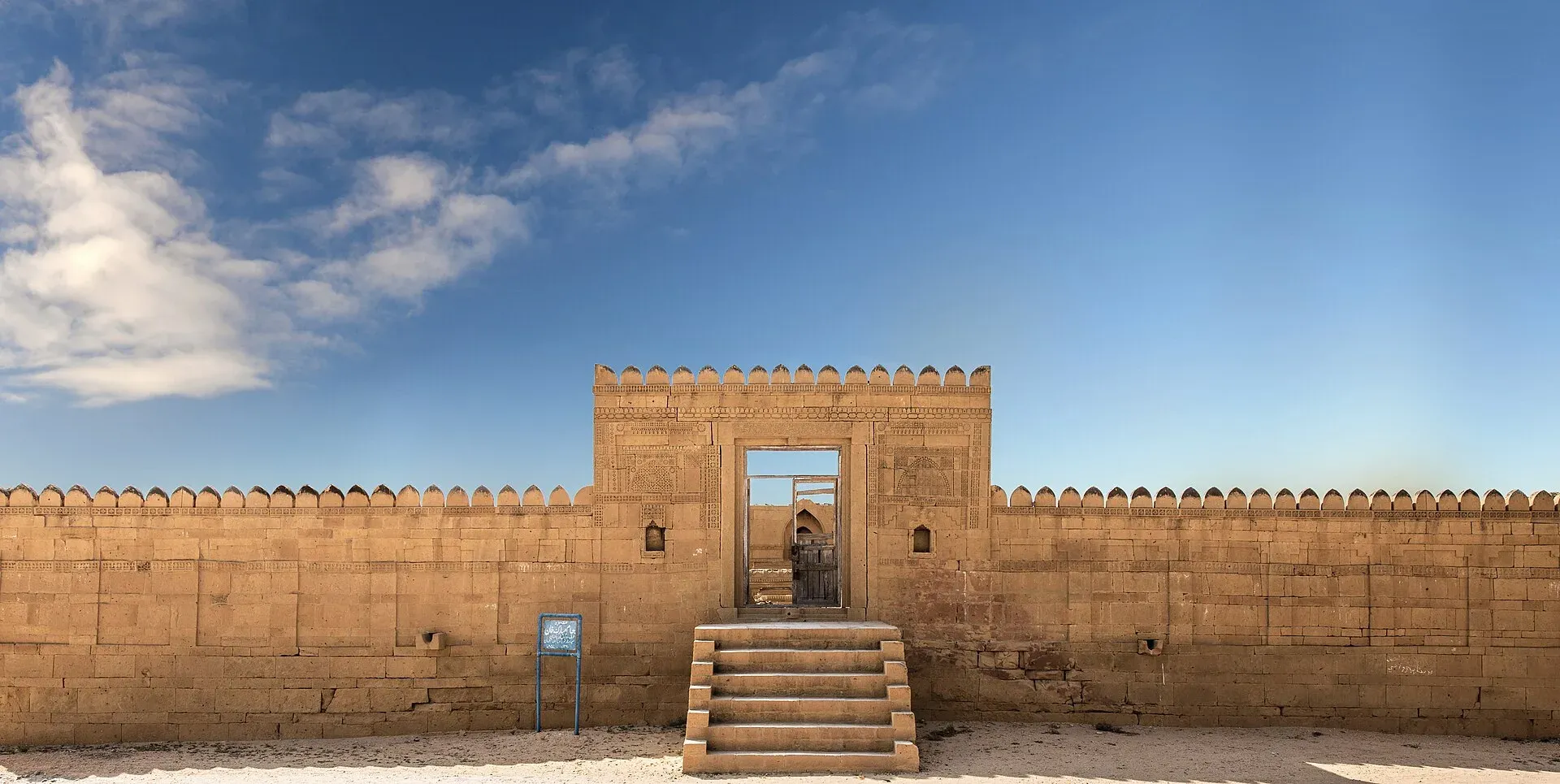
Photo: Yasir Dora, with thanks · CC BY-SA 4.0 · via Wikimedia Commons · temporary stand-in photo

Makli Necropolis
One of the world's largest burial grounds, near Thatta in Sindh, with hundreds of thousands of graves and royal tombs from the 14th to 18th centuries. A UNESCO World Heritage Site since 1981.
Overview
Makli Necropolis is a vast cemetery on a plateau about 6 km from Thatta, roughly 98 km east of Karachi and near the apex of the Indus delta. It covers about 10 square kilometres and is estimated to hold between 500,000 and a million graves, built over about 400 years. Thatta was the capital of lower Sindh until the 17th century, and the rulers, saints and scholars of that time are buried here.
You can walk among carved sandstone tombs, domed brick mausoleums and small tiled graves. The scale is what stays with most visitors.
Plan your visit
- Nearest town
- Thatta
- Getting there
Makli is about 4.5 km (7 minutes) from the centre of Thatta and about 101 km (around 1 hour 45 minutes) from Karachi by road (OSRM, checked 16 November 2026). Buses run from Karachi to Thatta; More
Best months
Nov – Feb
- Makli Necropolis
- Related place nearby: Keenjhar Lake
History
The Sufi saint Shaikh Hamad Jamali is said to have set up a gathering place (khanqah) here and was buried on the site. In the 14th century the Samma ruler Jam Tamachi asked to be buried near him, which began the tradition of royal burials. The Samma dynasty took Thatta in 1335. The most elaborate tombs date from the Mughal period, between about 1570 and 1640.
UNESCO inscribed the site in 1981 (reference 143, criterion iii) as a testament to Sindhi civilisation between the 14th and 18th centuries. It suffers from siltation, encroachment, vandalism and rubbish, and the 2010 floods added to the damage.
Wikipedia records a popular story that the saint named the hill "Makli", meaning "little Makkah", but adds that historical evidence does not confirm it. The historian Ali Ahmad Brohi has suggested the name comes from an old Mahakali temple.
Layout
The tombs stretch roughly in a diamond from Pir Patho at the southern end of the Makli hills northwards. The ridge forms the eastern edge. The largest monuments are mostly at the southern edge, and the Samma tombs lie in the north.
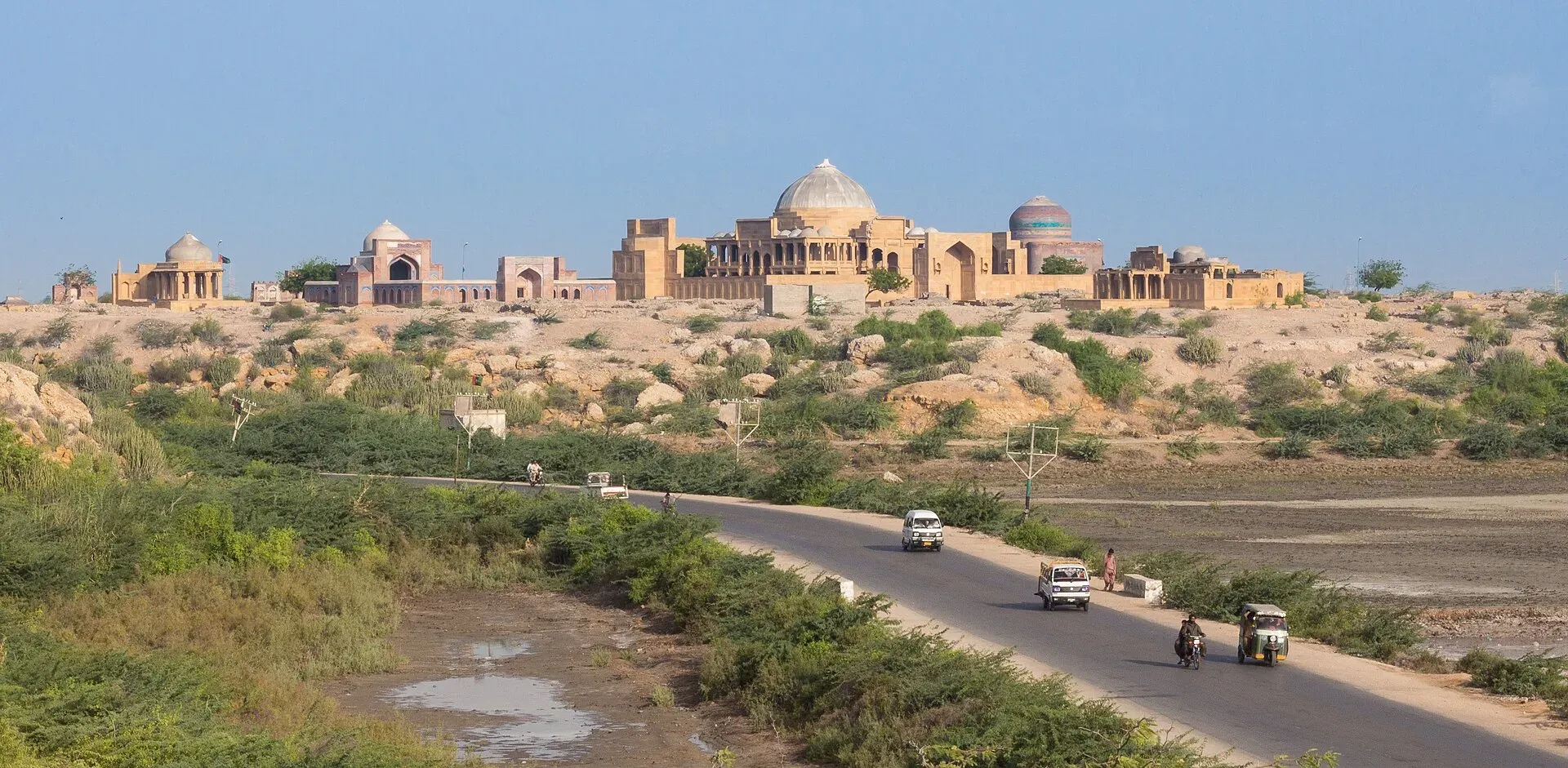
Photo: Shaharyar wiki, with thanks · CC BY-SA 3.0 · via Wikimedia Commons · temporary stand-in photo

The Samma tombs
- Tomb of Jam Nizamuddin II. Finished in 1510, it is a square sandstone tomb about 11.4 m on each side. Its box shape may echo the Kaaba. The carving has 14 bands of motifs, mixing Quranic verses with patterns found on Hindu temples, and a large Gujarati-style balcony (jharoka) that gives it a temple-like look. Its only figurative element is a frieze of local ducks. The dome was never built.
- Tomb of Darya Khan. Built after his death in 1521. Darya Khan was Jam Nizamuddin's adopted son, born a slave, who rose to general and chief minister. The tomb resembles a Rajasthani fort.
- Canopy tombs. Samma-period tombs include open canopy tombs on pillars, such as the one attributed to Daya Khan Rahu.
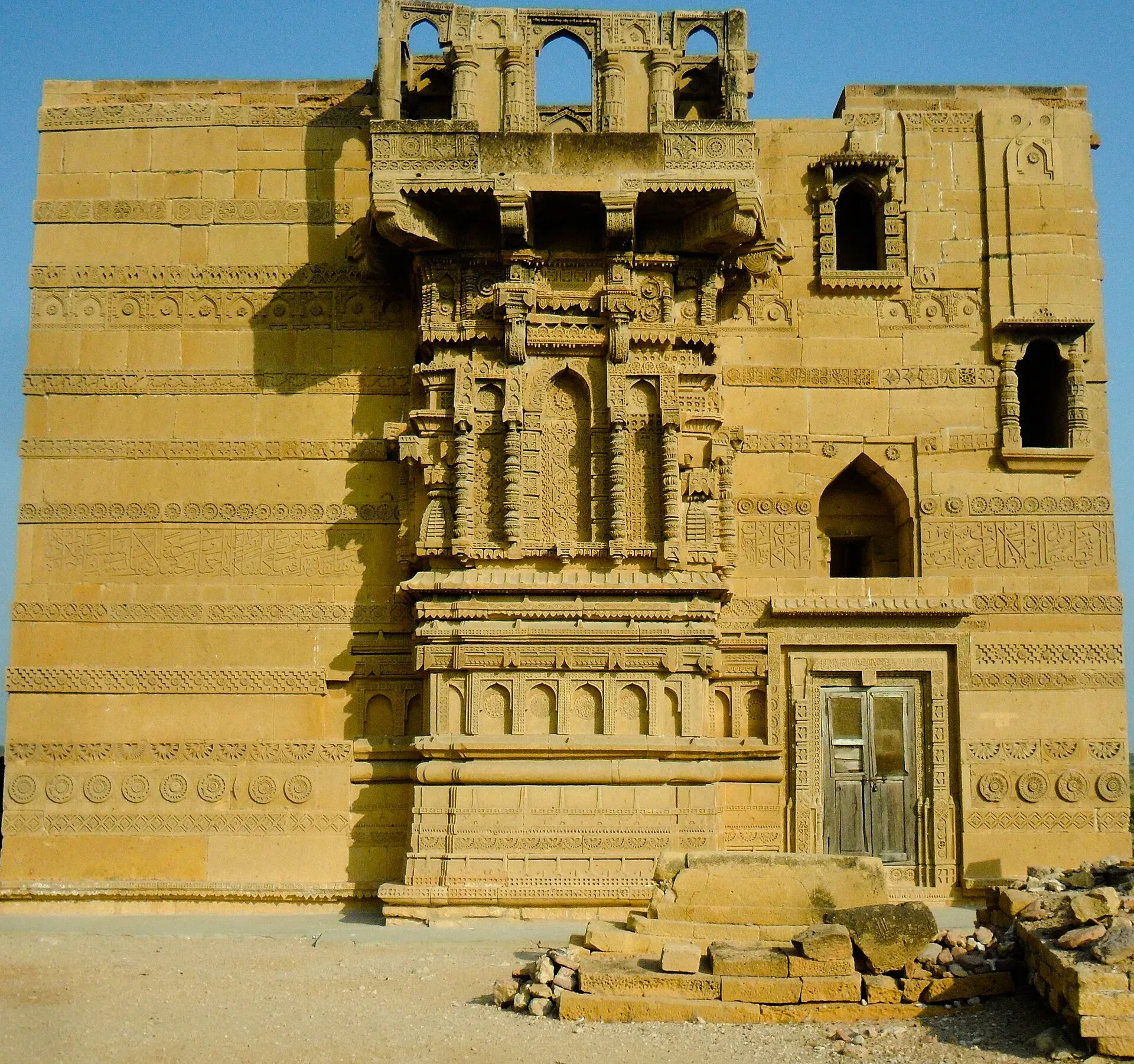
Photo: Syed HussainHyder Zaidi, with thanks · CC BY-SA 3.0 · via Wikimedia Commons · temporary stand-in photo

The Arghun, Tarkhan and Mughal tombs
- Isa Khan Tarkhan I (ruled 1554 to 1565). A rectangular tomb with Quranic verses on the inner walls, and an area for the graves of five royal women.
- Jan Beg Tarkhan (died 1600). An octagonal brick tomb with a dome covered in blue and turquoise glazed tile.
- Isa Khan Tarkhan II (Wikipedia calls him Isa Khan Hussain II Tarkhan; died 1651). A two-storey stone mausoleum with cupolas and balconies, said to have been built in his lifetime. A local story says the builders' hands were cut off to stop a rival monument; Wikipedia gives it as legend.
- Other Mughal-period tombs on the southern side include those of Mirza Jani Baig and Mirza Ghazi Baig, and of Nawab Shurfa Khan.
Architecture and carving
The tombs belong to the Chaukhandi style, named after tombs near Karachi, and mix Muslim, Hindu, Persian, Mughal and Gujarati ideas. The earliest graves are stacks of three to six carved sandstone slabs, like a small pyramid. In the 15th century rosettes and circular patterns appear, and later slabs carry complex patterns and Arabic calligraphy giving details of the person buried. Some carry animals, warriors and weapons, which Wikipedia calls uncommon in Muslim funerary art. The largest tombs have yellow sandstone canopies, plastered white, and the size of the dome shows the rank of the person buried. Some canopies show lotus flowers on the underside. Later tombs are often brick with only a sandstone slab. The 17th-century Leilo Sheikh tombs look like Jain temples from a distance. Blue tilework, typical of Sindh, appears on some tombs.
One or two days around Thatta
An outline built from the sights on this page: spend the morning at Makli, starting at the southern end for the large Tarkhan and Mughal tombs, then walk north to the Samma tombs. In the afternoon visit the Shah Jahan Mosque in Thatta, a red-brick mosque of 1647 with 93 domes (Wikivoyage). Rabri, a sweet made from condensed milk, is sold in clay pots along the N-5 near Thatta (Wikivoyage). See Thatta.
When to visit
November to February is the best time. Summer is very hot and the site has almost no shade. Go in the morning or late afternoon for the best light on the sandstone.
Where to stay and eat
Thatta has simple guesthouses and eateries, most of them on the N-5 and serving Pakistani food. Many visitors come on a day trip from Karachi. Bring water.
Good to know
- This is still a working cemetery, and some graves are visited for prayer. Dress modestly, do not walk on graves and keep your voice down.
- Wikivoyage says the gates of several large mausoleums, including that of Isa Khan Tarkhan II, stay closed without written permission from the Sindh Archaeological Department. Groups usually ask for it; individual visitors often do not. Ask at the main gate.
- The site is large and spread out. A vehicle helps; walking all of it in the heat is not realistic.
- Ticket prices and hours were not confirmed from an official source. Current fees will be added soon; check with the Department of Culture, Tourism and Antiquities, Government of Sindh.
Highlights
- Around 500,000 to 1 million graves over about 10 sq km
- Royal tombs of the Samma, Arghun, Tarkhan and Mughal periods
- Tomb of Jam Nizamuddin II, finished 1510
- Carved sandstone and blue-tiled tombs
- UNESCO World Heritage Site since 1981
Getting there
Makli is about 4.5 km (7 minutes) from the centre of Thatta and about 101 km (around 1 hour 45 minutes) from Karachi by road (OSRM, checked 16 November 2026). Buses run from Karachi to Thatta; take a rickshaw or taxi from there. Most visitors go by car on a day trip.
Tips
- Go between November and February and carry plenty of water.
- Hire a vehicle; the site is too big to walk in summer heat.
- Dress modestly and stay off the graves.
- Combine with the Shah Jahan Mosque in Thatta.
Sources and last checked
Last checked Confidence medium6 sources3 still to check
- Last checked
- Method
- Desk research from published sources
- Confidence
- medium
- Checked by
- trek.pk research team
Researched from published sources; not yet checked on the ground by our team. Spot something out of date? Report a mistake.
Sources
- Makli Necropolis (Wikipedia) · Wikipedia · checked
- List of World Heritage Sites in Pakistan · Wikipedia · checked
- Historical Monuments at Makli, Thatta · UNESCO World Heritage Centre · checked
- Pakistan Tourism Guide 2021 · TDAP Pakistan (Trade Development Authority of Pakistan) · checked
- OSRM routing (road distances) · Project OSRM · checked
- Thatta (Makli Necropolis entry notes) · Wikivoyage · checked
Still to be checked on the ground (3)
- Entry fee and opening hours (Wikipedia and Wikivoyage give neither; UNESCO page returns 403; no Sindh government page found)
- Current condition and which tombs are accessible (Wikivoyage says several large mausoleums are often closed; no dated report)
- Position of Pir Patho and which tombs are open now
Nearby and related

Karachi
Pakistan's largest city and main port: colonial buildings, museums, beaches, busy bazaars and some of the country's best food.

Sindh
Pakistan's south-east: Karachi's beaches and markets, the Indus Valley city of Moenjodaro, Thatta's Makli tombs, Sufi shrines, the Thar desert and the Indus delta.

Keenjhar Lake
Sindh's largest freshwater lake, about 36 km from Thatta and roughly 120 km from Karachi. A Ramsar site since 1976, with winter ducks, geese and flamingos and a shrine on an island.