

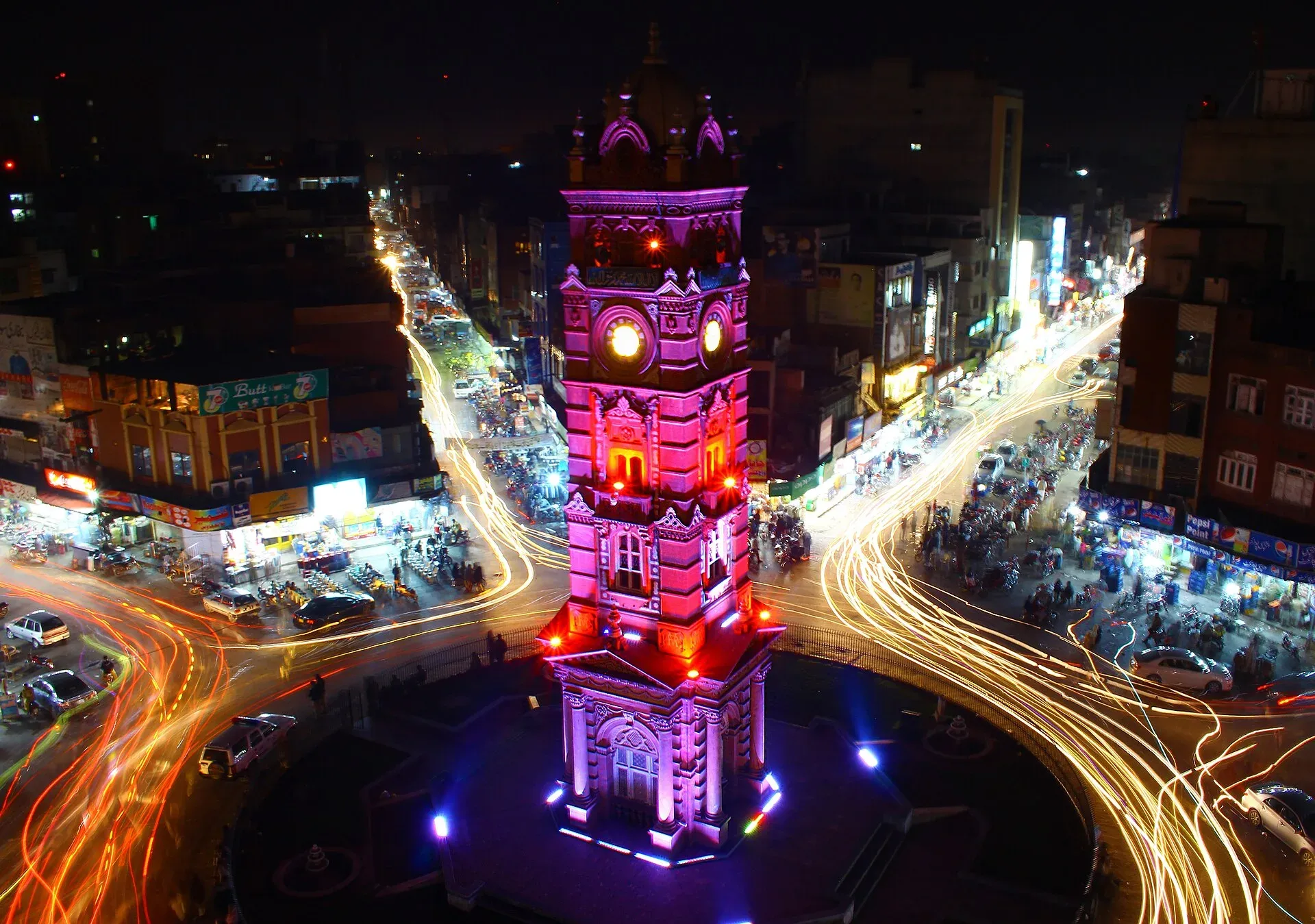
Photo: Usman Nadeem, with thanks · CC BY-SA 4.0 · via Wikimedia Commons · temporary stand-in photo

Faisalabad Clock Tower and Eight Bazaars
Faisalabad's red-sandstone Ghanta Ghar, built in 1905 at the centre of eight radiating bazaars laid out like the Union Jack.
Overview
The Clock Tower, locally Ghanta Ghar ("Hour House"), stands in the old centre of Faisalabad, once called Lyallpur. Eight bazaars run out from it in a star shape. Seen from above, the layout resembles the Union Jack flag. A round road called Gole Bazaar connects them. The tower is one of the city's oldest monuments still standing in its original state.
Plan your visit
- Nearest town
- Faisalabad
- Getting there
The tower is about 1.6 km from the centre of Faisalabad, roughly 4 minutes by road without traffic (OSRM routing). Rickshaws and ride-hailing cars reach the edge of the bazaars; the circle itself is crowded. More
Best months
Oct – Mar
- Faisalabad Clock Tower and Eight Bazaars
- Related places nearby: Faisalabad, Jhang, Lyallpur Museum
History
Faisalabad was planned as a market town for the new canal colony, laid out after the Sandal Bar scrub forest was cleared and canal water arrived. It was named Lyallpur after Sir James Lyall.
Sir James Lyall chose the site of the tower. A well on the plot was filled in. Sir Charles Montgomery Rivaz, lieutenant governor of the Punjab, laid the foundation stone on 14 November 1905. Money was raised at Rs 18 per square of land and passed to the Municipal Committee, which completed the work. Building took two years and cost Rs 40,000 at the time.
Architecture
The style is Indo-Saracenic Revival, a colonial-era blend of European and South Asian forms. The tower is built of red sandstone quarried in Sangla Hill tehsil, about 50 km away.
The eight bazaars
The bazaars are named for the direction they lead: Katchery, Chiniot, Aminpur, Bhawana, Jhang, Montgomery, Karkhana and Rail. Wikipedia lists their main trades as:
- Katchery: mobile phones.
- Chiniot: medicine, cloth and household fabrics.
- Aminpur: stationery and interior decor.
- Bhawana: electrical goods.
- Jhang: fish, meat, fruit and vegetables.
- Montgomery (also Sutar Mandi): yarn and raw cloth.
- Karkhana: herbal medicines.
- Rail: gold and cloth.
Trades change, so treat this as a guide. Faisalabad is called the "Manchester of Pakistan" for its textiles, and cloth and home furnishings are the staple goods of the wider market area.
Events at the tower
The tower is also the city's public stage. On Eid and Independence Day the city's head speaks here and raises the flag. Political rallies and demonstrations are often held at the circle. The central rally of the Juloos-e-Muhammadi procession and the city's largest Muharram procession are held here every year.
Food around the tower
Dishes listed for Faisalabad include halwa poori with lassi for breakfast, samosas, gol gappay, dahi bhale and malai seekh kebabs, with biryani and murgh pulao as local specialities. Rabri, a milk drink with nuts, is described as the city's favourite drink. Wikivoyage says parathas near the Ghanta Ghar draw crowds late into the night.
Nearby
- Lyallpur Museum is close to the tower.
- Jinnah Gardens (Company Bagh) is the city's oldest public park, and the Chenab Club inside it, built in 1904, is the oldest social club. Both are within walking distance of the tower and the railway station.
- Gatwala Park, on the north-east side of the city, has a lake and a zoo.
A short visit
An honest outline, built from the sights above: reach the circle in the morning, walk out along one or two bazaars, eat at the stalls and sweet shops, then walk to the Lyallpur Museum and Jinnah Gardens. Allow half a day. Heat and crowds make the early morning best in summer.
When to visit
October to March is best. Summer is very hot; go in the early morning or evening.
Where to stay and eat
Faisalabad has hotels across the city and plenty of casual food in the bazaars.
Good to know
- The area is very crowded and traffic is chaotic. Walk rather than drive.
- Protests and processions sometimes close the circle; check the news.
- Watch for pickpockets.
- Shops often close on Friday afternoons or on one weekday; check locally.
Highlights
- Clock tower, foundation stone laid 14 Nov 1905
- Eight bazaars radiating like the Union Jack
- Red sandstone from Sangla Hill
- Textile and street-food shopping
Getting there
The tower is about 1.6 km from the centre of Faisalabad, roughly 4 minutes by road without traffic (OSRM routing). Rickshaws and ride-hailing cars reach the edge of the bazaars; the circle itself is crowded.
Tips
- Walk in; traffic is heavy.
- Go early in the morning in summer.
- Check the news for processions.
- Bargain politely.
Photos we still need: a bazaar street radiating from the tower; street food around the circle. Send us yours
Sources and last checked
Last checked Confidence medium5 sources2 still to check
- Last checked
- Method
- Desk research from published sources
- Confidence
- medium
- Checked by
- trek.pk research team
Researched from published sources; not yet checked on the ground by our team. Spot something out of date? Report a mistake.
Sources
- Clock Tower, Faisalabad (Wikipedia) · Wikipedia · checked
- TDAP Pakistan Tourism Guide 2021 (heritage list) · TDAP · checked
- OSRM road routing (driving distance and time from the city centre) · OpenStreetMap / OSRM · checked
- Faisalabad (Wikipedia) · Wikipedia · checked
- Faisalabad · Wikivoyage · checked
Still to be checked on the ground (2)
- Which trades each bazaar has today (the list on the page is from Wikipedia and not dated)
- Whether the Lyallpur Museum and Jinnah Gardens are open and their hours
Nearby and related

Faisalabad
Pakistan's textile capital: a planned colonial city built around a clock tower with eight bazaars, plus gardens, a wildlife park, and the old wood-carving town of Chiniot nearby.

Sheikhupura
District capital 42 km from Lahore, founded by the Mughal emperor Jahangir in 1607. Home to Hiran Minar, a tower and tank built for his pet deer.

Jhang
Old Sial capital on the Chenab, known for the tomb of Heer and Ranjha and the shrine of Sultan Bahu at Garh Maharaja nearby. About 86 km from Faisalabad.
Lyallpur Museum
A regional heritage museum on University Road in Faisalabad, opened in 2011, with more than 7,000 items in ten galleries on the history of the Sandal Bar and Lyallpur.