

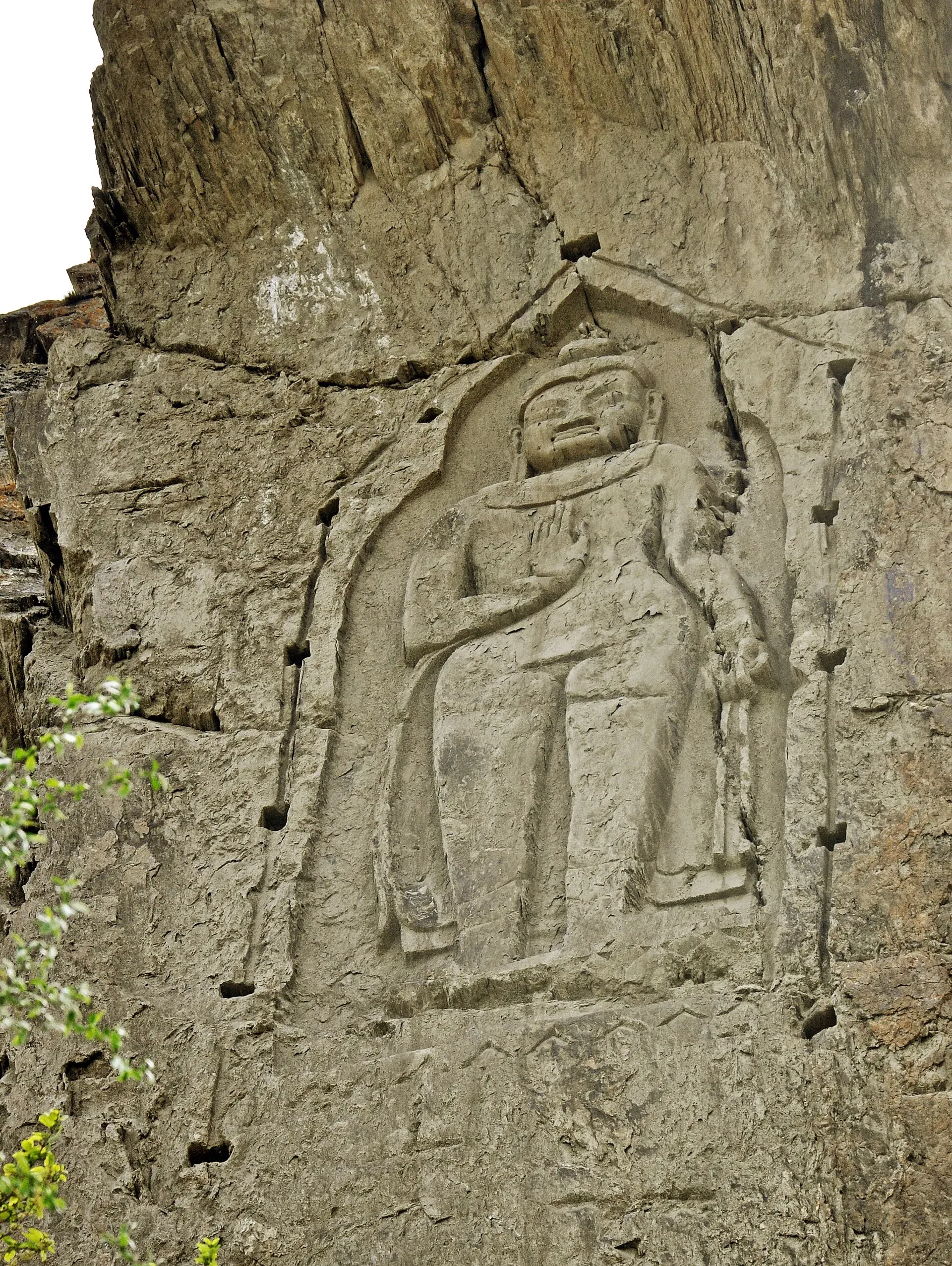
Photo: Furqanlw, with thanks · CC BY-SA 4.0 · via Wikimedia Commons · temporary stand-in photo

Kargah Buddha
A standing Buddha about 15 m tall, carved into a cliff in Kargah Nala west of Gilgit, probably from the 7th century.
Overview
The Kargah Buddha is a large standing Buddha cut into a cliff face in Kargah Nala, about 9.7 km (6 miles) west of Gilgit. The figure is about 15 m (50 ft) high. Holes around it once held a wooden cover that sheltered it from the weather. The style resembles carvings found in Baltistan. It is one of the clearest signs of Gilgit's Buddhist past. Another carved Buddhist site in the region is Manthal Buddha Rock.
Plan your visit
- Nearest town
- Gilgit
- Getting there
Kargah Nala is about 8 to 10 km west of Gilgit along the road towards Punial (sources vary on the exact distance). Take a taxi or a private car from Gilgit and ask for the Buddha, not the nala, at the fork. More
Best months
Apr – Oct
- Kargah Buddha
- Related place nearby: Gilgit
Where it stands
The carving is at the junction of two streams, the Kargah and the Shukogah, about 9.7 km west of Gilgit. Napur and the Rakaposhi mountain are nearby. In Shina the figure is called Yshani (see the legend below).
History
From the 3rd to the 11th century Gilgit was a prominent centre of early Buddhism. Several powers contested the region in that time, including the Tibetan Empire, the Kashmiri Karkota dynasty and the Umayyad and Abbasid caliphates. About 400 m upstream from the Buddha, a Buddhist monastery and three stupas holding Sanskrit manuscripts were excavated in 1931. These are the Gilgit manuscripts. The carving itself was noted in 1938 to 1939, after that discovery. By the 11th century Gilgit had grown into an autonomous kingdom before largely adopting Islam.
Wikipedia (citing King, 1989) and Dawn (8 July 2019) both give the 7th century. Some sources suggest, the 4th or 5th century, and the Gilgit-Baltistan tourism portal gives a range from the 4th to the 7th century. It was recorded in 1938 to 1939.
Local legend
According to a local legend, the figure is not a Buddha at all. It is a man-eating giantess or witch, a yakshini (Shina: ya-shaani or yacheni), who terrorised the local people and was pinned to the cliff by a pir (holy man) as punishment.
What to see and do
- The Buddha carving: viewed from across the stream. The figure stands in a style also found in Baltistan. Look for the holes in the rock around it, which once held the beams of a wooden shelter.
- The valley: the Kargah Nala gorge with a stream and some picnic spots.
- Facilities: the Gilgit Development Authority was building huts, a boundary wall and a viewpoint in 2019, with more than Rs10 million to be spent (Dawn, 8 July 2019). We do not know if the work is finished.
Allow an hour or two with the walk.
When to visit
April to October. After rain the stream can be high.
Where to stay and eat
Gilgit has hotels and restaurants of all kinds.
Good to know
- Access: the road forks near the nala; one branch goes up the nala and the other to the Buddha. You cross the stream on foot or by a small bridge, so check conditions.
- Etiquette: do not touch or climb the rock. Dress modestly.
- Entry and hours: no official fee or opening hours were found.
- Condition: Dawn (8 July 2019) described the road to the site as in poor repair, though the carving itself was intact. Ask locally about the current state.
Highlights
- About 15 m standing Buddha cut into a cliff
- Probably 7th century
- Short drive from Gilgit
- Set in the Kargah Nala gorge
Getting there
Kargah Nala is about 8 to 10 km west of Gilgit along the road towards Punial (sources vary on the exact distance). Take a taxi or a private car from Gilgit and ask for the Buddha, not the nala, at the fork. The last section is rough, and you cross the stream.
Tips
- Go in the morning when the stream is lower.
- Hire a driver who knows the fork in the road.
- Wear shoes you can wet.
- Check on bridge and stream conditions first.
Photos we still need: Kargah Nala gorge and stream, and the setting around the carving; the Gilgit manuscripts site upstream (if accessible). Send us yours
Sources and last checked
Last checked Confidence medium2 sources3 still to check
- Last checked
- Method
- Desk research from published sources
- Confidence
- medium
- Checked by
- trek.pk research team
Researched from published sources; not yet checked on the ground by our team. Spot something out of date? Report a mistake.
Sources
- Kargah Buddha (Wikipedia) · Wikipedia · checked
- Buddhist treasure in Gilgit cries out for govt's attention · Dawn · checked
Still to be checked on the ground (3)
- Coordinates (approximate; Wikipedia gives none)
- Current road and bridge condition (latest source is July 2019)
- Whether the Gilgit Development Authority facilities were finished
Nearby and related

Gilgit
Gateway to Gilgit-Baltistan on the Karakoram Highway: a busy mountain town with the Kargah Buddha and the base for Hunza, Naltar and Skardu.

Gilgit-Baltistan
Pakistan's far north: three great ranges meet here, with K2, Nanga Parbat, giant glaciers, the Karakoram Highway and the valleys of Hunza, Skardu and Gilgit.

Manthal Buddha Rock
A granite boulder carved with a Buddha in relief, probably from the 8th century, at Manthal village near Skardu.