

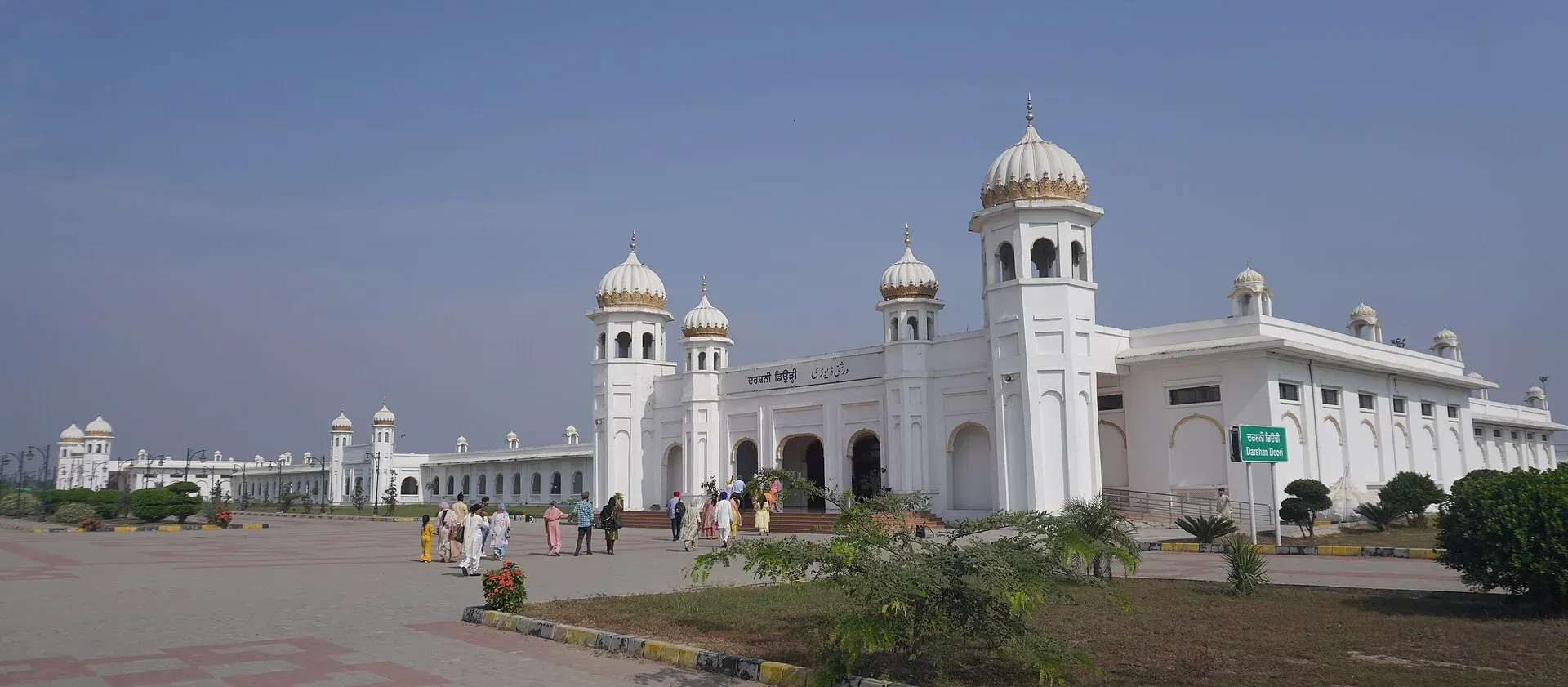
Photo: Harvinder Chandigarh, with thanks · CC BY 4.0 · via Wikimedia Commons · temporary stand-in photo

Kartarpur Sahib
The gurdwara where Guru Nanak is said to have spent his last 18 years, beside the Ravi in Narowal District, close to the Indian border. The Kartarpur Corridor has been closed from India's side since May 2025.
Overview
Gurdwara Darbar Sahib Kartarpur, usually called Kartarpur Sahib, stands in the small town of Kartarpur in Shakargarh tehsil, Narowal District, beside the Ravi River. It is one of the holiest sites in Sikhism. Guru Nanak founded the settlement in 1504 and lived there for about 18 years until his death on 22 September 1539. Here he is said to have farmed, set up a community kitchen (langar) and taught honest work, remembrance of God and sharing with others. The shrine is only about 3 km from the border with India.
Plan your visit
- Nearest town
- Narowal
- Getting there
Kartarpur is about 18.5 km (around 20 minutes) from Narowal and about 114 km (roughly 1 hour 50 minutes) from Lahore by road (OSRM, checked 16 November 2026). Reach Narowal by bus or rail from Lahore, then take a taxi. More
Best months
Oct – Mar
- Kartarpur Sahib
- Related places nearby: Narowal, Shakargarh
The complex
Wikipedia's captions and descriptions name these parts of the site: the gateway (Darshan Deori), the Diwan Hall for congregation, the inner sanctum, the langar hall, the Sarovar Sahib (pool) and the old well. The well, called Khue Sahib, is made of small red bricks, is about 20 feet deep and is said to be 500 years old, from the Guru's lifetime. It carries a Persian wheel, a bucket-chain lift once turned by animals to irrigate the fields. The farmland beside the shrine is tied by tradition to Guru Nanak's years of cultivation here.
History
After Guru Nanak's death, Hindus and Muslims are said to have disputed whether to cremate or bury him. In the best-known account, a shawl (chadar) was divided so each community could follow its own rite. Wikipedia also records a version in which the body turned to flowers that were shared between the two communities. The ashes site, lying near the Ravi, was later moved to Dera Baba Nanak on the Indian side.
The present shrine building was built in 1925 using donations from the Maharaja of Patiala. Pakistan repaired it in 1995 and restored it fully in 2004. In November 2018 a new courtyard, museum, library, dormitories and lockers were added across about 42 acres. A well on the site is said to be about 500 years old.
The Kartarpur Corridor
The corridor from India to the shrine opened on 9 November 2019, a few days before the 550th birth anniversary of Guru Nanak. India suspended it in May 2025, days after the Pahalgam attack, and it was still closed in October 2026 according to The Friday Times. The two countries renewed their formal agreement on the corridor through 2029 in August 2026, but no reopening date has been announced. Indian pilgrims who want to visit now need a Pakistani visa and travel via the Attari-Wagah route.
What to see and do
- The gurdwara and prayer hall (diwan hall). The main complex, which carries the Sikh architectural style described by Wikipedia.
- The well and the fields. Look for the old well with its Persian wheel and the farmland tied to the Guru's life.
- The 1925 shrine. The main building was built in 1925 at a cost of Rs 135,600, donated by Bhupinder Singh, Maharaja of Patiala (Wikipedia).
- The sarovar, museum and library. Added in the 2018 expansion.
- Langar. Free vegetarian meals are served to all visitors.
When to visit
October to March is comfortable. Crowds peak around Guru Nanak's birth anniversary in November and other Sikh festivals.
Where to stay and eat
Narowal is the nearest town with hotels; Lahore is the main base. Eat at the langar or in Narowal.
Good to know and etiquette
- Pakistani citizens do visit. Between late 2021 and mid-2023 over 680,000 people visited, and fewer than a quarter were Indian nationals, per The Friday Times. Whether and how foreigners can visit now was not confirmed; check with the Evacuee Trust Property Board (ETPB) before going.
- Cover your head and remove shoes and socks. Dress modestly. No tobacco or alcohol.
- Ask before photographing worshippers. Expect security checks.
- Current entry fees and hours were not confirmed from an official source; fees will be added soon. Ask the ETPB or the gurdwara committee.
Highlights
- Where Guru Nanak is said to have spent his last 18 years
- Main shrine built 1925, restored 2004
- Expanded in 2018 with museum, library and courtyard
- About 3 km from the India border
- Kartarpur Corridor opened 9 November 2019, closed since May 2025
Getting there
Kartarpur is about 18.5 km (around 20 minutes) from Narowal and about 114 km (roughly 1 hour 50 minutes) from Lahore by road (OSRM, checked 16 November 2026). Reach Narowal by bus or rail from Lahore, then take a taxi. Expect checkpoints near the border area.
Tips
- Check ETPB for current access, especially if you are not a Pakistani citizen.
- Cover your head and remove shoes.
- The Indian-side corridor is closed; do not plan around it.
- Visit October to March.
Photos we still need: the Kartarpur Corridor and the border approach (not located). Send us yours
Sources and last checked
Last checked Confidence medium5 sources3 still to check
- Last checked
- Method
- Desk research from published sources
- Confidence
- medium
- Checked by
- trek.pk research team
Researched from published sources; not yet checked on the ground by our team. Spot something out of date? Report a mistake.
Sources
- Gurdwara Darbar Sahib Kartarpur (Wikipedia) · Wikipedia · checked
- A Corridor of Peace, Closed on Both Sides · The Friday Times · checked
- Extant security scenario compels Kartarpur corridor to remain suspended · ThePrint · checked
- Evacuee Trust Property Board: Travel advisory for yatrees · Evacuee Trust Property Board (ETPB) · checked
- OSRM routing (road distances) · Project OSRM · checked
Still to be checked on the ground (3)
- Whether foreign visitors are allowed and how to get permission
- Entry fee and hours
- Dates of festival crowds (the ETPB advisory lists only the June 2026 Jore Mela for Indian pilgrims, not the November anniversary)
Nearby and related

Lahore
Punjab's capital and Pakistan's cultural city: Mughal forts, mosques and gardens, a lively Walled City, and some of the best food in the country.

Punjab
Pakistan's most populous province: Mughal Lahore, ancient Taxila and Harappa, Sufi shrines, the Salt Range, the Cholistan desert and the hills of Murree.

Gurdwara Janam Asthan (Nankana Sahib)
The gurdwara at Nankana Sahib marking the birthplace of Guru Nanak, founder of Sikhism, about 65 km from Lahore. One of the holiest Sikh sites. Visitor access rules vary, so check before you go.
Narowal
District capital in north-east Punjab and the nearest city to Kartarpur Sahib, with 130,692 people at the 2023 census.
Shakargarh
Tehsil town in north-east Narowal District on the west bank of the Ravi, close to the Indian border. 126,742 people at the 2023 census.