

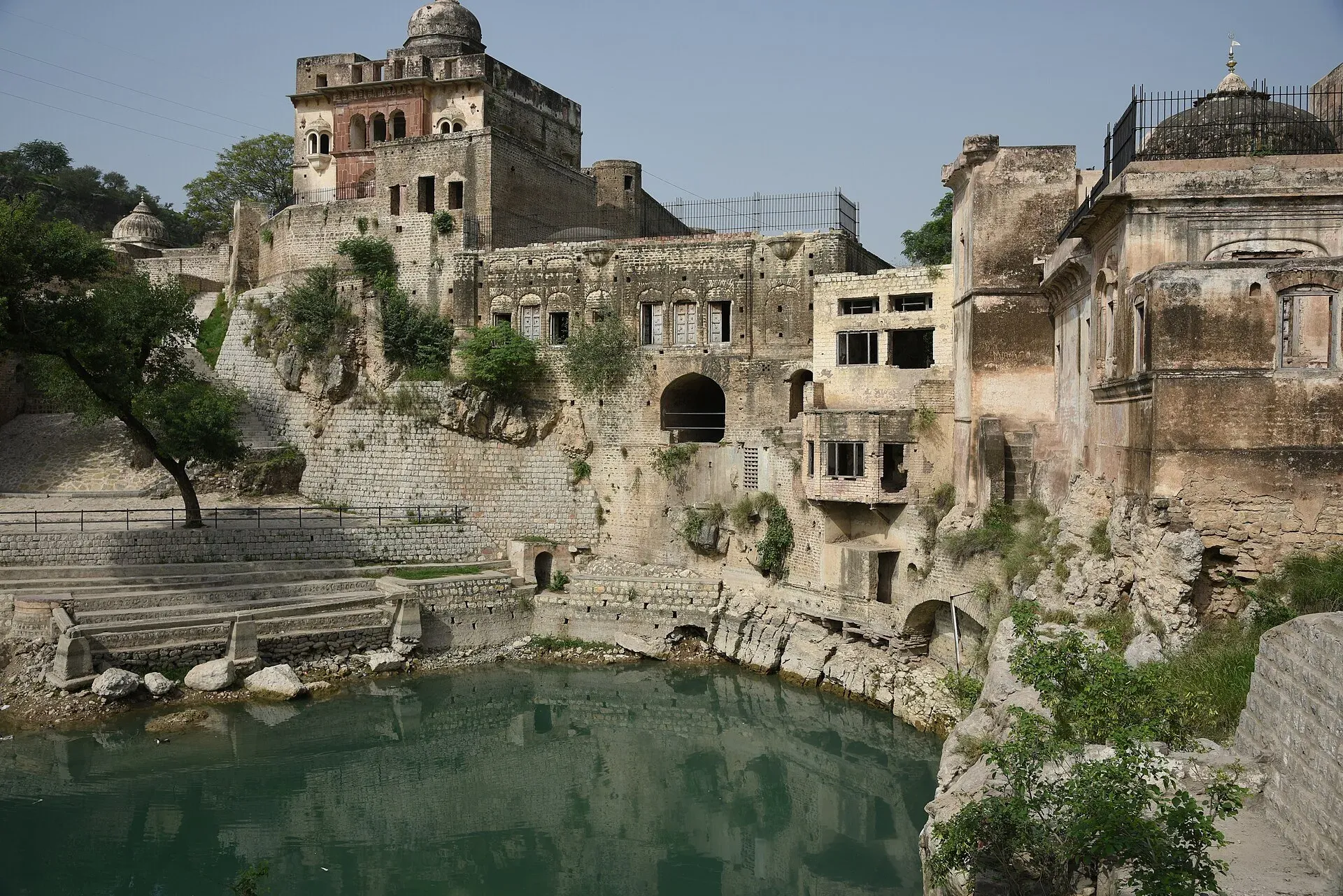
Photo: Mhtoori, with thanks · CC BY-SA 4.0 · via Wikimedia Commons · temporary stand-in photo

Katas Raj Temples
A group of Hindu temples around a sacred pond in the Salt Range near Kallar Kahar, dating from about the 6th to 10th centuries. Important to Hindus and visited by pilgrims each year. Near the M2 motorway.
Overview
Katas Raj is a complex of temples around a sacred pond in the Salt Range, in Chakwal District, close to Kallar Kahar and the M2 motorway. It stands at about 610 m. The temples are connected by walkways, and a second group called Satghara lies a little to the south-west. Hindus consider it the second most sacred site in historic Punjab, after Jwalamukhi in Himachal Pradesh. The oldest temple is believed to date to the 6th century CE.
Plan your visit
- Nearest town
- Choa Saidan Shah
- Getting there
Katas Raj is about 37 km (around 35 minutes) from Chakwal, 153 km (about 1 hour 45 minutes) from Islamabad and 262 km (about 3 hours 15 minutes) from Lahore by road (OSRM, checked 16 November 2026). More
Best months
Oct – Mar
- Katas Raj Temples
- Related places nearby: Kallar Kahar Lake, Malot Fort, Choa Saidan Shah, Pind Dadan Khan
History
Stone tools, terracotta bangles and pottery from the site show people lived here long before the temples. The name comes from the Sanskrit kataksha, "tearful eyes". The pond was earlier called Viskund, Amarkund and Chamaskund, and in Urdu and Persian it is Chashm-e-Alam.
Chinese travellers wrote about the area. Faxian in the 4th century described a temple, and Xuanzang in the 7th century reported a Buddhist stupa, said to be about 200 ft high and surrounded by ten springs, from the time of the Mauryan emperor Ashoka. The surviving temples were built under the Hindu Shahi (Odi Shahi) dynasty, which funded temples across northern Punjab and Khyber Pakhtunkhwa. TDAP dates them to about 615 to 950 CE; the 19th-century archaeologist Alexander Cunningham dated them much earlier.
Guru Nanak is believed to have visited, and Maharaja Ranjit Singh made pilgrimages here, in 1806, 1818 and 1824. Before 1947 Katas was a well known pilgrimage site for Maha Shivaratri. After partition most local Hindus left and the complex fell into disrepair. A restoration project began in 2006, which cleaned the pond and restored some temples. In January 2017 shikharas (temple spires) were added to some temples.
The site is managed by religious-property authorities and is a destination for Hindu pilgrims, including groups who travel from India with visas (154 visas were issued for a visit in February to March 2025).
The legend of the pond
The Puranas say the pond formed from Shiva's tears after the death of his wife Sati. Another version of the story tells of the death of Shiva's horse, Katas, instead. The complex also features in the Mahabharata. Tradition holds that the Pandava brothers spent part of their exile here, and that four of them fell lifeless after drinking from the pond without answering a yaksha's questions. The fifth, Yudhishthira, answered the riddles and brought them back to life.
The pond covers about two kanals and 15 marlas, with a depth of up to 20 ft according to Wikipedia, and its water is very clear.
What to see and do
- The Katas pond. The sacred pool in the middle of the complex.
- Satghara. A group of seven temples, five of them surviving, a little way from the pond. They are the oldest structures. The earliest is dated to the late 6th century CE, and the largest, from the 10th century, is in the Gandhara Nagara style. They resemble Kashmiri temples, with fluted pillars, trefoil arches and pointed rooflines.
- The pondside temples. Small brick and stone shrines on square platforms, with rows of small pillars and cornices rising to a ribbed dome.
- The old haveli. A small fortified residence on a hillock above the temples is attributed to the time of the Sikh general Hari Singh Nalwa. Next to it is the double-storeyed Rama Mandir, with eight rooms on the ground floor and a staircase to the upper floor.
- The Salt Range setting. Quiet hills with views.
The pond today
Locals say the pond was once "bottomless". It supplied drinking water to the villages of Katas and Waulah and to Choa Saidan Shah. Dawn reported in 2017 that the pond was drying for the second time in five years, after April 2012. Residents and some officials blamed cement-factory water bores and eucalyptus planting for lowering the water table, while one district official said the water level rises and falls routinely. A water filtration plant opened at the site in January 2017 had not run since it opened. In July 2025 Dawn reported that the pond overflowed after a drain was blocked and had little water a few days later. The level varies, so do not count on a full pond.
When to visit
October to March is comfortable. The Maha Shivaratri festival, usually in February or March, draws large Hindu gatherings. Summer heat can be strong.
Where to stay and eat
Kallar Kahar and Chakwal have hotels and restaurants. There are no services at the site, so bring water.
Good to know and etiquette
- This is a living place of worship for Hindus. Remove shoes before entering the temples and the pond area, dress modestly and speak quietly.
- Do not touch idols or offerings; ask before taking photographs of worshippers.
- Dawn (July 2025) noted there were no signboards explaining the temples. Visit with a guide or read ahead.
- Opening times and fees were not confirmed from an official source. Fees will be added soon. Ask the Evacuee Trust Property Board (ETPB) or Punjab Archaeology.
Highlights
- Sacred pond with a ring of ancient temples
- Oldest temple believed 6th century CE
- Hindu Shahi period temples, about 615 to 950 CE
- Satghara temple group nearby
- Pilgrim festival at Maha Shivaratri
Getting there
Katas Raj is about 37 km (around 35 minutes) from Chakwal, 153 km (about 1 hour 45 minutes) from Islamabad and 262 km (about 3 hours 15 minutes) from Lahore by road (OSRM, checked 16 November 2026). The temples are linked to the M2 motorway. Use a private car or taxi; there is little public transport to the site.
Tips
- Remove shoes at the temples and the pond.
- Bring water; services are minimal.
- Visit October to March.
- Combine with Kallar Kahar Lake and the Salt Range.
Sources and last checked
Last checked Confidence medium7 sources4 still to check
- Last checked
- Method
- Desk research from published sources
- Confidence
- medium
- Checked by
- trek.pk research team
Researched from published sources; not yet checked on the ground by our team. Spot something out of date? Report a mistake.
Sources
- Katas Raj Temples (Wikipedia) · Wikipedia · checked
- Katas Raj Temple complex stands intact against deluge · Dawn · checked
- Pakistan issues 154 visas to Indian pilgrims to visit Katas Raj temples · The Tribune (India) · checked
- Pakistan Tourism Guide 2021 · TDAP Pakistan (Trade Development Authority of Pakistan) · checked
- OSRM routing (road distances) · Project OSRM · checked
- List of World Heritage Sites in Pakistan · Wikipedia · checked
- Fabled pond of Katas Raj drying out, again (2017) · Dawn · checked
Still to be checked on the ground (4)
- Opening hours and whether the site is locked outside festivals
- Entry fee
- Dates of Maha Shivaratri gatherings (not in any opened source; varies yearly)
- Current condition of the pond water (latest report found is July 2025)
Nearby and related

Kallar Kahar Lake
A shallow salt lake beside the town of Kallar Kahar in the Salt Range, minutes from the M-2 motorway. Known for its peacocks and the Mughal-era Takht-e-Babri.

Punjab
Pakistan's most populous province: Mughal Lahore, ancient Taxila and Harappa, Sufi shrines, the Salt Range, the Cholistan desert and the hills of Murree.

Islamabad
Pakistan's green, planned capital at the foot of the Margalla Hills: Faisal Mosque, hillside trails, cafes and the gateway to the north.
Malot Fort
A 10th-century Hindu Shahi temple of red sandstone in the Salt Range, Chakwal district, also called Malot Temple or Malot Fort. It is in ruins and about seven miles from Katas Raj.
Choa Saidan Shah
Spring-fed town in Chakwal District named after the saint Saidan Shah, about 6 km from Katas Raj temples. Known for its shrine, roses and perfumes.
Pind Dadan Khan
Old river-port and grain-market town on the Jhelum, the nearest town to Khewra Salt Mine. Historically known for brass, pottery and boats.