

Photo: Mr. Shamayel Afzal Khan, with thanks · CC BY-SA 4.0 · via Wikimedia Commons · temporary stand-in photo

Khewra Salt Mine
One of the largest and oldest salt mines in South Asia, in the Salt Range of Jhelum District, run by PMDC. A guided walk on lit tunnels takes in brine ponds, a salt-brick mosque and a salt bridge.
Overview
Khewra Salt Mine is in the Salt Range, in Pind Dadan Khan tehsil of Jhelum District, about 288 m above sea level. The Pakistan Mineral Development Corporation (PMDC) runs it and the visitor section. Wikipedia describes it as a mine with 19 levels, 11 of them underground, about 730 m deep into the hill, and roughly 40 km of tunnels. The salt is nearly pure halite.
Plan your visit
- Nearest town
- Pind Dadan Khan
- Opening hours
- Every day, 9 am to 6 pm, including Sundays and gazetted holidays (PMDC visitor page, official site, undated; checked 18 November 2026). Tourist entry was reported stopped for the monsoon in August 2026; call PMDC to confirm it has reopened.
- Entry fee
- Foreign adults US$24, foreign students US$12, Pakistani adults Rs 475, Pakistani students Rs 265, seniors over 60 and children aged 2 to 12 Rs 265; the electric train costs Rs 285 more (infants under 2 free). Parking: car Rs 50, motorcycle Rs 20. Source: PMDC visitor page (official site, undated; checked 18 November 2026), so confirm with PMDC on 051-9265123.
- Getting there
From Islamabad or Lahore it is roughly 140-160 km. Take the M-2 motorway to the Lilla interchange, then follow the road about 30 km to Pind Dadan Khan and Khewra. More
Best months
Oct – Mar
- Khewra Salt Mine
- Related places nearby: Jhelum, Pind Dadan Khan, Choa Saidan Shah
Geology and history
The mine is cut into the base of the Salt Range Formation, a thick layer of crystalline halite (rock salt) laid down in the Ediacaran to early Cambrian periods. Over it lie gypsum-bearing marl, gypsum and dolomite, and then 200 to 500 m of younger rock. The Salt Range is the southern edge of a fold-and-thrust belt that formed as India collided with Eurasia. The salt is red, pink, off-white or transparent, and the mine is best known for its pink Khewra salt, often sold as Himalayan salt.
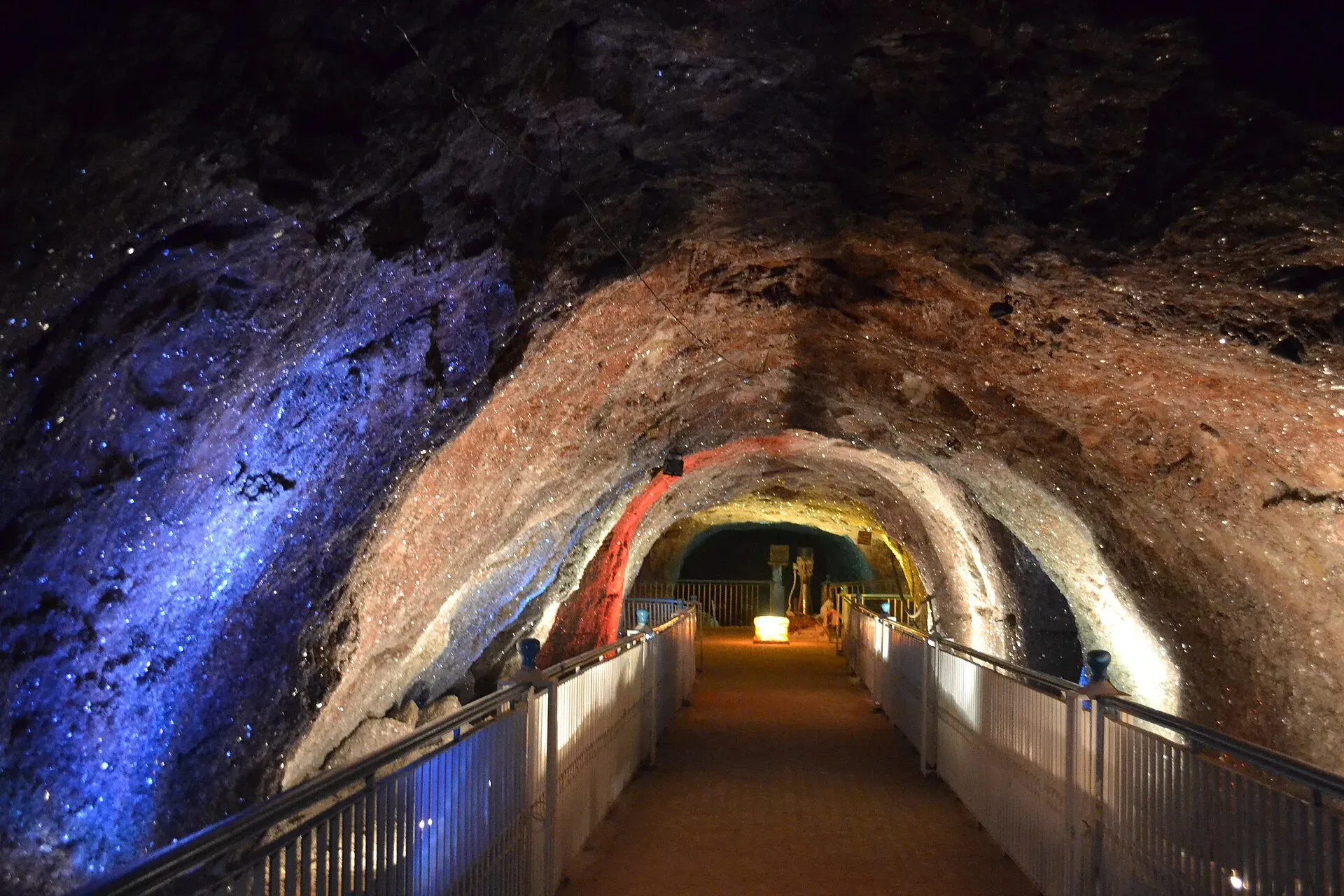
Photo: Shikari7, with thanks · CC BY-SA 3.0 · via Wikimedia Commons · temporary stand-in photo

The mine is also called Mayo Salt Mine, after Lord Mayo, a Viceroy of India who visited it. Under the Mughals the salt was traded as far as Central Asia. After the Mughal decline, Sikh rule followed: Hari Singh Nalwa managed the Warcha mine and Gulab Singh of Jammu held Khewra. In 1872 the British found the workings inefficient, with narrow, irregular tunnels. They levelled the road, built warehouses, provided water, improved the entrances and brought in a better method of excavation. The main tunnel at ground level was developed by the mining engineer H. Warth. The mine passed to Pakistani state bodies after independence, and PMDC has run it since 1974.
Mining here uses the room-and-pillar method, which takes about half of the salt and leaves the rest as pillars to hold up the hill. Salt comes out in rail cars on a 2 ft (610 mm) narrow-gauge line laid in the British period. Output was reported at 385,000 tonnes a year in 2003, roughly half of Pakistan's rock salt.
What to see and do
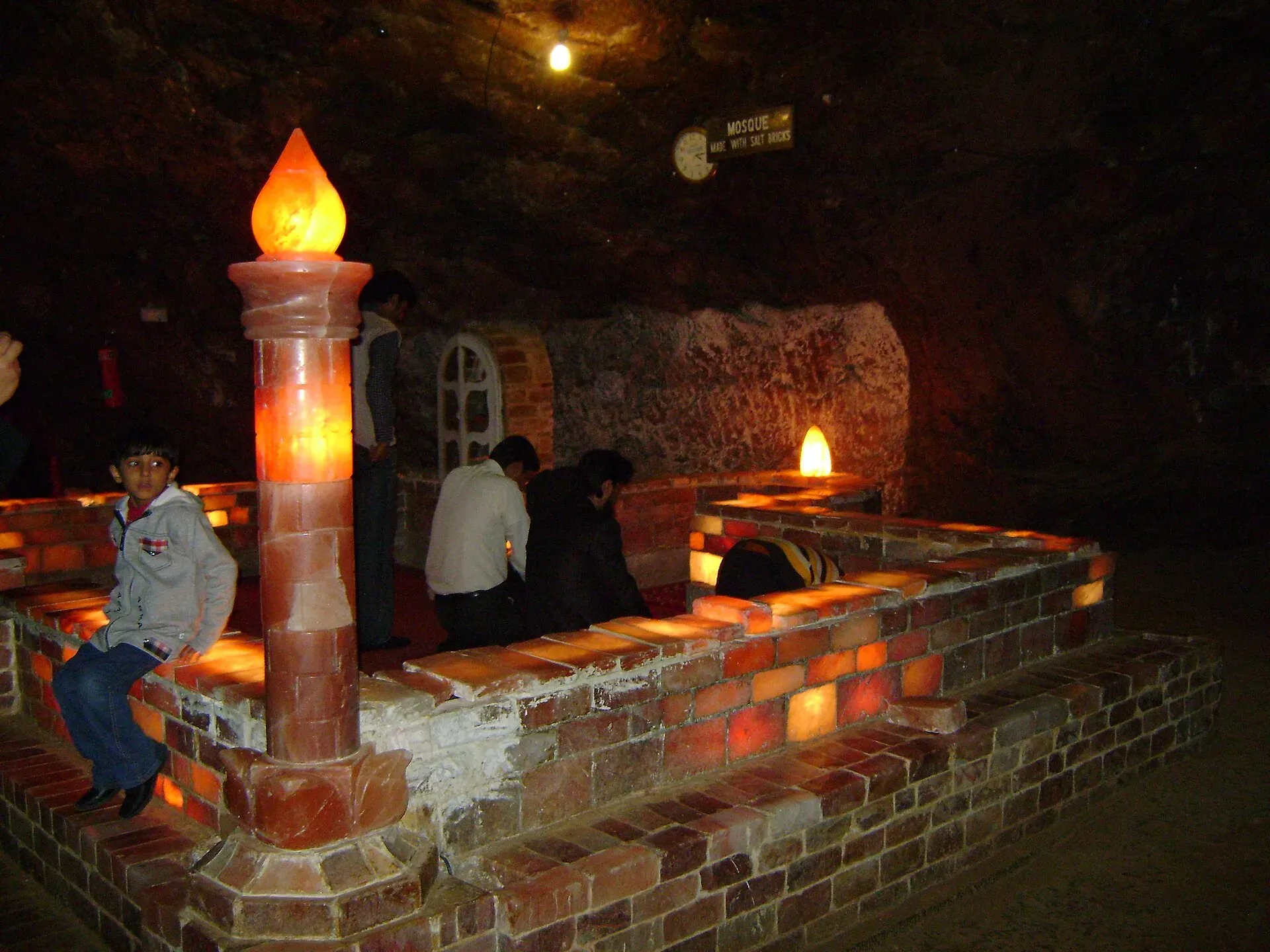
PMDC's visitor page describes a guided route with an electric train to the main junction, then walking. Highlights are brine-filled pond chambers under decorative lighting, a mosque built of rock salt, Sheesh Mahal (an area of light pink crystals), the Assembly Hall chamber, about 75 m high, and Pul-Saraat, a pillarless salt bridge over a brine pond about 25 m deep. Carvings in salt include a replica of Minar-e-Pakistan, a statue of Allama Iqbal and models of the Great Wall of China and Murree's Mall Road. There is a souvenir shop, a small geology and mining museum and, according to PMDC, a salt-air asthma resort. Treat the health claims with care: we make no medical claims, and anyone with a chest condition should ask their doctor first.
Wikipedia gives a local story that Alexander the Great's army found the salt in 326 BC when horses licked the rock. That is tradition, not documented history. More solidly, the British developed the mine from 1872, and PMDC has owned it since 1974.
Salt crafts
Rock salt has been carved for decoration since Mughal times, when craftsmen made tableware and ornaments from it. Warth introduced the lathe, as the salt cuts much like gypsum. Lamps, vases, ashtrays and statues from Khewra are exported to the United States, India and Europe. The souvenir shop at the visitor section sells salt goods; prices are not confirmed here.
When to visit
The mine stays around 18-20 degrees Celsius all year, so any dry month is comfortable. Check status first. ProPakistani reported on 10 August 2026 that tourist entry had stopped until the end of the monsoon because of heavy rain and maintenance. There is no known official reopening notice on 16 November 2026. Call PMDC before you travel.
Where to stay and eat
PMDC says it runs a tourist resort and guest house at the site. Jhelum and Pind Dadan Khan have simple hotels and restaurants. Fees for stays are not confirmed here.
Good to know
- Timings: PMDC's visitor page says 9 am to 6 pm daily, including Sundays and holidays. The page carries no date, so confirm by phone.
- Tickets: PMDC's visitor page lists: foreign adults US$24, foreign students US$12, Pakistani adults Rs 475, Pakistani students Rs 265, and Rs 265 for seniors over 60 and children aged 2 to 12. The electric train costs Rs 285 extra (infants under 2 free). Parking is Rs 50 for a car and Rs 20 for a motorcycle. The page is undated (official site, undated; checked 18 November 2026), so confirm by phone on 051-9265123.
- Underground it is dim, damp and slippery. Wear shoes with grip, and keep to the lit route and your guide.
- The 2010 flooding from a nearby stream shows why rain closures are taken seriously.
- Do not chip or lick the walls, and keep the mosque quiet and respectful.
Highlights
- Guided route with electric train
- Brine ponds and salt bridge
- Mosque built of rock salt
- Stable 18-20 degrees Celsius inside
Getting there
From Islamabad or Lahore it is roughly 140-160 km. Take the M-2 motorway to the Lilla interchange, then follow the road about 30 km to Pind Dadan Khan and Khewra. OSRM puts Pind Dadan Khan about 9 km (11 minutes) from the mine, and Islamabad about 142 km (about 2 hours 15 minutes) by road. There is no scheduled public service to the gate; most visitors drive or hire a car. Parking is charged.
Tips
- Call PMDC before travelling: tourist entry was reported stopped for the monsoon in August 2026
- PMDC's undated page gives 9 am to 6 pm daily; confirm locally
- Wear grippy shoes; floors are wet
- Carry a light layer if you feel the damp
Sources and last checked
Last checked Confidence medium4 sources3 still to check
- Last checked
- Method
- Desk research from published sources
- Confidence
- medium
- Checked by
- trek.pk research team
Researched from published sources; not yet checked on the ground by our team. Spot something out of date? Report a mistake.
Sources
- Khewra Salt Mine · Wikipedia · checked
- Tourist Attraction (visitor information) · PMDC · checked
- Khewra Salt Mine Temporarily Closed to Tourists (10 Aug 2026) · ProPakistani · checked
- Pakistan Tourism Guide 2021 · TDAP · checked
Still to be checked on the ground (3)
- Whether tourist entry has reopened after the monsoon closure (single news report, no PMDC notice found)
- Mine dimensions: only Wikipedia gives figures (19 levels, 730 m, about 40 km tunnels); PMDC gives none
- Whether the salt-craft shop lists prices and which items are sold
Nearby and related

Jhelum
Grand Trunk Road city on the Jhelum River, 23 km from Rohtas Fort (UNESCO), about 30 km from Mangla Dam and about 116 km from Islamabad.
Pind Dadan Khan
Old river-port and grain-market town on the Jhelum, the nearest town to Khewra Salt Mine. Historically known for brass, pottery and boats.
Choa Saidan Shah
Spring-fed town in Chakwal District named after the saint Saidan Shah, about 6 km from Katas Raj temples. Known for its shrine, roses and perfumes.