

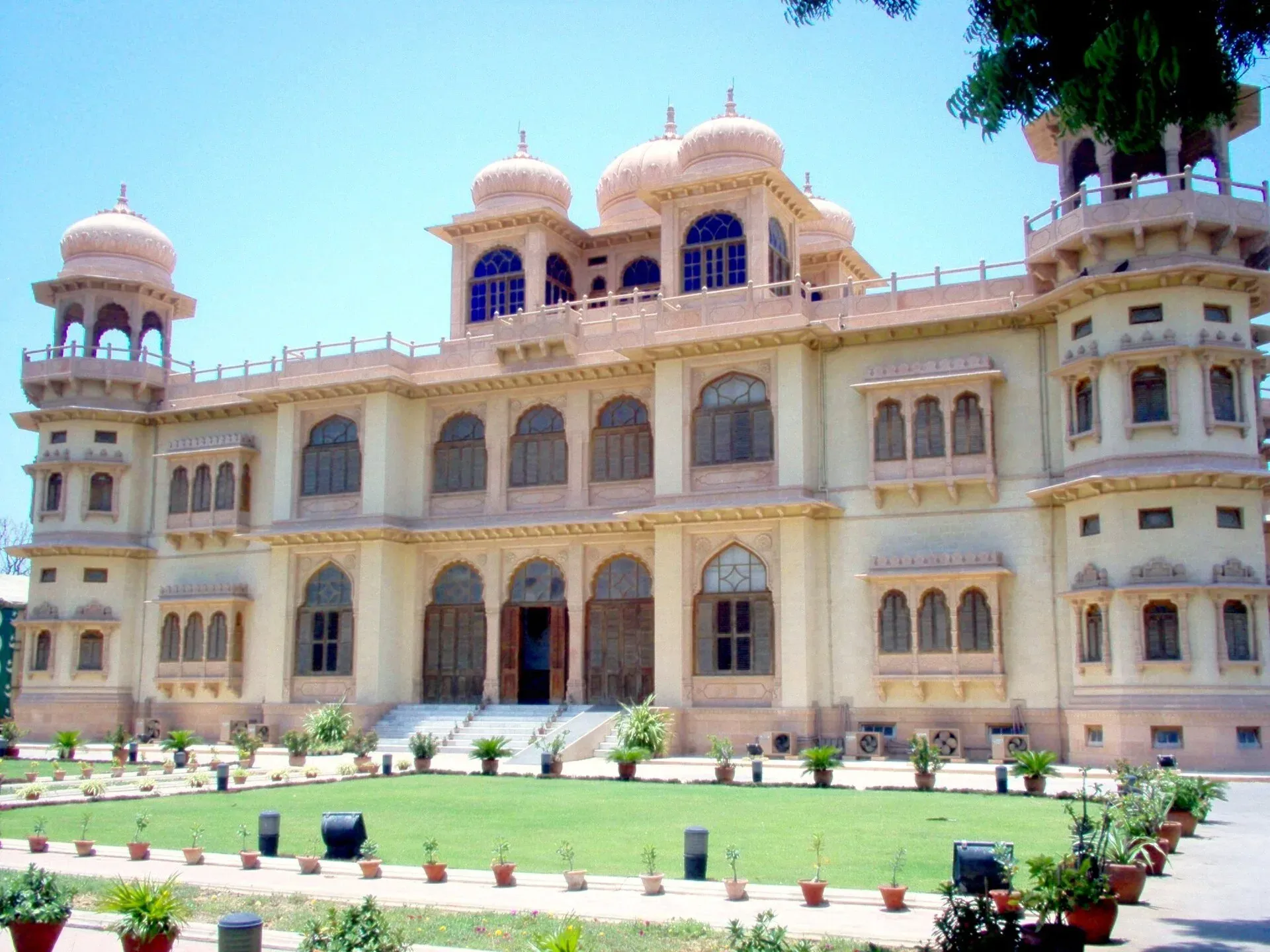
Photo: User Swerveut, with thanks · Public domain (CC0) · via Wikimedia Commons · temporary stand-in photo

Mohatta Palace Museum
A 1927 pink-and-yellow stone palace in Clifton, Karachi, now an art museum with changing exhibitions. It was once the home of Fatima Jinnah, which is why it was also called Qasr-e-Fatima.
Overview
The Mohatta Palace stands in the seaside district of Clifton in Karachi. It was built in 1927 as a summer home for Shivratan Chandraratan Mohatta, a Marwari businessman whose family came from Bikaner in Rajasthan and who made his fortune in Karachi, where he manufactured palm olive soap. The family used the house for about two decades before leaving for India in 1947.
Plan your visit
- Nearest town
- Karachi
- Opening hours
- Check before you go: no official hours confirmed.
- Getting there
The palace is in the Clifton area of Karachi, near the sea. Use a taxi or ride-hailing car from anywhere in Karachi; traffic is heavy, so allow extra time. More
Best months
Nov – Mar
History
After 1947 the Government of Pakistan took over the building, and it housed the Ministry of Foreign Affairs. Fatima Jinnah, the sister of the founder of Pakistan, moved here around 1964, and it became known as Qasr-e-Fatima. During the 1960s it was the hub of her presidential campaign against Ayub Khan. Her sister Shireen Jinnah lived on the ground floor for many years, and the palace was sealed after Shireen's death in 1980.
The Government of Sindh bought the property in 1995 to turn it into a museum of Pakistani arts. A trust with a board of trustees headed by the Governor manages it, and the trust deed bars its sale or any non-museum use. The museum opened to the public in 1999.
Architecture
The architect was Ahmed Hussain Agha. The palace follows the tradition of Rajasthani stone palaces (the style is often called Indo-Saracenic) and covers about 1,720 m2 on three levels. Pink Jodhpur stone is combined with yellow stone from nearby Gizri.
- Ground floor: five large reception rooms around a central hall with an ornate ceiling, and a teak staircase to the upper floor.
- First floor: the private quarters, with four large bedrooms and a terrace overlooking the Arabian Sea. A small family temple to Shiva stood on the terrace.
- Basement: a small room leads down to a pool room for hot water, with a changing room.
- Exterior: four octagonal corner towers topped with chattris (small domed pavilions), and a domed roof. Carved details include bird's-wing shapes in window arches, peacock motifs on the domes, marigold and hibiscus flowers, and projecting eaves (chhajjas) that shade the ground floor windows.
A small group of colonial-era statues, including one of Queen Victoria, stands beside the main building. They were removed from public places in Karachi in 1960-61, and some were damaged.
What to see and do
The museum works mainly through changing exhibitions. Past shows have included the Talpur rulers' treasures (1999 to 2003), calligraphy, Gandhara art, costumes and textiles, the painter Sadequain, Pakistani ceramics and tiles, the artist Rashid Rana, rare maps and prints, and Kashmiri manuscripts. The museum website lists Symphonies in Stone on the Makli necropolis (from May 2018), a show on the artist Hal Bevan Petman (from December 2019) and a show on Imran Mir. What is on now may be different, so look at the official website or social media before you go.
The building itself is a major part of the visit: the rooms, the teak staircase, the stained-glass windows and the roof terrace.
When to visit
November to March is best for Karachi weather. Go on a weekday morning to avoid crowds. An hour or two is enough.
Where to stay and eat
Clifton has many hotels, restaurants and cafes close to the museum. Choose a place near the seafront for easy taxis.
Good to know
- Hours and tickets: the museum's website gives no hours or ticket prices. Wikipedia lists Tuesday to Sunday, 11:00 to 18:00, closed Monday, with a Friday prayer break from 13:00 to 15:00, but that is not confirmed here. A fee may apply; current fees will be added soon. Check the museum website or call before you go.
- Photography: rules not confirmed; ask at the entrance.
- Nearby: the Quaid-e-Azam House Museum, where Fatima Jinnah lived before moving here, is in Karachi, and Clifton and Sea View is close.
- Travel advice: Sindh south of Nawabshah is not among the areas the UK Foreign, Commonwealth & Development Office (FCDO) advises against (page updated 27 October 2026, checked 16 November 2026). Karachi has street crime and sometimes strikes or protests that close roads, so use ride-hailing or a trusted driver, keep phones and cameras out of sight in crowds and check the FCDO page before you travel.
Highlights
- Indo-Saracenic palace built in 1927 from pink Jodhpur and yellow Gizri stone
- Home of Fatima Jinnah from 1964, renamed Qasr-e-Fatima
- Museum of the arts of Pakistan since 1999
- Changing exhibitions of art, ceramics, maps and manuscripts
Getting there
The palace is in the Clifton area of Karachi, near the sea. Use a taxi or ride-hailing car from anywhere in Karachi; traffic is heavy, so allow extra time. It is about 30 to 45 minutes from Karachi's airport depending on traffic.
Tips
- Check the current exhibition before you go; displays change.
- Allow one to two hours.
- Look at the stonework, domes and carved details of the building as well as the galleries.
- Pair it with the Quaid-e-Azam House Museum and the Karachi seafront by taxi.
Photos we still need: the interior (teak staircase or central hall) and the roof terrace (for the 'Architecture' section). Send us yours
Sources and last checked
Last checked Confidence medium5 sources5 still to check
- Last checked
- Method
- Desk research from published sources
- Confidence
- medium
- Checked by
- trek.pk research team
Researched from published sources; not yet checked on the ground by our team. Spot something out of date? Report a mistake.
Sources
- Qasr-e-Fatima (Mohatta Palace) · Wikipedia · checked
- Mohatta Palace Museum (official website) · Mohatta Palace Museum · checked
- Quaid-e-Azam House (Flag Staff House), Karachi · Culture, Tourism, Antiquities & Archives Department, Government of Sindh · checked
- Pakistan Tourism Guide 2021 (museums lists) · Trade Development Authority of Pakistan (TDAP) · checked
- Pakistan travel advice (updated 27 October 2026) · UK Foreign, Commonwealth & Development Office · checked
Still to be checked on the ground (5)
- Opening days and hours: Wikipedia lists Tuesday to Sunday, 11:00 to 18:00, closed Monday, with a Friday prayer break 13:00 to 15:00; the museum's own site gave no hours
- Ticket charge (not on Wikipedia or the museum's site)
- What is on display now (the museum's site still lists exhibitions from 2017 to 2019)
- Photography rules
- Whether Fatima Jinnah lived at Quaid-e-Azam House before moving here (statement from an earlier version of this page)
Nearby and related

Karachi
Pakistan's largest city and main port: colonial buildings, museums, beaches, busy bazaars and some of the country's best food.
TDF Ghar
A restored 1930s house in Karachi's Soldier Bazaar area, run by The Dawood Foundation as a small museum, gallery and community space with a rooftop view of the Quaid's mausoleum.
State Bank of Pakistan Museum & Art Gallery
A museum of coins and currency on I. I. Chundrigar Road in Karachi, in a 1920s sandstone former Imperial Bank of India building. Opened in 2004.