

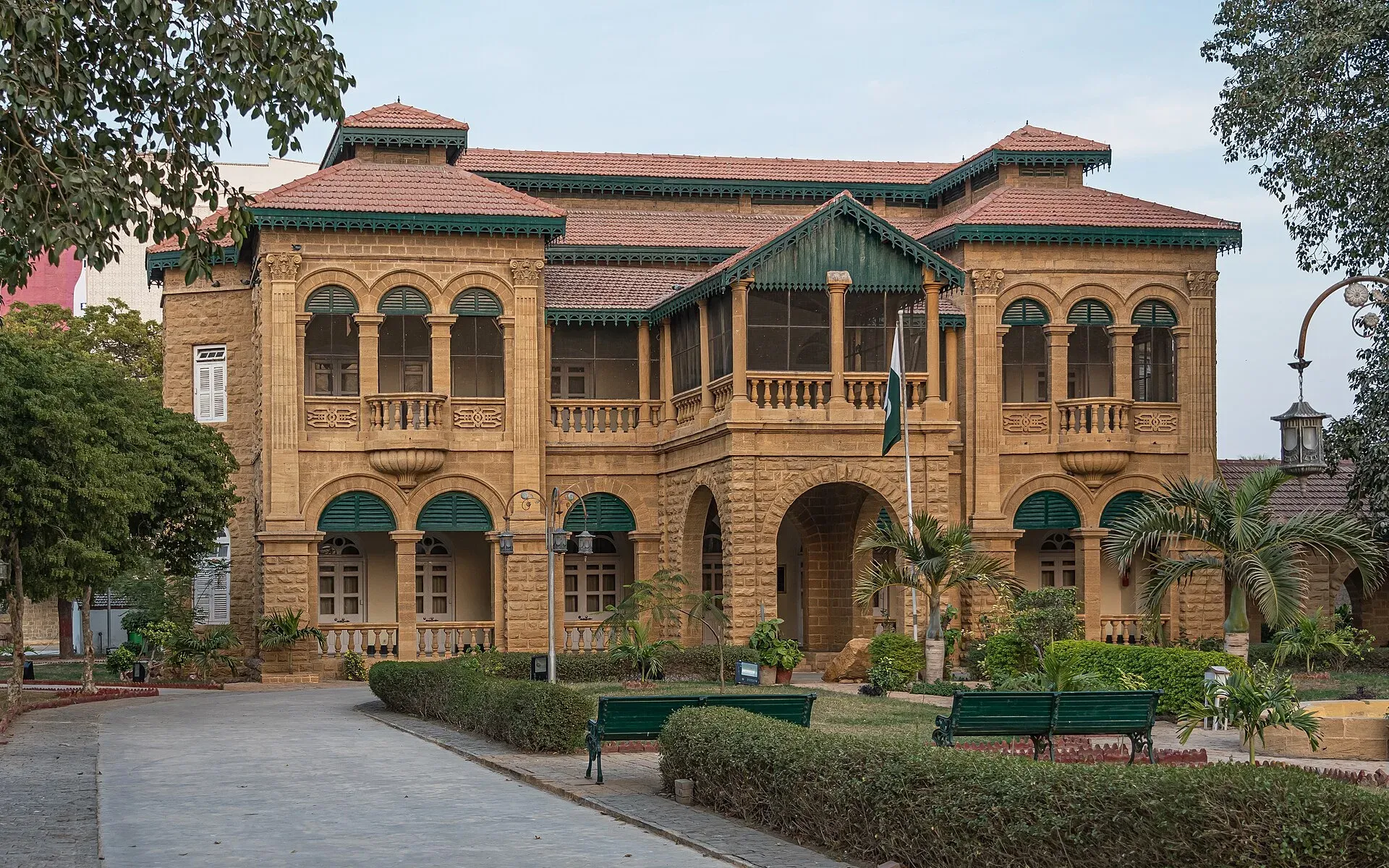
Photo: A.Savin, with thanks · Public domain (CC0) · via Wikimedia Commons · temporary stand-in photo
Quaid-e-Azam House Museum (Flagstaff House)
The Karachi house Muhammad Ali Jinnah bought in 1943, now a museum of his furniture and belongings. Fatima Jinnah lived here until 1964. It opened to the public in 1993.
Overview
Quaid-e-Azam House, also called Flagstaff House or Flag Staff House, is a yellow-stone mansion at the crossing of Shahrah-e-Faisal and Fatima Jinnah Road, on Plot 241 in Staff Lines, Karachi Cantonment. The Sindh antiquities department calls it a national monument and says it is believed to date from the late 19th century, though the exact date of construction is unknown. It is a house museum about Muhammad Ali Jinnah, the founder of Pakistan.
Plan your visit
- Nearest town
- Karachi
- Opening hours
- Check before you go: two pages on the official antiquities site give different hours (one says closed on Wednesdays, 9 am to 5 pm; another gives summer 8 am to 7 pm and winter 9 am to 6 pm). Phone +92 21 99212126.
- Entry fee
- Adults Rs 20, children aged 6 to 12 Rs 10, foreigners Rs 300; student groups free (Sindh antiquities department, official site, undated; checked 18 November 2026; confirm at the gate).
- Getting there
The museum is at the crossing of Shahrah-e-Faisal and Fatima Jinnah Road, in Staff Lines, Karachi Cantonment. Use a taxi or ride-hailing car from anywhere in Karachi; traffic is heavy, so allow extra time. More
Best months
Nov – Mar
- Quaid-e-Azam House Museum (Flagstaff House)
- Related place nearby: Karachi
History of the house
The Sindh antiquities page records that Ramachand Hansraj Kutchi Lohana owned the house until 1922. The British Indian Army then rented it, and army commanders lived there from 1940. Jinnah bought it on 14 August 1943 from Sorab Kavasji Katrak, a former mayor of Karachi, for Rs 115,000, paying Rs 5,000 down.
The same page says Jinnah visited often but did not live in the house. Wikipedia says he lived there from 1944 until his death in 1948. The official account is followed here. His belongings were moved here from his New Delhi home at 10 Aurangzeb Road in September 1947. After his death his sister Fatima Jinnah lived here from 13 September 1948 until 1964, when she moved to the Mohatta Palace in Clifton (see Mohatta Palace Museum). The house later passed to the reconstituted Quaid-i-Azam Trust, and Wikipedia says the government acquired it in 1985.
A presidential decree set up a commission to identify Jinnah's historically significant belongings, and damaged relics were conserved and restored for display. Restoration of the house began on 1 June 1984 and it opened as a museum on 25 November 1993.
The building
The house is a two-storey building of limestone masonry with wooden roof trusses and red Mangalore clay tiles. The ground floor has tiled floors; the first floor has wooden planks, and a dark brown wooden staircase links them. There are three rooms on each floor, and the first-floor rooms open onto a verandah. The site covers about 10,241 square yards.
The restoration scheme was prepared by the Department of Archaeology and Museums with the Public Works Department, with architect Yasmin Lari as consultant. It covered termite and moisture treatment, repair of the main house and roofs, rewiring with old-style fittings, air conditioning, fire systems and new landscaping. The former annexe of four small rooms became a hall for debates, lectures and audio-visual shows. Some of the outbuildings, which include 18 outhouses, four garages and a kitchen, became offices, stores and a library, and the front and back gardens were redesigned with lighting for visitors.
Inside the museum
Each room holds relics Jinnah used. The official page names a finely carved sandalwood cigarette box and a carved camphorwood box in the first-floor bedroom, the original sofa sets, and a study with a reading table, chairs, a table lamp, stationery and a resting sofa. Shelves hold the crockery he used. The building has central air conditioning, fire-fighting equipment, an alarm and CCTV.
A small library on Jinnah and the independence movement opened in July 2003 for scholars and students. Entry is through the main gate, where the booking office and a book shop are.
Other Jinnah sites in Karachi
Wikipedia lists Wazir Mansion, Jinnah's birthplace, among his properties, and his mausoleum is at Mazar-e-Quaid. Both are covered on other pages: Wazir Mansion and Mazar-e-Quaid Museum. The Karachi seafront and Frere Hall are also in the city; see Karachi.
When to visit
November to March gives the best weather. Plan an hour. Public holidays such as 25 December (Jinnah's birthday) and 14 August are very busy.
Where to stay and eat
Hotels and restaurants are close by in Saddar and along Shahrah-e-Faisal. Many visitors stay near Clifton or the airport.
Good to know
- Hours: the two official pages disagree, so phone +92 21 99212126 or email dgantiquitiessindh@gmail.com before you go.
- Tickets: the Sindh antiquities department's museum page (official site, undated; checked 18 November 2026) lists Rs 20 for adults, Rs 10 for children aged 6 to 12 and Rs 300 for foreigners, with student groups free for study. Confirm at the gate, as the amounts may have changed.
- Photography: rules not confirmed; ask at the gate.
- Travel advice: Sindh south of Nawabshah is not among the areas the UK Foreign, Commonwealth & Development Office (FCDO) advises against (page updated 27 October 2026, checked 16 November 2026). Karachi has street crime and sometimes strikes or protests that close roads, so use ride-hailing or a trusted driver, keep phones and cameras out of sight in crowds and check the FCDO page before you travel.
Highlights
- Bought by Jinnah in 1943; Fatima Jinnah lived here from 1948 to 1964
- Rooms with his sofa sets, study furniture and personal items
- Opened to the public on 25 November 1993
- A small library on Jinnah and the freedom movement, set up in 2003
Getting there
The museum is at the crossing of Shahrah-e-Faisal and Fatima Jinnah Road, in Staff Lines, Karachi Cantonment. Use a taxi or ride-hailing car from anywhere in Karachi; traffic is heavy, so allow extra time. The Directorate of Antiquities lists +92 21 99212126.
Tips
- Allow about an hour.
- Official hours differ between two pages of the Sindh antiquities site, so phone first.
- Wear comfortable shoes; the garden and rooms are best seen slowly.
- Combine with the Mohatta Palace, Wazir Mansion and Mazar-e-Quaid in one Karachi heritage day.
Photos we still need: the ground-floor and first-floor rooms and the garden; the ground-floor and first-floor rooms and the garden. Send us yours
Sources and last checked
Last checked Confidence medium5 sources5 still to check
- Last checked
- Method
- Desk research from published sources
- Confidence
- medium
- Checked by
- trek.pk research team
Researched from published sources; not yet checked on the ground by our team. Spot something out of date? Report a mistake.
Sources
- Quaid-e-Azam House (Flag Staff House), Karachi · Culture, Tourism, Antiquities & Archives Department, Government of Sindh · checked
- Quaid-e-Azam House Museum, Karachi · Culture, Tourism, Antiquities & Archives Department, Government of Sindh · checked
- Quaid-e-Azam House · Wikipedia · checked
- Pakistan Tourism Guide 2021 (museums lists) · Trade Development Authority of Pakistan (TDAP) · checked
- Pakistan travel advice (updated 27 October 2026) · UK Foreign, Commonwealth & Development Office · checked
Still to be checked on the ground (5)
- Opening days and hours (the two official pages still disagree: one says closed Wednesdays, 9 am to 5 pm; the other gives 8 am to 7 pm in summer and 9 am to 6 pm in winter, with no closed day)
- Photography rules (neither official page mentions them)
- Whether Jinnah ever lived here: the official Sindh page says he did not, Wikipedia says 1944 to 1948; no primary record opened settles it
- Wikipedia credits the architect as Moses Somake and the stone as Gizri sandstone; no official source confirms this
- Wikipedia credits the architect as Moses Somake and the stone as Gizri sandstone; no official source confirms this

