

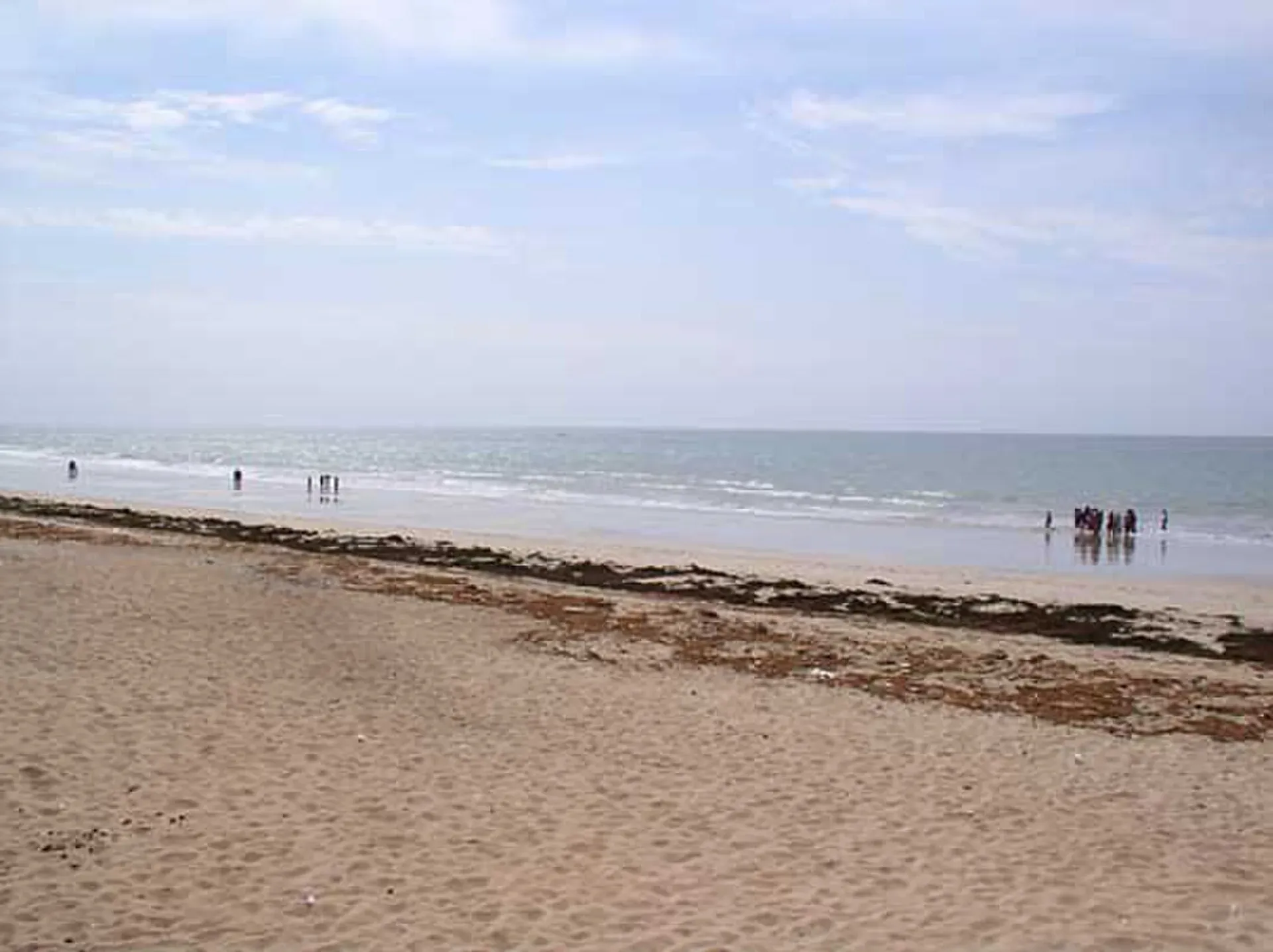
Photo: Yasir Hussain, with thanks · CC BY-SA 2.0 · via Wikimedia Commons · temporary stand-in photo

Sandspit
Sand bar beach south-west of Karachi with mangrove backwaters and green turtle nesting. Shallow-looking water hides a steep drop, and swimming bans are common.
Overview
Sandspit is a narrow strip of sand on Karachi's Arabian Sea coast, about 15 km from the city centre by road (OSRM, 16 November 2026). Behind the beach lie tidal backwaters. WWF-Pakistan describes the Sandspit and Hawke's Bay coast as a habitat for fish, crabs, shrimps and migratory birds, and a feeding ground for dolphins and porpoises. The June 2025 sea-bathing order did not cover Sandspit: Dawn said officials left Sandspit, Hawke's Bay, Paradise Point and Seaview open because lifeguards and law enforcers guard them. The Lyari River feeds the backwaters from the east and seawater enters from the south and from Karachi harbour. The only mangrove species there is the grey mangrove (Avicennia marina).
Plan your visit
- Nearest town
- Karachi
- Getting there
About 15 km and 19 minutes from central Karachi by road (OSRM, checked 16 November 2026). Use a taxi, ride-hailing car or private vehicle; there is no known confirmed public bus. More
Best months
Oct – Mar
- Sandspit
- Related places nearby: Karachi, Hawke's Bay, Clifton and Sea View, Kakapir (Kaka Pir), Shamspir (Shams Pir)
The beach and its backwaters
The sandy beach facing the Arabian Sea runs for about 10 km and is about 100 to 200 m wide, made of fine and coarse sand (WWF-Pakistan, 2015 submission to the Convention on Biological Diversity). The eastern part is all sand, while the western end, towards Hawke's Bay, has some rocky patches. The name Sandspit is said to come from the many turtle nesting pits on the beach. Distances to the city vary by source: WWF gives 15 km in one place and 18 km in another, and OSRM gives about 15 km by road.
Behind the beach is a complex of shallow tidal lagoons, mudflats, saltpans, mangrove swamps and creeks. The Lyari River feeds it from the east and the sea enters from the south and from Karachi harbour. WWF describes the backwaters as a nursery for fish and shrimp, and it has records of crabs, shrimps and small fish in the mangrove channels. The wider area has an arid sub-tropical climate, with average annual rainfall of about 125 mm and a mean annual temperature of about 32 °C.
Birds, reptiles and sea life
WWF cites a count of 114 bird species from the area, most of them migratory, including 66 winter visitors. Many feed on the mudflats and in the mangroves. A reptile survey from 2001 to 2009 recorded 27 species, including nine lizards (among them the Bengal monitor) and several sea snakes, along with land snakes such as the saw-scaled viper and black cobra. Do not handle any snake. Offshore waters are a feeding area for humpback dolphins, common dolphins and finless porpoises.
Green turtles
The Hawke's Bay and Sandspit shore is a 20 km stretch where green and olive ridley turtles nest. About 5.5 km of the Sandspit side is the main nesting area. A 1984 estimate put nesting at about 6,000 green turtles and 200 olive ridley turtles a year, but that figure is old. Olive ridley nesting has not been confirmed for many years (see below). The Sindh Wildlife Department runs a hatchery.
What to see and do
Visitors come to picnic, ride camels and horses, and rent beach huts. Wikipedia mentions an unusual rocky formation on the shore. If you want to see the backwaters, WWF-Pakistan suggests hiring a boat to see the mangroves and learn why they protect the coastline; agree the price and safety gear before you go.
Sandspit is also a green turtle nesting beach, with a Sindh Wildlife Department hatchery. The Express Tribune (2 November 2025) says the green turtle season typically runs from August to February, while Wikipedia says nesting takes place in early winter. WWF-Pakistan lists Sandspit, Hawke's Bay and Paradise Point as the key Sindh sites (Business Recorder, 23 May 2018). Olive ridley turtles once nested here too, but no nesting has been confirmed for many years (Express Tribune, 26 October 2026). Dead green turtles have been found at Sandspit and Hawke's Bay in recent years (same report).
Turtle etiquette: stay out of fenced hatchery and nesting areas, keep lights, torches and phone flashes off the sand at night, make no noise near nesting females, never touch or pick up eggs or hatchlings, and follow the wildlife staff on site. The Sindh Wildlife Department posts teams day and night at nesting zones to limit light, noise and disturbance (Express Tribune, 2 November 2025).
Swimming safety
The seabed here is uneven. The Herald reported that about four feet from the shore the bottom drops roughly 10 feet, and Dawn describes waist-deep walkers suddenly stepping into a deep dip. Two teenagers drowned at Sandspit on 30 July 2022, while the commissioner's sea ban was in force (Dawn, 31 July 2022). If a rip current pulls you out, do not fight it. Swim parallel to the shore, then angle back in with the waves (Dawn, 2019).
Sindh's authorities have banned sea bathing more than once. The Karachi commissioner, a provincial officer, issued a two-month order for Kanupp, Sunerah and Mubarak Village beaches until 13 August 2024 (Dawn, 16 June 2024), and an eight-day order for five beaches until 13 June 2025 (Dawn, 7 June 2025). In 2022 a citywide ban ran from 25 to 31 July (Dawn, 31 July 2022). Orders come at short notice and name dates and beaches, so check the news before you travel.
When to visit
October to March is the comfortable season, and it overlaps with turtle nesting. Mid-May to mid-August is the monsoon, when the sea is roughest (Dawn, 2019).
Where to stay and eat
Karachi is the base. Day huts and food stalls are on the beach; there is no named official accommodation to recommend here.
One morning at Sandspit
Go early in the cooler season. Walk the beach edge, keep out of fenced turtle areas, then take an agreed boat trip into the backwaters if the tide and the operator allow it. Finish before the afternoon crowds. The day pairs with a drive on to Hawke's Bay and the rest of the Karachi coastal mangroves.
Good to know
Keep to the edge of the sea, take your rubbish with you and keep your distance from nesting zones. Dress modestly and ask before photographing others. For foreign visitors: the UK FCDO page (updated 27 October 2026, checked 16 November 2026) does not name Karachi or the Sindh coast. Its Sindh advice, against all but essential travel, applies to areas north of and including Nawabshah. Read the live page before you go.
Highlights
- Beach with mangrove backwaters fed by the Lyari River
- Green turtle nesting and hatchery
- About 15 km from central Karachi
- Steep drop-off close to the shore
Getting there
About 15 km and 19 minutes from central Karachi by road (OSRM, checked 16 November 2026). Use a taxi, ride-hailing car or private vehicle; there is no known confirmed public bus. Check whether the road and access gate are open.
Tips
- Do not wade out: the seabed drops suddenly.
- Hire backwater boats only with life jackets.
- Keep lights and noise away from turtles at night.
- Check for sea swimming bans before you go.
Wildlife
Facilities
- Rented beach huts
- Food stalls
- Camel and horse rides
- Boat trips on the backwaters
Photos we still need: backwaters and mangroves; turtle hatchery (no disturbing close-ups). Send us yours
Sources and last checked
Last checked Confidence medium12 sources5 still to check
- Last checked
- Method
- Desk research from published sources
- Confidence
- medium
- Checked by
- trek.pk research team
Researched from published sources; not yet checked on the ground by our team. Spot something out of date? Report a mistake.
Sources
- Sandspit Beach · Wikipedia · checked
- OSRM driving route service: distances and times measured 16 November 2026 (without stops) · OSRM / OpenStreetMap contributors · checked
- Ecologically or biologically significant marine area template: Sandspit and Hawks Bay backwaters (WWF-Pakistan) · WWF-Pakistan / Convention on Biological Diversity · checked
- Two-month ban on swimming in sea imposed (16 June 2024) · Dawn · checked
- Karachi bans visits to five beaches until 13 June (7 June 2025) · Dawn · checked
- Beach ban report: four drown at Hawkesbay despite ban (31 July 2022) · Dawn · checked
- What makes Karachi's beaches so dangerous (Herald, updated 1 November 2017) · Dawn Herald · checked
- Life and death on Karachi's beaches (5 May 2019) · Dawn (EOS) · checked
- 25,000 turtle eggs secured in one month (2 November 2025) · The Express Tribune · checked
- Where have Karachi's olive ridley turtles gone? (26 October 2026) · The Express Tribune · checked
- World Turtle Day: WWF-Pakistan for conservation of marine, freshwater turtles (23 May 2018) · Business Recorder · checked
- Pakistan travel advice: warnings and insurance (updated 27 October 2026) · UK Foreign, Commonwealth and Development Office · checked
Still to be checked on the ground (5)
- Backwater boat operators and safety (none found)
- Hut and road access (Wikipedia silent; confirm the access gate on the day)
- Beach photo is low resolution and old
- Current turtle nesting numbers (the only count found is a 1984 estimate in a WWF-Pakistan submission)
- Bird and reptile counts come from older surveys cited by WWF-Pakistan (up to 2010)
Nearby and related

Karachi
Pakistan's largest city and main port: colonial buildings, museums, beaches, busy bazaars and some of the country's best food.

Sindh
Pakistan's south-east: Karachi's beaches and markets, the Indus Valley city of Moenjodaro, Thatta's Makli tombs, Sufi shrines, the Thar desert and the Indus delta.

Hawke's Bay
Long sandy beach west of Karachi, popular for picnics and a key green turtle nesting site. The sea is dangerous: powerful waves and rip currents drown people most years, and swimming bans are common.

Clifton and Sea View
Karachi's most visited city beach, open day and night, with camel rides, food stalls and seaside restaurants. Strong currents make the sea risky, and swimming is often banned.
Kakapir (Kaka Pir)
A fishing village in Karachi Harbour that was once an island and is now joined to the mainland near the west end of Sandspit.
Shamspir (Shams Pir)
A small inhabited island on the west side of Karachi Harbour, named after a saint's shrine. A fishing community, not set up for tourism.